
WhiteHorse Finance Leverages H.I.G. Capital Nexus to Sustain Growth in Lower Middle Market Lending
WhiteHorse Finance’s distinct affiliation with H.I.G. Capital supports its targeted debt investments and strategic capital management within regulatory boundaries.
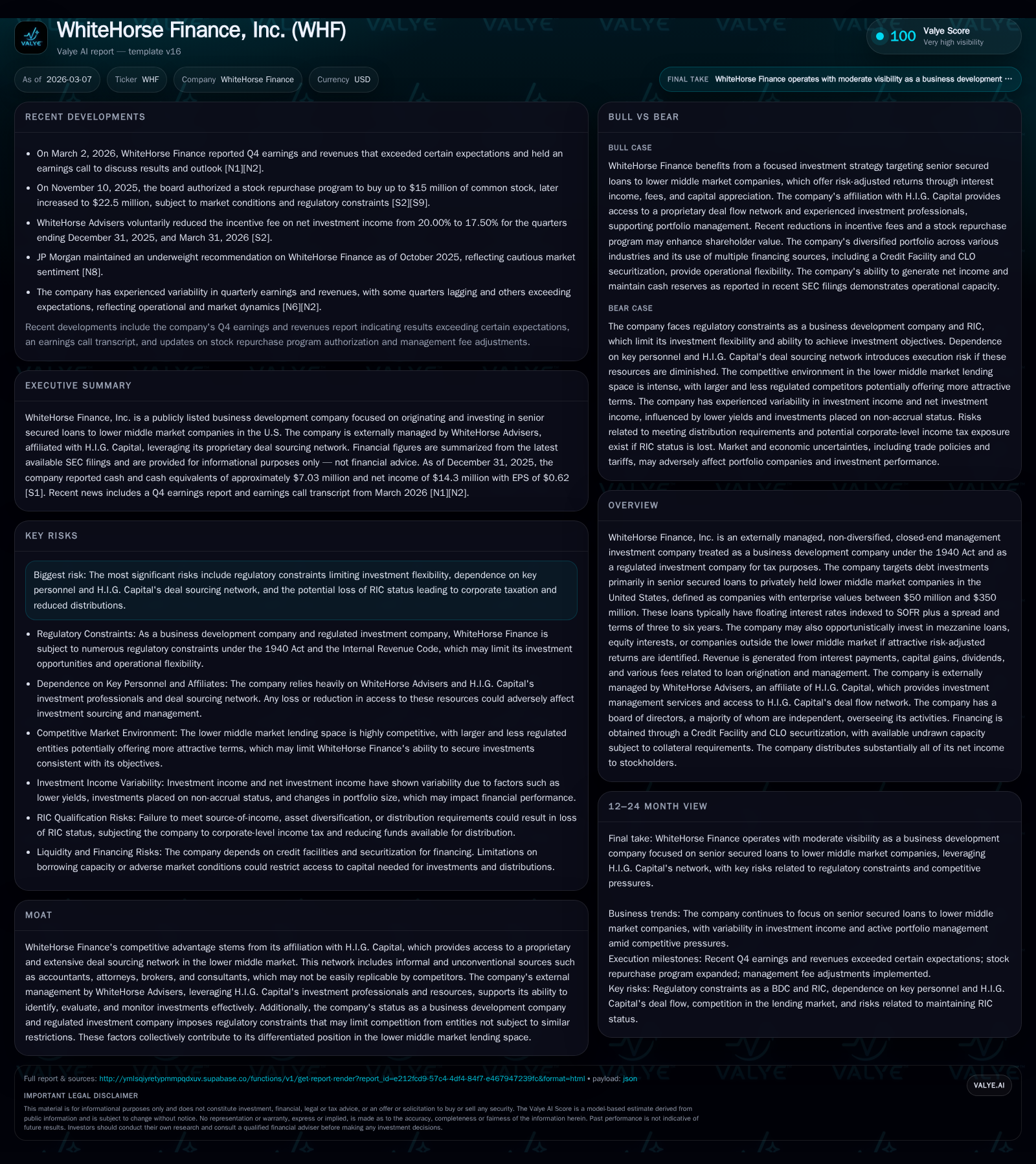
WhiteHorse Finance operates as a business development company focused primarily on senior secured loans to U.S. lower middle market companies, leveraging H.I.G. Capital’s proprietary deal sourcing network for competitive advantage. The company has demonstrated a net income increase of 32.1% from FY2024 to FY2025, driven by its niche portfolio of floating-rate loans indexed to SOFR and supplemented by fee income. Regulatory constraints inherent to its BDC and RIC status shape investment flexibility and distribution policies, while recent credit facility amendments reflect tightened liquidity management yet preserve operational leeway. Share repurchases alongside dividends position capital allocation towards shareholder returns amid a 5.5% ROE metric measured in 2025.
WhiteHorse Finance’s Growth Trajectory and Market Focus
WhiteHorse Finance operates as an externally managed business development company (BDC), specializing in providing debt capital predominantly through senior secured loans to lower middle market U.S. companies with enterprise values ranging from $50 million to $350 million [S1]. These loans typically carry floating rates indexed to SOFR plus a spread and mature over three to six years. This focused niche allows WhiteHorse to capture attractive risk-adjusted returns supported by steady interest payments.
From a financial performance standpoint, the company reported a net income of approximately $14.3 million for fiscal year (FY) 2025, representing a robust 32.1% increase relative to the $10.85 million recorded in FY2024 [F1]. Despite this growth in profitability, operating cash flow (CFO) remained relatively stable at around $77 million in FY2025 versus $78.8 million in FY2024 [F1], signaling consistency in the underlying cash-generative capacity despite market or portfolio valuation shifts.
This trajectory reflects disciplined credit selection aided by H.I.G. Capital's extensive proprietary deal sourcing network which penetrates informal channels like accountants and attorneys—sources challenging for competitors to replicate—thus embedding a durable competitive advantage into WhiteHorse's acquisition funnel [N2][S1]. The strategic focus on floating-rate loans links revenue closely with prevailing SOFR benchmarks plus defined spreads, imparting resilience against rising rate environments.
Historical performance (annual)
| FY | Net ($mm) | CFO ($mm) | Net YoY |
|---|---|---|---|
| 2025 | 14 | 77 | +32.1% |
| 2024 | 11 | 79 | -46.8% |
| 2023 | 20 | 90 | +30.2% |
| 2022 | 16 | 72 |
Source: SEC companyfacts cache [F1].
Capital returns and efficiency (annual)
| FY | ROE% |
|---|---|
| 2025 | 5.5 |
| 2024 | 3.8 |
| 2023 | 6.4 |
| 2022 | 4.7 |
Source: SEC companyfacts cache [F1].
Net income growth driven partially by steady interest income streams; ROE calculated as net income divided by end-of-year equity [F1].
Impact of Regulatory Framework on Investment Flexibility
As a BDC registered under the Investment Company Act of 1940 (the “1940 Act”) and electing regulated investment company (RIC) status for tax purposes under Subchapter M of the Internal Revenue Code (the "Code"), WhiteHorse operates under strict regulatory parameters that limit its investment universe and influence portfolio management [S1][S2].
Foremost among these constraints is the requirement that at least 70% of assets be held in qualifying investments — primarily U.S.-based private or thinly traded companies or high-quality short-term instruments — which restricts exposure beyond this segment even if other risk-return opportunities arise elsewhere [S1]. Further limitations extend to follow-on investments and forced dispositions; rapid portfolio sales may necessitate unfavorable terms due to illiquidity within the specialized lower middle market lending space.
Tax qualification as an RIC imposes annual distribution requirements whereby WhiteHorse must distribute at least 90% of net ordinary income plus realized short-term gains less long-term losses each year; failure could trigger corporate taxation that would materially diminish distributable capital [S1]. These rules collectively cap flexibility but also encourage disciplined income generation paired with prudent dividend policies.
Investment Portfolio Composition and Performance Metrics
At the close of FY2025, WhiteHorse’s portfolio was concentrated chiefly into senior secured loans across approximately 129 positions within about 68 distinct companies valued at nearly $579 million fair value [S15]. The dominant revenue driver remains floating-rate interest income linked closely with SOFR benchmarks plus negotiated credit spreads averaging around low single-digit percentages over SOFR [S15][N2].
Loan maturities span three-to-six years aligning with typical credit cycle horizons for this market tier; fixed-rate loans form a minimal portion (~1.3%) of total fair value emphasizing preference for variable yield exposure [S15]. Beyond interest payments, ancillary sources include capital gains realized upon loan repayments or sales as well as fees related to loan origination and ongoing management—each integral for diversifying revenue inflows [S1][N2].
Opportunistic mezzanine debt or equity stakes may supplement core holdings when risk-adjusted returns justify deviation from strict seniority or market segment limits but remain peripheral [S1]. This compositional strategy balances yield potential against capital preservation within prevailing regulatory guardrails.
Capital Structure Amendments and Liquidity Management
Recent developments have seen notable adjustments within WhiteHorse Credit’s revolving Credit Facility: originally capped at $335 million with optional accordion expansion capability up to $375 million; however effective June 27, 2025, availability was curtailed sharply down to $100 million reflecting more stringent collateral coverage tests and borrowing base ratios [S5][S6][S7].
Specifically:
- Borrowing base test enforces that outstanding lender advances cannot exceed 60% of net asset value attributable collateralizing assets.
- Market value test requires collateral portfolio valuations exceed at least 167.5% of aggregate principal borrowings.
- Interest margin reduced from SOFR +2.50% previously down to SOFR +2.25%, lowering cost of capital but reflecting tighter credit conditions.
- Extended maturity dates through January 17, 2030 provide long-dated funding stability [S23].
Cash resources as of December 31, 2025 comprised roughly $29.7 million including restricted cash earmarked for financing covenant compliance; undrawn availability stood near $100 million subject only partially ($43.8 million) to borrowing base limitations due to collateral quality requirements [S8][S15][S16]. These amendments indicate intentional balancing between liquidity preservation amid evolving loan conditions while maintaining capacity for incremental draws aligned with asset coverage metrics.
Moreover, June 10, 2025 marked completion of the $298 million term CLO securitization which segments portfolio financing into rated tranches ranging from AAA-rated Class A Notes through subordinated residual notes held internally by WhiteHorse [S12][S21]. This transaction bolsters structural leverage within regulatory thresholds while enhancing medium-term funding diversity.
Dividend Policies, Buybacks, and Shareholder Returns
Consistent with RIC distribution mandates necessitating near-total passthrough of taxable earnings as dividends annually [S1], WhiteHorse sustains regular dividend payouts complemented recently by an active share repurchase program initiated November 10, 2025 authorizing up to $15 million in common stock buybacks below net asset value per share [S16].
In late FY2025 alone approximately $7.4 million worth of shares were repurchased comprising over one million shares across November–December periods at average prices around $7.35 each [S16], signaling deliberate capital return actions enhancing shareholder value within legal stipulations.
Return on equity (ROE), computed as net income over average shareholders’ equity stood near a modest yet positive ~5.5% for FY2025 suggesting balanced profit generation alongside capital conservation imperatives typical for BDCs with regulatory distribution constraints limiting retained earnings accumulation [F1].
The company has not disclosed further specific buyback or special dividend intentions beyond these frameworks; ongoing capital allocation prioritizes maintaining liquidity under tightening credit covenants while returning cash efficiently.
Navigating External Management and Dependence on Key Alliances
WhiteHorse Finance operates without internal employee infrastructure relying instead on external management provided by WhiteHorse Advisers LLC affiliated closely with H.I.G. Capital L.L.C., their investment adviser nexus that supplies critical human resources and proprietary deal flow access [S1][N1].
This arrangement enhances competitive moat through embedded relationships penetrating unconventional sourcing avenues such as accountants or attorneys who feed early-stage lending opportunities seldom visible via traditional intermediary pipelines [S1]. However it simultaneously concentrates operational dependence risking disruption if key personnel depart or if regulatory dynamics impair adviser agreements.
The specialized team invoked benefits regular evaluation efficacy around investment identification, evaluation procedures along with real-time monitoring consistent with lower middle market lending sensitivity—an often overlooked feature differentiating externally managed BDCs versus internally staffed peers lacking equivalent boutique insight depth.
Outlook: What Earnings and Credit Facility Trends Suggest for 2026
While explicit guidance remains undisclosed by management post-FY2025 reporting [N1], recent quarterly results indicated Q4 earnings beat estimates driven by steady portfolio performance despite challenging credit markets characterized by constrained capital availability and rising interest rates pressuring borrower fundamentals [N2][N1]. This performance aligns with disciplined underwriting focused on high-quality collateralized senior secured loans exhibiting resilience due to variable rate floors tracking SOFR movements favorably relative to fixed coupon liability costs.
Conversely tightening credit facility availability from peak offer ceilings exceeding $300M down sharply restricts immediate borrowing capacity requiring strategic capital usage oversight amid compliance mandated borrowing base & market value tests imposed during the last twelve months [S6][S7][S23]. Management signals cautious optimism balanced by prudent liquidity stewardship that will likely govern incremental exposure expansion throughout fiscal year coupled with opportunistic sale or restructuring initiatives addressing non-core holdings when valuation-supported convenience arises.
Monitoring asset coverage ratios and reinvestment pacing within evolving economic conditions will be pivotal milestones demonstrating sustained growth trajectories feasible under current governance constraints.
Risks Related to RIC Status, Market Conditions, and Competition
Primary risks stem from the potential loss of Hypothetical RIC tax-qualified status which would impose corporate taxation severely reducing distributable earnings capacity thus negatively affecting NAV and share pricing levels [S1]. The structure’s dependence on adherence to stringent governing statutes limits management agility enabling potentially beneficial investments outside narrow qualifying assets universe mandated by the BDC construct.
There is significant exposure embedded within reliance on H.I.G.’s deal sourcing network; any attrition among key advisers or reputational impairments could disrupt pipeline inflows fundamentally impacting origination velocity relative to competitors not burdened by similar external management models.
Furthermore shifts in market interest rates influence loan yield floors directly tied to SOFR-linked coupons impacting net spread margins particularly given the cost-sensitive current credit facility adjustments lowering leverage headroom also exacerbated by tightening debt covenants restricting operational maneuverability during economic downturns or sector-specific downturn stresses impacting underlying borrower performance profiles.[S24]
Increased competitive intensity from other lenders including non-BDC structures offering greater investment flexibility may impose pressure as well although WhiteHorse’s niche focus provides some insulation albeit necessitating continuous refinement of asset quality monitoring frameworks.
Disclaimer: This report is prepared solely for informational purposes without making any recommendations regarding securities transactions or investments involving WhiteHorse Finance Inc., based exclusively on publicly available information from SEC filings and credible news sources cited herein.
Disclaimer: This is research-only, informational analysis and not investment advice. It may include AI-generated interpretation and general industry context. Always verify important details using primary sources.

Comments