
Spring Valley Acquisition Corp. III: Launch and Path Toward Fusion Energy Public Listing
SPAC with $230 million trust targets a pure-play fusion company amid a 24-month deal completion window.
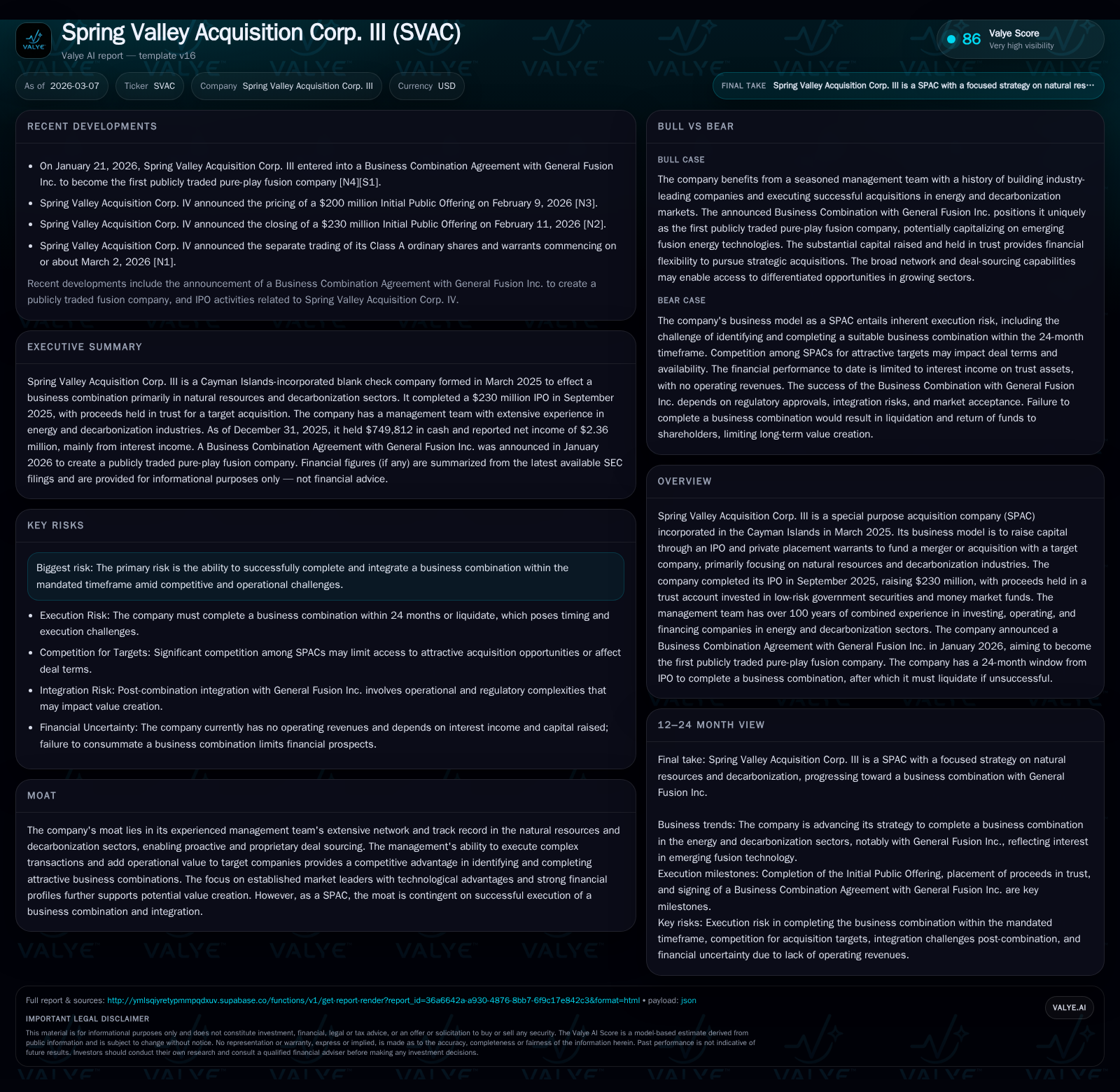
Spring Valley Acquisition Corp. III (SVAC) is a Cayman Islands-incorporated SPAC formed in March 2025, focusing on natural resources and decarbonization sectors, notably announcing a business combination with General Fusion Inc. in January 2026 to create the first publicly traded pure-play fusion company. Since its September 2025 IPO raising $230 million, SVAC has no operating revenue but holds cash primarily in government securities within a trust account while preparing for its transformative business combination. The company’s future growth relies heavily on executing this deal within two years, leveraging an experienced management team’s expertise and network, though execution risks and integration remain key uncertainties.
Company Overview and Business Model
Spring Valley Acquisition Corp. III was incorporated in the Cayman Islands on March 12, 2025 as a special purpose acquisition company (SPAC) intending to raise capital through an initial public offering (IPO) coupled with private placement warrants. The proceeds from the IPO are earmarked primarily for completing one or more business combinations — transactions such as mergers or acquisitions — targeting companies within natural resources and decarbonization sectors.
The SPAC structure means that SVAC entered the public markets without any operating history or revenues; it functions solely as a capital vehicle until it identifies and closes on a qualifying target.
Historical Performance and Financial Metrics
SVAC consummated its IPO on September 5, 2025, issuing 23 million units at $10 per unit including the full exercise of over-allotment options, raising gross proceeds of approximately $230 million [S16], [S22]. Additionally, private placement warrants were sold concurrently for approximately $6.3 million [S22].
Following the offering, net proceeds are placed into a Trust Account invested in short-duration U.S. Treasury bills or money market funds focused on government securities to preserve principal and liquidity [S22]. As of December 31, 2025, the company reported cash and equivalents outside the Trust Account of approximately $750k USD along with total current assets of about $851k USD against current liabilities of roughly $103k USD — yielding a strong current ratio of approximately 8.3x [F1]. Operating income was negative around $450k USD for the period ended December 31, 2025 due mainly to administrative costs and no revenues [F1]. Net income registered positive but driven by non-operating income sources including interest earned on trust account investments amounting to about $2.36 million USD [F1].
Historical performance (annual)
| FY |
|---|
| 2025 |
Source: SEC companyfacts cache [F1].
Note: Revenues are nil since SVAC is a pre-transaction SPAC; net income reflects non-cash gains largely from interest income.
Management Expertise and Competitive Positioning
SVAC's value proposition centers around its management team's extensive expertise exceeding 100 combined years across public/private investing and operational roles in energy and decarbonization fields [S9], [S16]. This deep sector knowledge facilitates proactive sourcing of attractive deals with natural resource businesses focused on technological innovation and decarbonization benefits.
The management team also brings experience navigating complex regulatory frameworks common in these industries [S9], which can be an important competitive edge when deploying capital into transformative technologies like fusion energy.
Business Combination Agreement with General Fusion Inc.
In January 2026, Spring Valley Acquisition Corp. III announced entering into a Business Combination Agreement with General Fusion Inc., a company specializing exclusively in fusion energy technology [N4]. This transaction positions SVAC as potentially the first publicly traded pure-play fusion enterprise — an emerging market segment with high scientific complexity and long development horizons.
This arrangement represents the crystallization of SVAC’s mission to fund technologically advanced decarbonization-focused firms. However, it also introduces significant execution risk given fusion’s novel technological status and commercialization uncertainties.
Strategic Considerations and Growth Outlook
Growth potential for SVAC post-business combination is largely contingent upon General Fusion's successful transition to commercial operations, scaling technology deployment, securing follow-on capital investments, and building sustainable revenue streams reflective of their novel energy solution [N4], [S17].
Given that SVAC itself holds no operating assets aside from investment securities until merging, its topline growth will depend entirely on this merger’s closure success within its available window.
The company has up to 24 months post-IPO (from September 2025) to complete such transactions before forced liquidation must occur by repurchasing outstanding shares at trust-account values plus earned interest [S22]. Early announcement shortly after IPO suggests management is proactively advancing; however closure timelines remain critical catalysts.
Risks Impacting Execution
As an early-stage SPAC entity without revenues or diversified operations, SVAC faces several inherent risks:
- Failure to consummate a qualifying business combination within mandated timeframes would result in liquidation and shareholders receiving cash distributions rather than equity exposure [S1], [S22].
- Shareholder voting rights may be limited or restricted depending upon transaction structure or Nasdaq requirements; sponsors may vote founder shares regardless of public holder sentiment potentially diluting influence [S1], [S15].
- Additional financing may be necessary if redemptions exceed expectations or if working capital needs increase; sponsor-provided working capital loans exist but bear conversion risks [S18], [S21].
- The underlying target company’s scientific risk inherent in fusion technology adoption could impact combined entity valuations negatively if milestones are delayed or technological hurdles persist [N4].
- Broader macroeconomic instability including geopolitical tensions cited by management could introduce complexities around capital markets access or operational continuity for target entities [S5], [S18].
Capital Allocation and Shareholder Returns
SVAC currently holds substantial liquidity constrained largely to the Trust Account ($230 million), which must be used almost exclusively toward completing the initial business combination less underwriting commissions previously deferred during IPO execution [S22], [S25]. No dividends or share repurchases exist as no operating cash flows are generated pre-combination.
Sponsor commitments have included purchasing Private Placement Warrants alongside underwriters at nominal pricing points providing incremental capital buffers if exercised post-business combination [S22]. Working capital loans may be extended by sponsors or affiliates to finance transaction costs but were not outstanding as of latest reports [S18], [S21].
Summary Table: Cash Flow Activity Around IPO Period (millions USD)
| Activity | Amount |
|---|---|
| Gross Proceeds from IPO | $230.0 |
| Proceeds from Private Placement Warrants | $6.34 |
| Investment Into Trust Account | $(230.0) |
| Cash Outside Trust Account | ~$0.75 |
| Operating Expenses | Minimal |
Long-term returns will rely heavily on stock value appreciation post-merger resulting from successful growth phases of General Fusion Inc., if completed.
What To Monitor Going Forward
Key milestones deserving attention include:
- Completion timing of Business Combination Agreement steps including shareholder approvals or tender offer outcomes.
- Financial disclosures from General Fusion following merger closing that outline projected revenue acceleration paths.
- Any indications of operational setbacks or regulatory hurdles affecting fusion commercialization.
- Redemption levels by public shareholders which could influence available deal consideration funding.
- Potential future equity raises or debt issuances related to working capital demands post-closing.
- Market reception towards pure-play clean-tech/fusion opportunities as sector enthusiasm fluctuates.
Conclusion
Spring Valley Acquisition Corp. III stands at the threshold between SPAC formation phase stability backed by substantial trust account reserves and an uncertain but potentially transformative business combination focused on pioneering fusion energy technology commercialization via General Fusion Inc. The company's experienced management team underpins its moat through deal sourcing acumen within specialized sectors; however ultimate value creation hinges critically on integrating an unproven technology platform within typical public market constraints over the coming two years.
While liquidity metrics reflect solid financial footing through IPO proceeds held conservatively until deal closure, investors face typical blank check entity risks amplified by technological uncertainties intrinsic to fusion energy.
Disclaimer: This report is for informational purposes only derived from publicly available data sources including SEC filings ([F1], [S1]–[S29]) and verified news reports ([N1]-[N4]). It does not constitute investment advice or recommendations. Readers should consider additional independent research before drawing conclusions regarding securities discussed herein.
Disclaimer: This is research-only, informational analysis and not investment advice. It may include AI-generated interpretation and general industry context. Always verify important details using primary sources.

Comments