
Backblaze’s Growth Rebound and Strategic Shift Toward AI Cloud Storage
Backblaze is leveraging its proprietary cloud platform to capitalize on expanding AI workloads while improving financial performance through operational efficiency and capital discipline.
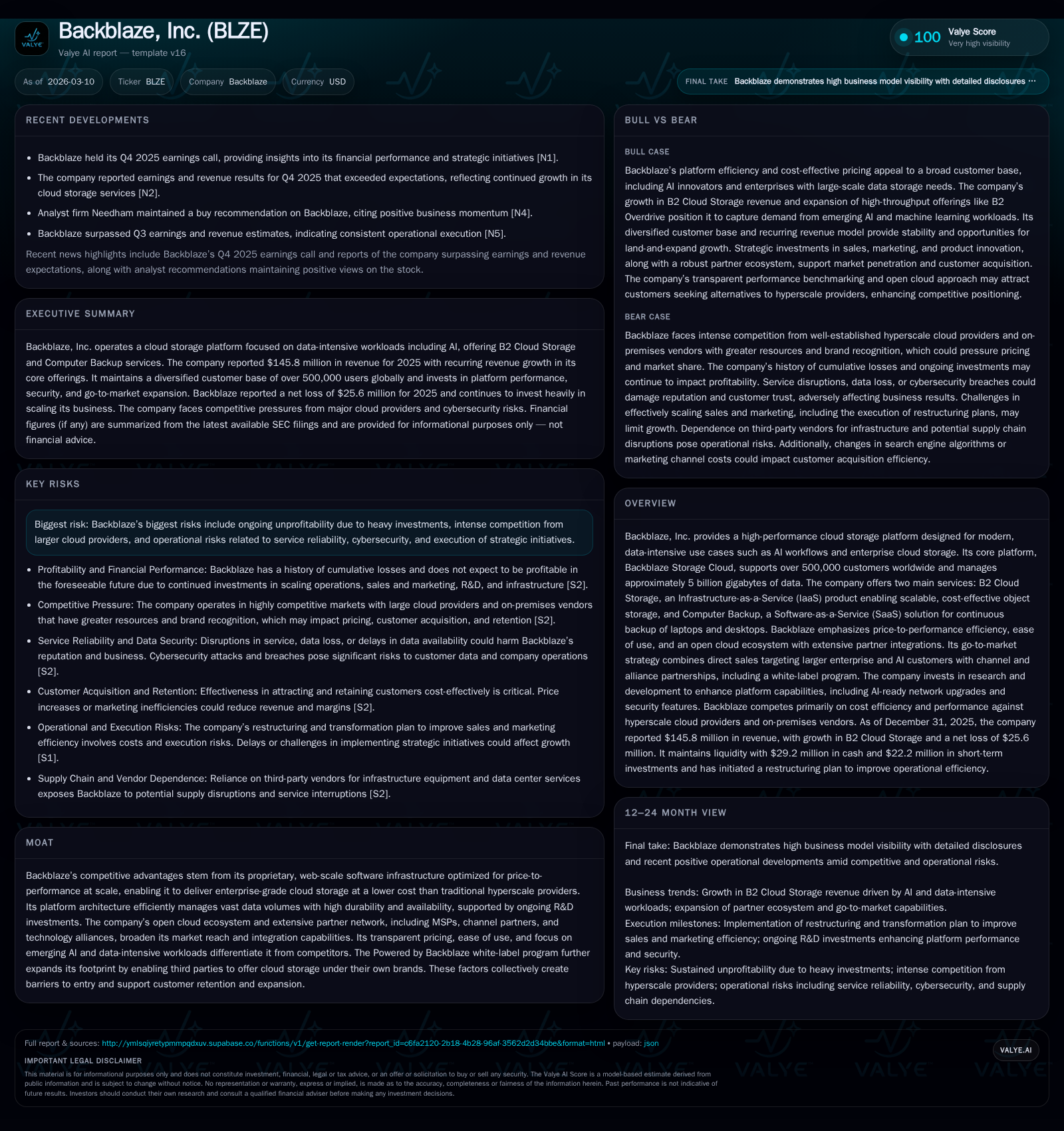
Backblaze, Inc. demonstrated a notable financial recovery in 2025 with near halving of operating income losses and a significant increase in operating cash flow, reflecting improved operational leverage and efficiency. The company’s cloud storage platform is distinctly optimized for AI and data-intensive workloads, featuring offerings such as B2 Overdrive that provide high throughput and flexible private networking. Its customer base exceeding 500,000 globally spans individual users to large enterprises, supported by a blended go-to-market strategy involving direct sales and an extensive partner ecosystem including white-label solutions. Despite competitive pressure from hyperscalers and ongoing unprofitability, Backblaze’s careful capital allocation—highlighted by conservative debt usage and an active share repurchase program—positions it to pursue growth opportunities centered on AI workload adoption.
Financial Recovery and Performance Drivers in 2025
Backblaze’s financial results for fiscal year 2025 illustrate a clear trajectory towards operational improvement amid ongoing investments for growth. Operating income losses narrowed substantially from -$46.3 million in 2024 to -$23.6 million in 2025—a near 49% improvement—signaling increasing operational leverage as revenue growth began to outpace underlying expense increases [F1]. Correspondingly, the company posted an approximate net loss reduction of 47.2%, moving from -$48.5 million to -$25.6 million over the same period [F1]. This turnaround was driven by revenue expansion supported by both its core B2 Cloud Storage infrastructure-as-a-service (IaaS) product and its Computer Backup software-as-a-service (SaaS) offering.
Operating cash flow nearly doubled year-over-year to $23.5 million from $12.5 million in 2024 [F1], demonstrating stronger cash generation even though net income remained negative due largely to non-cash stock-based compensation and depreciation expenses detailed in SEC filings [S24]. Capital expenditure spiked notably by approximately 174%, from $1.7 million in 2024 to $4.7 million in 2025 [F1], reflecting elevated spending on infrastructure expansion critical for scaling capacity and enhancing platform performance.
This balance between improved profitability metrics alongside strategic reinvestment is indicative of Backblaze’s effort to sustain growth momentum while mitigating countervailing cost pressures.
Historical performance (annual)
| FY | Net ($mm) | CFO ($mm) | OpInc ($mm) | Capex ($mm) | Net YoY |
|---|---|---|---|---|---|
| 2025 | -26 | 24 | -24 | 5 | +47.2% |
| 2024 | -49 | 13 | -46 | 2 | +18.7% |
| 2023 | -60 | -7 | -58 | 6 | -16.2% |
| 2022 | -51 | -14 | -48 | 7 |
Source: SEC companyfacts cache [F1].
Capital returns and efficiency (annual)
| FY | FCF ($mm) | ROE% |
|---|---|---|
| 2025 | 19 | -30.8 |
| 2024 | 11 | -62.5 |
| 2023 | -13 | -132.9 |
| 2022 | -21 | -74.8 |
Source: SEC companyfacts cache [F1].
Note: All figures are per audited annual financial statements ending December 31; YoY reflects percent change relative to prior year.
Backblaze’s Cloud Platform: Tailoring Storage for AI and Data-Intensive Workloads
Central to Backblaze’s value proposition is its purpose-built cloud storage platform engineered for price-to-performance efficiency tailored specifically for emerging AI workflows and demanding data-centric environments [S1]. The Backblaze Storage Cloud underpins distinct business lines: the foundational B2 Cloud Storage IaaS product offers scalable object storage with a pay-as-you-go or committed contract pricing model facilitating usage flexibility without vendor lock-in [S13].
Building atop this foundation is B2 Overdrive—a high-performance IaaS tier designed explicitly for AI workloads requiring substantial throughput bandwidth up to 1 terabit per second alongside zero egress fees and private networking capabilities enabling secure data transfer outside public internet paths [N1][S1][S13]. This distinguishes Backblaze from hyperscale cloud providers by combining infrastructure simplicity on commodity hardware with performance optimization through proprietary web-scale software stack innovations.
The platform supports extensive API-driven automation while maintaining transparent pricing that resonates strongly with developers experimenting with AI models as well as enterprise customers managing complex multi-year contracts.
Revenue Segmentation and Customer Base Evolution
As of December 31, 2025, Backblaze reported serving over half a million customers globally across more than 175 countries [S17], roughly segmented between approximately 400,000 Computer Backup SaaS subscribers and about 120,000 active clients on the B2 Cloud Storage IaaS service; around 20,000 customers use both products concurrently [S17].
Its diverse client base spans individual developers experimenting with AI workloads through self-serve channels to sizable enterprises consuming increasing volumes of data storage via direct sales engagements facilitated by account-based marketing strategies highlighted during recent earnings calls [N1][S21]. Moreover,
its Powered by Backblaze white-label program extends market reach by enabling third parties—including neocloud platforms—to integrate the Backblaze Storage Cloud into their solutions under custom brand identities via APIs and CNAME custom domains [S17]. This layered approach amplifies adoption in verticals such as media & entertainment workflows alongside emergent high-throughput AI use cases.
Channel partners including managed service providers (MSPs), resellers positioned within government or education markets further broaden distribution avenues leveraging discounted reseller pricing structures that stimulate go-to-market flexibility [S21].
Capital Allocation Priorities: Debt Structure, Share Repurchases, and Cash Flow Dynamics
Backblaze maintains a conservative leverage profile supported by a senior secured revolving credit facility established mid-2025 with Citizens Bank offering up to $20 million of borrowing capacity with $3 million sublimit for letters of credit [S4][S5][S6]. As of December year-end 2025 balances show zero borrowings drawn against this facility while fully complying with customary covenants limiting total leverage ratio below 2.75x EBITDA alongside minimum liquidity thresholds of $10 million held in cash or equivalents under lender control [F1][S9].
Liquidity reserves stood at approximately $29.2 million in cash and equivalents complemented by $65.7 million total current assets against current liabilities near $61.6 million—with current ratio at a moderate but sufficient 1.07x indicating reasonable short-term financial stability [F1].
In August 2025 the Board authorized a new share repurchase program permitting up to $10 million of Class A common stock buybacks primarily intended to offset dilution arising from stock-based compensation plans consistent with typical SaaS industry practice [S24][F1]. During FY25 roughly $2 million was spent buying back approximately 256K shares leaving about $8 million available under this authorization at year-end [F1][S24].
Free cash flow generation—defined here as operating cash flow less capital expenditures—was positive at an estimated $18.85 million in FY25 underpinning capacity for further disciplined investment without external financing dependence at present [F1].
Return on equity remains negative at about -30.8%, reflecting accumulated historical losses outweighing equity base gains despite profit improvements signaling the company remains on transition path toward sustained profitability but not there yet [F1].
Competitive Landscape and Differentiation through Pricing and Ecosystem Partnerships
Backblaze’s moat centers on its proprietary web-scale software infrastructure that harnesses commodity hardware coupled with automated management optimizations allowing delivery of enterprise-grade cloud storage services at substantially lower unit costs compared to traditional hyperscale providers who rely on more complex ecosystems often hampered by opaque pricing models or customer lock-in trade-offs [S13][N1].
This technological edge enables transparent pricing aligned around fixed-per-gigabyte monthly fees complemented by flexible consumption tiers or committed contracts providing predictable cost controls favored by large-scale users while maintaining ease-of-use appealing across SMBs or individual developers exploring AI applications [S19].
A key differentiator lies also within its extensive open cloud ecosystem embracing managed service providers (MSPs), channel partners targeting niche segments such as education or government verticals plus technology alliances fostering interoperable integrations enhancing joint value propositions beyond pure storage commoditization paradigms [S21].
The Powered by Backblaze white-label initiative exemplifies Backblaze’s innovation beyond standard reselling—it allows partners deeper product embedding via APIs empowering them not just as distribution channels but co-creators of differentiated solutions tailored either vertically or functionally enhancing stickiness across evolving customer requirements typical for modern cloud infrastructure offerings.
Strategic Risks: Profitability Pressures, Cybersecurity, and Technology Execution
Despite encouraging improvements in operating results during 2025,[...] Backblaze continues facing material risks inherent to its challenging market environment: persistent unprofitability driven partly by significant R&D spend aimed at sustaining technological leadership; intense competition from well-resourced cloud hyperscalers capable of aggressive pricing or bundling; cybersecurity threats that potentially jeopardize data integrity or availability compromising customer trust; plus execution risks tied to delivering planned strategic initiatives such as scaling direct sales motions effectively or integrating new technology platforms without disruption remain prominent concerns flagged explicitly by management disclosures[S2][S23].
Further layers of operational risk stem from dependencies on third-party hardware supply chains impacting equipment availability crucial for infrastructure deployment plus ongoing legal contingencies arising from normal course claims although presently none judged materially adverse[S8][S23].
The company’s ability to manage these multifaceted risks will critically influence its prospects moving forward.
Growth Outlook: Direct Sales Push and Platform Enhancements to Capture AI Demand
Management commentary during recent quarterly disclosures highlighted an intensified focus on expanding direct sales engagement targeting larger enterprises—particularly those developing or deploying artificial intelligence workloads requiring robust scalable storage infrastructure optimized for high throughput usage patterns typical in training datasets or inference pipelines[N1][S16].
Elevated research & development expenditure signals commitment toward continuous performance enhancements aimed at extending capabilities such as those showcased via B2 Overdrive[S16]. This initiative seeks not only incremental revenue growth but greater customer wallet share through upselling higher-tier features addressing evolving demands within fast-growing markets like generative AI platform builders.
Operating leverage benefits—wherein fixed software infrastructure costs dilute over rising revenues—are expected contingent upon successful upmarket penetration combined with channel expansion efforts reinforcing partner alignment strategies announced previously[S16][N1].
Though explicit public guidance regarding quantitative milestones remains absent,[...] market participants should watch adoption rates of the B2 Overdrive tier alongside trends in direct sales bookings as leading indicators reflecting traction within target AI-centric customer segments.
Key Metrics to Monitor: Operational Milestones and Financial Targets Ahead
Absent specific quantitative guidance provided publicly,[...] several operational benchmarks merit close observation going forward:
- Margin improvements particularly contractions in net loss margins reflecting fixed-cost absorption effects plus potential gross margin stability amid scaling;
- Growth rates in subscription revenues broken down between Computer Backup SaaS versus Infrastructure-as-a-Service B2 Cloud Storage;
- Uptake velocity within the newly introduced high-throughput B2 Overdrive product which embodies the pivot toward AI-specific cloud use cases;
- Progression of share repurchase activity vis-à-vis liquidity conditions indicating management confidence;
- Efficacy of direct sales transformation evidenced through client acquisition metrics among large enterprises;
- Capital expenditure pacing relative to deployment needs versus prudent cash flow management balancing investment returns versus risk exposure. Together these factors collectively offer meaningful insight into whether Backblaze can sustain its positive momentum transforming into durable profitability fueled by emerging market tailwinds amid evolving competitive dynamics.
This analysis focuses strictly on publicly available company disclosures including SEC filings and reported earnings calls alongside verified numeric data snapshots. It does not constitute investment advice but aims to provide layered context around Backblaze’s strategic evolution amid financial recovery efforts within the competitive cloud storage arena shaping growth trajectories focused increasingly on artificial intelligence-driven demand.*
Disclaimer: This is research-only, informational analysis and not investment advice. It may include AI-generated interpretation and general industry context. Always verify important details using primary sources.

Comments