
VALHI Inc’s Strategic Balancing Act Between Chemicals and Real Estate Returns
Valhi leverages its diversified holdings, anchored by Kronos Worldwide's titanium dioxide business and real estate assets, to manage growth and volatility.
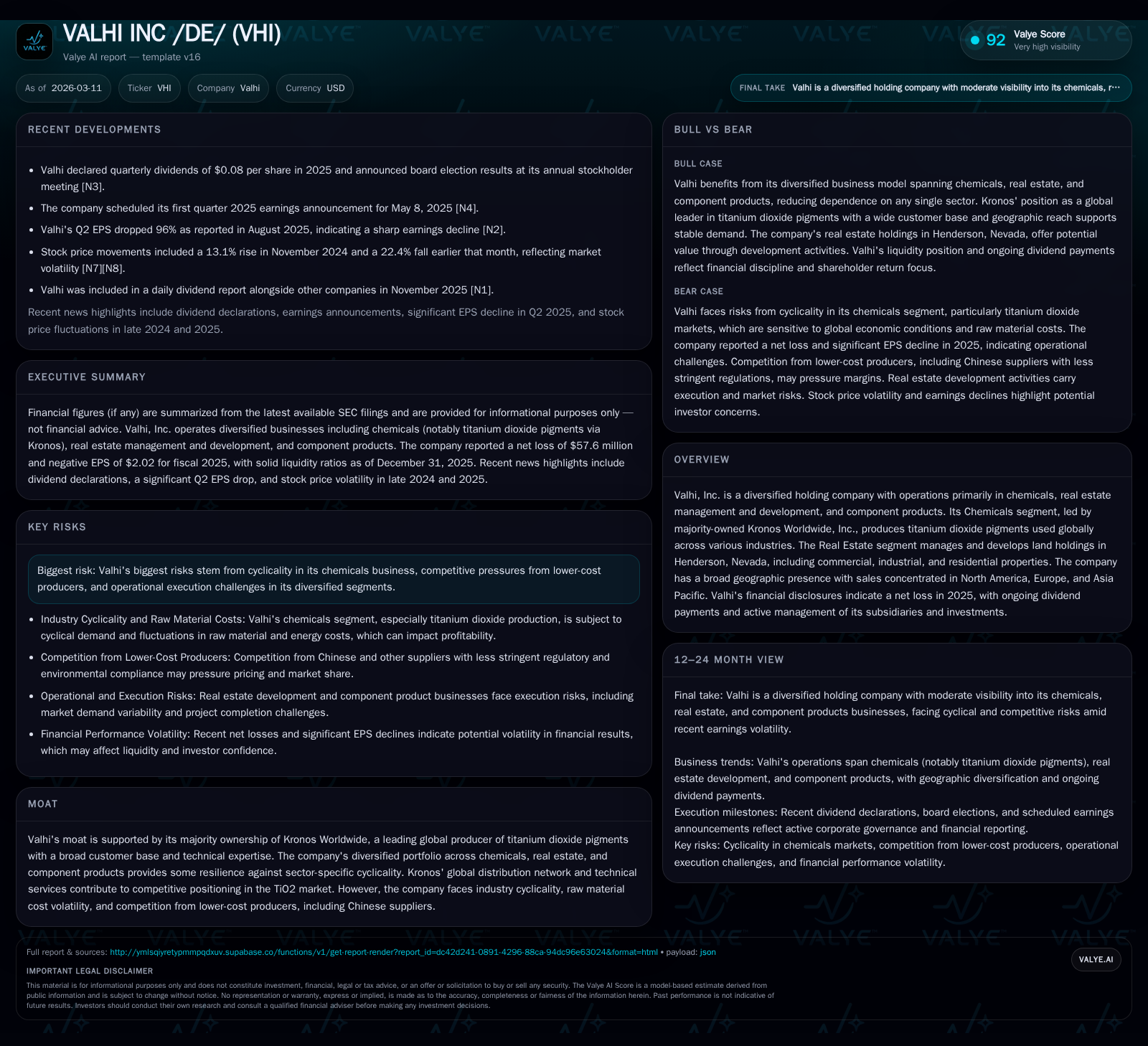
VALHI Inc operates as a diversified holding company with its principal value driver rooted in the chemicals segment through majority ownership of Kronos Worldwide, a global titanium dioxide pigment producer. While 2025 saw a net loss driven by cyclical headwinds and raw material cost pressures in chemicals, real estate holdings in Henderson, Nevada provide stable income offsets. The company maintains a solid liquidity position and consistent dividend payments despite operating losses, reflecting tactical capital allocation in a challenging industry environment. Key metrics including cash flow recovery and chemical market dynamics will be critical to watch for potential stabilization and growth.
Overview of VALHI's Business Structure and Diversification
VALHI Inc functions primarily as a diversified holding entity whose financial backbone lies in the chemicals sector, specifically through its majority stake in Kronos Worldwide, Inc. Kronos commands a leading position globally for titanium dioxide (TiO2) pigments—a critical input across coatings, plastics, paper, and other industries due to its whitening and opacity properties [N1], [S4]. This exposure anchors VALHI’s industrial-facing operations.
Complementing this is VALHI’s real estate management and development segment focused around significant land assets in Henderson, Nevada. This portfolio spans commercial, industrial, and residential properties that yield more stable cash flows compared to the cyclical chemicals division [N1], [S5]. Additionally, component products represent a smaller portion of the portfolio but add further diversity.
The business model benefits from Kronos’ broad geographic footprint with sales dispersed across North America, Europe, and Asia Pacific regions. This diversification offers some mitigation against region-specific demand shocks [S4]. Moreover, Kronos' global distribution network coupled with technical expertise in TiO2 manufacturing forms part of Valhi’s moat despite the pressure from low-cost competitors.
Historical Performance: Revenue Growth and Profit Volatility from 2017 to 2025
Over recent years ending FY2025, VALHI reported revenue growth punctuated by wide swings in profitability largely reflective of commodity cyclicality.
Historical performance (annual)
| FY | Net ($mm) | CFO ($mm) | OpInc ($mm) | Capex ($mm) | Net YoY |
|---|---|---|---|---|---|
| 2025 | -58 | -35 | 63 | 47 | -153.3% |
| 2024 | 108 | 44 | 211 | 31 | +992.6% |
| 2023 | -12 | 4 | 34 | 49 | -113.4% |
| 2022 | 90 | 35 | 239 | 68 |
Source: SEC companyfacts cache [F1].
Capital returns and efficiency (annual)
| FY | Div ($mm) | Buybacks ($mm) | FCF ($mm) |
|---|---|---|---|
| 2025 | 9 | 3 | -82 |
| 2024 | 9 | 3 | 13 |
| 2023 | 9 | 3 | -45 |
| 2022 | 9 | 4 | -33 |
Source: SEC companyfacts cache [F1].
Note: Detailed top-line figures before FY2017 are unavailable; FY2017 reported revenue at $495.9M per [F1]. Significant volatility is visible in operating income with steep rises followed by sharp declines; net income similarly fluctuates with losses notably deepening in the latest fiscal year.
The decline towards a net loss in 2025 was driven largely by headwinds faced within the chemicals segment exposed to weaker TiO2 pricing and higher raw material costs exacerbated by industry cyclicality [S17]. Meanwhile, increased capital expenditures reflect ongoing investments possibly aimed at operational efficiencies or capacity expansions yet contributed to negative free cash flow.
Operational Drivers Within the Chemicals Segment Centered on Kronos Worldwide
Kronos Worldwide remains the linchpin for revenue generation within VALHI’s chemicals division through production of titanium dioxide pigments which are essential for multiple end markets requiring high-quality whiteness or opacity.
The technical complexity of TiO2 manufacturing combined with established global distribution channels underpins Kronos’ competitive positioning but also exposes it to raw material cost volatility notably from feedstocks like ilmenite or rutile minerals [N1], [S4]. Costs have fluctuated significantly over recent periods impacting margins.
Additionally, competition intensifies particularly from Chinese producers who benefit from lower input costs and increasingly sophisticated technology posing pricing pressures on established producers such as Kronos — a notable risk highlighted in regulatory filings [S17]. Market cyclicality linked to economic cycles affecting downstream demand compounds these challenges.
Real Estate Segment's Role in Stabilizing Income Streams
VALHI's real estate segment manages development projects mainly concentrated on land holdings within Henderson, Nevada—a rapidly growing metro area with commercial, industrial, and residential components providing diversification away from cyclical commodity markets [N1], [S5].
This segment offers relatively predictable rental incomes and property value appreciation potential which help stabilize consolidated earnings when chemical operations face downturns.
Although smaller than Kronos' footprint economically, steady cash inflows from real estate operations cushion earnings volatility inherent in titanium dioxide production enabling VALHI to navigate cycle troughs without compromising capital returns too aggressively.
Navigating Industry Cyclicality and Competitive Pressures
The key variable constraining sustained earnings growth remains the cyclicality intrinsic to chemical commodity markets dominated by TiO2 products which are sensitive to global economic swings affecting customers’ consumption patterns [N1], [S17].
Raw material input price volatility can compress margins quickly — an acute challenge exacerbated recently by inflationary pressures on ilmenite sourcing costs.
Competition from lower-cost producers especially those operating out of China intensifies pricing pressure while shifting trade policies or tariffs inject additional uncertainty into supply chains.
Operational execution challenges also persist given broad portfolio diversification necessitating attention across both industrial chemical manufacture and real estate development operations [N1], emphasizing management's balancing act.
Capital Allocation Patterns: Dividends, Buybacks, and Cash Flow Management
VALHI’s capital allocation reflects commitment to shareholder dividends despite recent losses—paying approximately $9.1 million annually through at least FY2025 per disclosures [F1], [S19].
Share repurchases continue at measured levels with modest $2.9 million aggregate buying noted over recent years signaling restrained capital return amid tighter cash flows.
Operating cash flow turned negative (-$35.5 million in FY2025), contrasting preceding positive periods; combining elevated capex ($46.6 million) supports an overall free cash flow deficit near -$82 million for FY2025—denoting financial stress points warranting close watch [F1].
Calculated ROE slipped into negative territory at approximately -5.6%, reflecting net loss impact on base equity totaling just over $1 billion end-2025 [F1].
Balance Sheet Strength and Liquidity Considerations
A salient strength remains VALHI's liquidity profile supported by $214 million cash equivalents alongside strong current assets totaling nearly $1.26 billion against current liabilities around $449 million yielding a healthy current ratio (~2.8) that cushions short-term obligations comfortably [F1], [S6].
Debt levels remain significant but manageable: subsidiary debt comprises senior secured notes issued through Kronos International totaling high hundreds millions alongside unsecured credit facilities; interest rates on borrowings hover around mid-to-high single digits percent reflecting credit risk adjustments typical within industrial chemical sectors [S8], [S10].
This conservatively structured balance sheet provides financial flexibility for debt servicing or strategic investments during cyclical downturns.
Future Growth Outlook: Potential Catalysts and Risk Factors
While explicit forward guidance is absent in public filings or news releases up to early-2026 [N1], core drivers for future growth appear tied principally to stabilization or improvement in TiO2 pigment pricing regime coupled with continued expansion or productivity improvements within Kronos' manufacturing footprint.
Simultaneously capitalizing on real estate development opportunities across Henderson could create incremental income streams offsetting upstream cyclical risks particularly if macroeconomic conditions favor construction and commercial leasing sectors.
Risks include persistent competitive pricing pressure from Chinese producers potentially eroding margins further alongside inherent cyclicality dampening demand during global economic slowdowns; operational execution across diverse segments remains another control point for management effectiveness going forward [S17].
Key Metrics to Monitor Going Forward
Investors should focus on several measurable indicators:
- Year-over-year revenue trends specifically within the titanium dioxide chemicals segment for signs of stabilization or recovery — an early marker for broader operational health.
- Net income trajectory balancing turnaround efforts versus cost inflation impacts.
- Operating cash flow improvements post-capex investment cycles signaling restored internal funding capacity.
- Dividend consistency amidst earnings variability reflecting management priorities around shareholder returns.
- Developments or asset sales within real estate that could materially augment recurring revenues or capital gains potential.
- Debt refinancing events or affordability signaling changes in financial leverage sustainability.
These parameters collectively shed light on VALHI’s ability to maintain its strategic balance between volatile industrial pigments chemistry business and steadier real estate operations supporting longer-term enterprise resilience.
This analysis synthesizes reported data up through VALHI's FY2025 filings without forward-looking estimates beyond disclosed facts; it does not constitute investment advice but aims to provide structured insights into company fundamentals and sector context relevant for valuation perspectives or operational assessment purposes.
Disclaimer: This is research-only, informational analysis and not investment advice. It may include AI-generated interpretation and general industry context. Always verify important details using primary sources.

Comments