
BriaCell Advances Phase 3 Breast Cancer Therapy While Managing Third-Party and Capital Risks
BriaCell Therapeutics supports pivotal trials of Bria-IMT amid growing operating losses and reliance on external partners for manufacturing and commercialization.
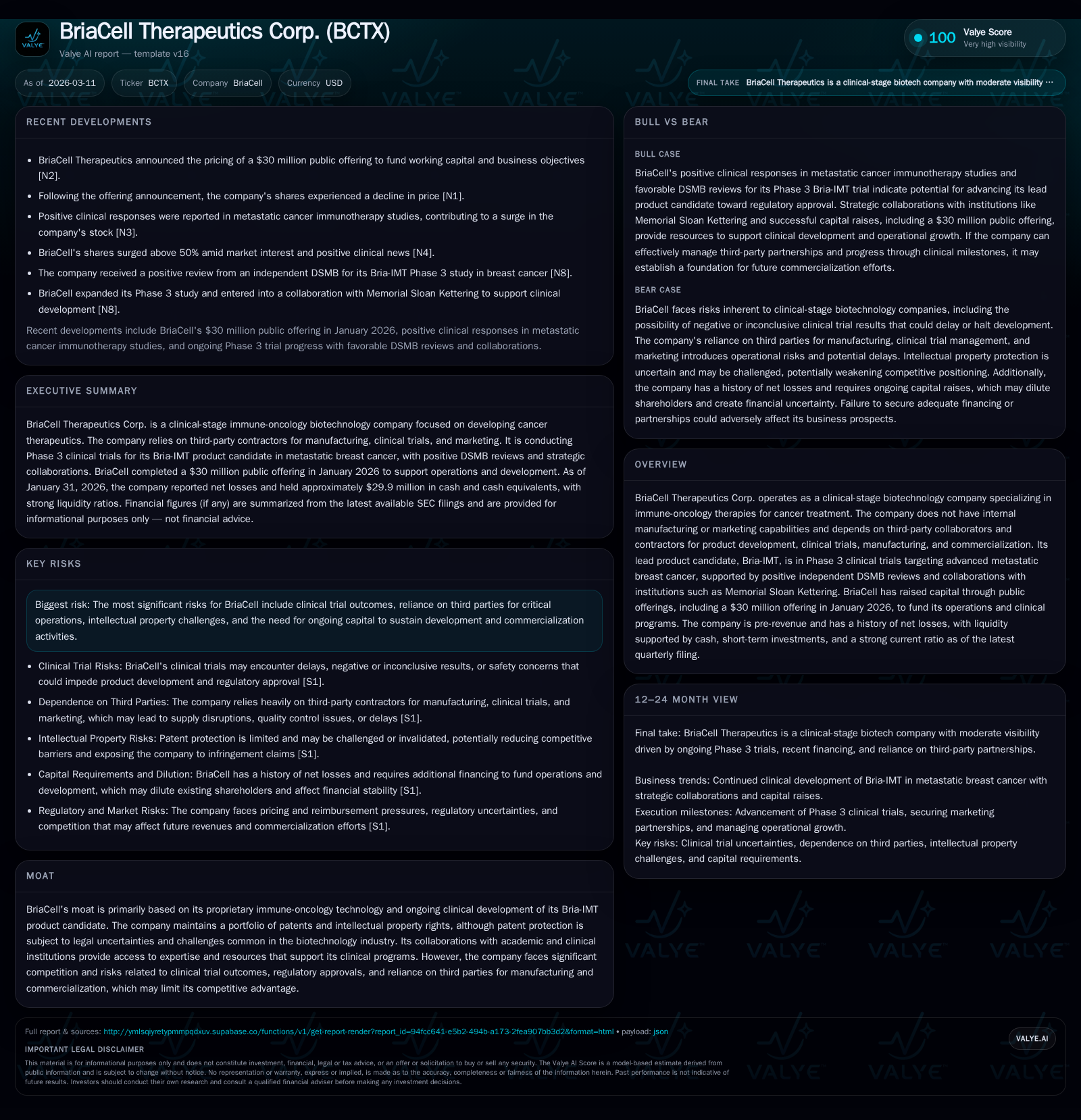
BriaCell Therapeutics Corp. is a clinical-stage biotech company focused on developing immuno-oncology therapies, principally its Phase 3 candidate Bria-IMT for metastatic breast cancer. The company remains pre-revenue, with sustained operating losses related to clinical development and infrastructure expansion. Its reliance on third-party partners for manufacturing and commercialization introduces execution risks. Recent equity financing supports near-term operations, but ongoing capital requirements persist. Future progress depends on successful clinical outcomes, regulatory approvals, and strategic collaborations to enable commercialization.
Historical Financial Performance
BriaCell Therapeutics has reported growing net losses over recent fiscal years as it invests heavily in research and development without generating commercial revenues. Net income losses increased from approximately $26.8 million in FY2022 to $26.3 million in FY2025. Operating income followed a similar pattern, worsening from -$15.3 million in FY2022 to -$27.2 million in FY2025 [F1].
Operating cash flows have consistently been negative, reflecting substantial expenditures supporting clinical trials and corporate functions. Cash flow from operations deteriorated from -$12.5 million in FY2022 to about -$28.2 million by FY2025. Capital expenditures have remained modest at around $0.46 million historically, consistent with an asset-light model relying on outsourced manufacturing [F1].
Historical performance (annual)
| FY | Net ($mm) | CFO ($mm) | OpInc ($mm) | Capex ($) | Net YoY |
|---|---|---|---|---|---|
| 2025 | -26 | -28 | -27 | 456801 | -449.1% |
| 2024 | -5 | -24 | -33 | 456801 | +76.4% |
| 2023 | -20 | -24 | -23 | +24.4% | |
| 2022 | -27 | -12 | -15 |
Source: SEC companyfacts cache [F1].
Capital returns and efficiency (annual)
| FY | Buybacks ($mm) | FCF ($mm) | ROE% |
|---|---|---|---|
| 2025 | -29 | ||
| 2024 | 0 | -25 | |
| 2023 | 0 | 537.5 | |
| 2022 | 10 | -259.8 |
Source: SEC companyfacts cache [F1].
Operational Model and Third-Party Reliance
BriaCell does not possess internal manufacturing or commercial capabilities; instead, it contracts these functions externally [S1][S6]. This strategy minimizes fixed asset investment but introduces risks related to supply chain reliability, quality control, and timing of product availability.
The company's collaboration with institutions such as Memorial Sloan Kettering Cancer Center supports clinical development efforts for Bria-IMT targeting metastatic breast cancer—a key program that underpins future commercial potential [S1][S3]. However, the absence of direct sales infrastructure necessitates forming strategic alliances or licensing agreements post-approval to enable effective market entry [S14].
Pipeline Focus and Growth Outlook
Bria-IMT constitutes the principal asset driving BriaCell's growth prospects; it is currently undergoing pivotal Phase 3 studies with favorable independent Data Safety Monitoring Board evaluations supporting continued progression [S1]. Success in these trials is essential for potential regulatory approval and subsequent revenue generation.
While other indications such as prostate cancer are under preclinical investigation, the company's disclosures emphasize Bria-IMT as the near-term focus [S8].
Growth is subject to considerable uncertainties including clinical trial outcomes, regulatory approval processes, reimbursement environments, and the ability to secure commercialization partners capable of scaling production and sales effectively [S14][S16].
Capital Position and Allocation
Recent financing activities include a $30 million equity raise completed in early 2026 aimed at sustaining clinical development programs and corporate operations [S3][F1]. As of January 31, 2026, the company reported cash and equivalents near $30 million alongside a strong current ratio reflecting healthy short-term liquidity [F1][S13].
Despite this liquidity buffer, ongoing negative operating cash flows exceeding $28 million annually underscore the continuing need for capital infusions to advance clinical assets through regulatory milestones [F1].
Capital expenditures remain minimal consistent with outsourced manufacturing strategies; financial resources are predominantly allocated toward research & development expenditures rather than fixed asset investments [F1].[S13]
Return metrics such as return on equity are not meaningful due to persistent net losses and negative equity balances recorded historically [-$3.7 million at FY2023] [F1]. Share repurchase activity is negligible given developmental priorities.
Intellectual Property Considerations
BriaCell maintains a portfolio of patents related to its immune-oncology technologies; however, typical uncertainties surrounding patent grants, scope of protection, and potential infringement litigation apply [S6][S25]. These factors introduce risks affecting competitive positioning and freedom-to-operate.
Confidentiality agreements seek to protect proprietary information though unauthorized disclosures remain an operational risk that could impact competitive advantages [S16]. The evolving international patent landscape further complicates protection enforcement.
Risk Factors Summary
Key risks include:
- Potential delays or failures in clinical trials impacting regulatory approval timelines and market potential [S11][S24].
- Heavy dependence on third-party vendors for manufacturing, supply chain continuity, clinical trial execution, and marketing capabilities introduces operational vulnerabilities [S16][S26].
- Regulatory compliance complexities worldwide may increase costs or restrict product labeling claims post-approval [S23].
- Capital raising challenges pose going concern considerations absent revenue generation or sufficient financing sources [S21][F1].
- Intellectual property disputes could result in costly litigation or loss of exclusivity [S25].
- Pricing pressures from government healthcare reforms may constrain future product profitability and reimbursement levels [S4][S9].
Key Developments To Monitor
Investors should track:
- Progress updates from pivotal Phase 3 Bria-IMT trials including data releases on primary endpoints.
- Announcements regarding strategic partnerships or licensing agreements facilitating late-stage development support or commercialization.
- Additional capital raises or debt issuance efforts addressing liquidity needs amid ongoing cash burn.
- Intellectual property developments including patent grants or litigation outcomes affecting competitive positioning.
- Regulatory communications influencing approval prospects or expedited pathways.
Conclusion
BriaCell Therapeutics exemplifies a typical clinical-stage biotechnology profile characterized by significant investment in product development amid operating losses and heavy reliance on external collaborators for critical functions including manufacturing and marketing.
Its future trajectory hinges primarily on successful advancement of Bria-IMT through pivotal clinical trials toward regulatory approval coupled with securing strategic alliances to bridge gaps in commercialization capability.
Recent financing provides runway into early 2026 but underscores ongoing funding requirements amidst high cash burn rates characteristic of this stage.
Investors should weigh promising clinical signals against substantial execution risks inherent to outsourced operational models, regulatory uncertainties, intellectual property challenges, and capital market dynamics when assessing the company's outlook.
This analysis is based exclusively on publicly available SEC filings as of March 11, 2026 (including Forms 10-K dated October 16, 2025; Form 10-Q dated March 10, 2026) without proprietary forecasts or investment recommendations.
Disclaimer: This is research-only, informational analysis and not investment advice. It may include AI-generated interpretation and general industry context. Always verify important details using primary sources.

Comments