
From Profit to Loss: Bitwise 10 Crypto Index ETF’s 2025 Performance and Outlook
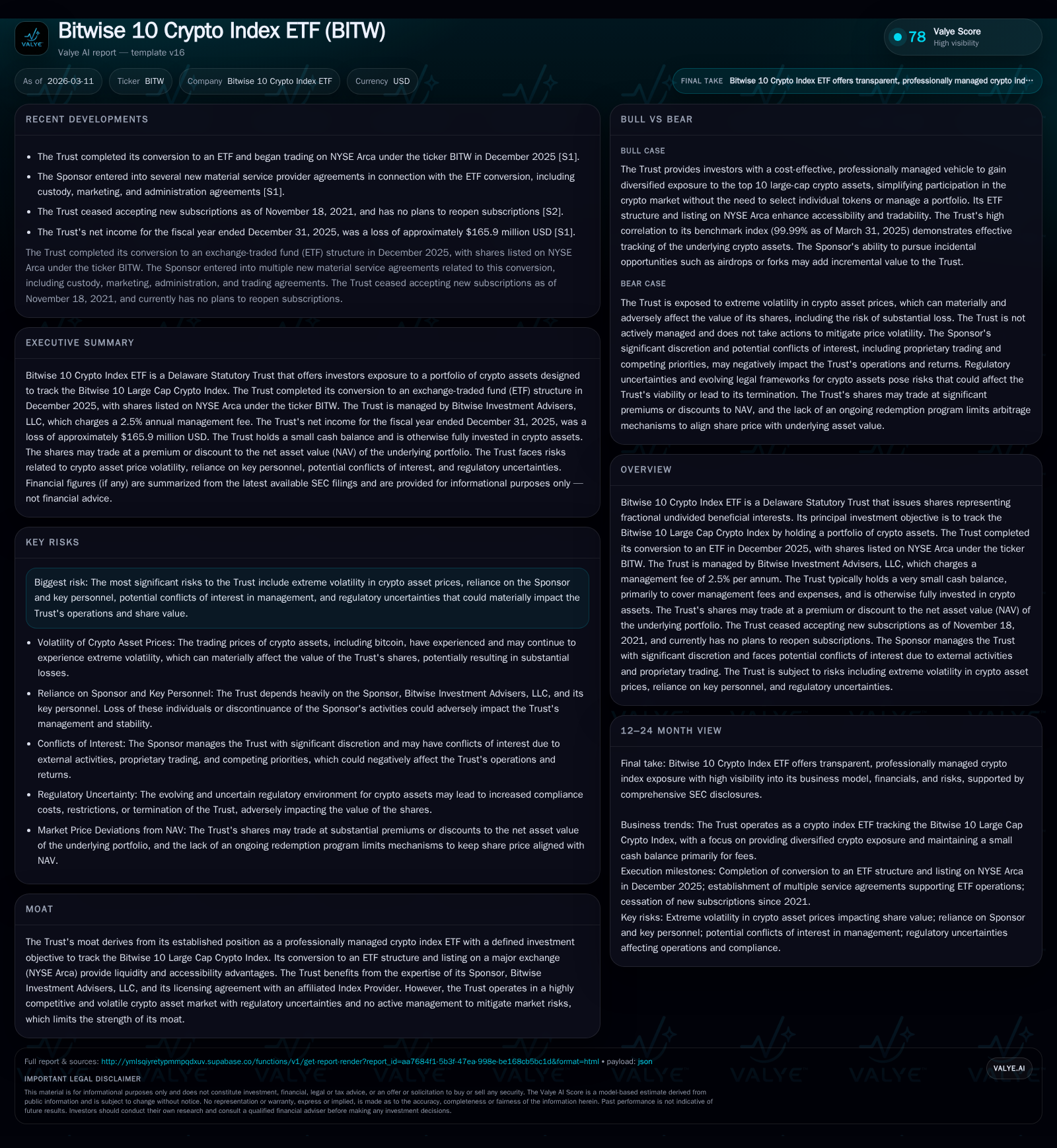
Bitwise 10 Crypto Index ETF’s transition to an ETF format in late 2025 coincided with a sharp swing from profitability to net loss amid crypto market volatility and regulatory flux.
The Bitwise 10 Crypto Index ETF experienced a pronounced reversal in financial performance in 2025, shifting from a profitable run to a substantial loss primarily driven by steep declines in crypto asset valuations. Its December 2025 conversion from a trust to an exchange-traded fund brought structural benefits but also reflected continued challenges related to limited subscription capacity and persistent regulatory ambiguity. Elevated management fees and minimal cash balances compounded pressures on returns. Going forward, the ETF’s prospects remain tightly coupled to crypto market dynamics and evolving regulatory frameworks, with limited near-term growth catalysts visible due to ongoing operational constraints.
Historical Performance and Revenue Drivers Through 2025
Bitwise 10 Crypto Index ETF demonstrated volatile financial results over the past four fiscal years as its portfolio value closely tracked the underlying Bitwise 10 Large Cap Crypto Index. From a significant net loss of $666 million in FY2022, the Trust rebounded sharply with net incomes of $393 million in FY2023 and $665 million in FY2024 before plunging back into negative territory with a net loss of $166 million in FY2025 [F1]. This dramatic earnings swing underscores the extreme sensitivity of the Trust's financial performance to fluctuations in cryptocurrency valuations.
Historical performance (annual)
| FY | Net ($mm) | Net YoY |
|---|---|---|
| 2025 | -166 | -125.0% |
| 2024 | 665 | +69.1% |
| 2023 | 393 | +159.0% |
| 2022 | -666 |
Source: SEC companyfacts cache [F1].
The shifting earnings primarily reflect realized gains/losses and changes in unrealized appreciation/depreciation of the portfolio crypto assets. The Trust's investment objective is strictly passive — tracking the index — which means any broad sector downturn or uptick translates almost directly into returns. For example, the record gains of FY2023-24 aligned with robust crypto rallies during those periods while FY2025 losses correlated with broad declines exacerbated by episodic events such as the October flash crash.
Volatility and Regulatory Impact on Investment Returns
Cryptocurrency markets saw extraordinary turbulence through early to mid-2025. Notably, October witnessed an abrupt "flash crash" characterized by unprecedented liquidations exceeding $19 billion within about one day and a total market cap contraction of approximately 14% over several days [S2]. These sudden price swings pressured the fair value of the Trust’s underlying holdings, precipitating large unrealized depreciation.
Regulatory landscapes further amplified uncertainty and complexity for crypto asset products including BITW. The absence of definitive asset classification complicates compliance, as varied federal agencies like the SEC and CFTC assert overlapping jurisdiction with differing interpretations — e.g., Bitcoin generally treated as commodity but ongoing debates around Ether’s classification . Such regulatory flux imposes potential "Extraordinary Expenses" for compliance that can materially impact Trust costs and investor returns.
This complex environment inhibits active risk mitigation since BITW is passively managed; it does not strategically reposition assets during volatility spikes or regulatory shifts. Consequently, investors bear full exposure to market swings without offset from management interventions.
Structural Changes: Conversion to an ETF in December 2025
A key milestone was achieved on December 8, 2025 when Bitwise completed its conversion from a Delaware Statutory Trust into an exchange-traded fund listed on NYSE Arca under ticker BITW [S23]. This shift improved liquidity via continuous intraday trading on a major exchange and enhanced accessibility for institutional investors accustomed to ETF vehicles.
Despite this structural upgrade, the Fund retains limited flexibility as it ceased accepting new subscriptions since November 18, 2021, absent plans for reopening [S8]. The conversion involved entering multiple new service agreements spanning custody, administration, prime execution, marketing, and trade financing — reflecting typical complexities ETFs manage but also reinforcing operational overhead.
Passive indexing continues post-conversion with tight correlation (~99.99%) between portfolio holdings and benchmark index reported as recently as March 31, 2025 [S7]. However, without redemption mechanisms akin to open-end ETFs or active management capability, certain liquidity risks associated with crypto assets persist.
Share Price Dynamics vs NAV: Premiums and Discounts Explained
BITW shares have exhibited notable variance from their calculated NAV per share. From December 9, 2020 through March 31, 2025 shares traded at an average NAV discount of approximately 16.4%, reaching extremes between nearly +650% premium (Dec ’20) down to -68% discount (Dec ’22) [S18]. Factors contributing include:
- Lack of ongoing redemption facilities prevents arbitrageurs from exploiting pricing gaps.
- Regulation M restricts the issuer from reconciling NAV/market price discrepancies actively.
- Thin cash balances limit operational flexibility around NAV stabilization.
- Market sentiment-driven swings exacerbated by crypto volatility.
These dynamics mean investors can occasionally face significant divergence between share market prices and underlying asset values — an important consideration when entering or exiting positions.
Future Growth Prospects Amid Regulatory and Market Risks
The current closed subscription approach constrains assets under management expansion despite broader growth potential in cryptocurrencies as an asset class [S8]. Competition intensifies as multiple other spot Bitcoin and Ethereum ETFs approved by regulators enjoy easier flow dynamics.
Ongoing legislative efforts such as the Fit21 Act clarifying agency jurisdiction and the GENIUS Act regulating stablecoins may ultimately stabilize or reshape regulatory frameworks affecting BITW's operations substantially [S4]. However, pending bills like the CLARITY Act remain uncertain in Senate passage timing.
Without reopening subscriptions or developing ancillary products, organic growth will be limited until regulatory clarity improves sufficiently to unlock investor confidence or product innovation possibility.
Capital Deployment, Fee Structure, and Return Analysis
BITW operates with a notably high management fee rate of approximately 2.5% annually charged monthly based on net asset value [S21], exceeding typical equity ETF management fees reflecting complexities handling digital assets.
Cash reserves are minimal—often at just thousands of dollars—to avoid detracting from full investment coverage aside from amounts earmarked for fees/expenses [F1,S21]. This strategy reduces opportunity cost but also imposes liquidity constraints if urgent capital outflows arise.
There is no explicit reporting of dividends or buybacks; combined with negative net results in FY25 indicates challenges sustaining positive shareholder returns currently [F1], making capital efficiency dependent predominantly on crypto market performance rather than active measures.
Key Personnel and Sponsor Influence on Fund Stability
Trust reliance on Bitwise Investment Advisers LLC as Sponsor introduces concentration risk centered around key executives including Hunter Horsley et al., whose expertise underpins operational continuity [S2,S17].
Loss or departure could impair investment strategy deployment or administrative functioning substantially given no key man insurance coverage noted. Conflicts may arise where Sponsor’s interests overlap or diverge from those of shareholders due to expansive external commitments among personnel.
This governance structure necessitates investor awareness regarding operational fragility tied closely to sponsor leadership stability.
Risks Around Market Volatility, Regulation, and Operational Dependencies
BITW faces several material risks highlighted repeatedly:
- Cryptocurrencies' notorious extreme volatility imposes wide profit/loss swings including total loss scenarios ([S2],[S20]).
- Regulatory uncertainty remains acute with multiple federal agencies asserting authority resulting in variable compliance costs and threat of forced restructuring or termination (,).
- Operational risk tied to Sponsor discretion, staffing limitations, conflicts of interest potentially impacting fund management ([S19]).
- Absence of active management limits ability to mitigate downside exposure during adverse market events ([S7]).
- Potential classification changes turning portfolio assets into regulated securities may trigger extraordinary expenses or liquidity constraints ().
These factors collectively challenge stability and valuation predictability for shareholders within this emerging asset class vehicle framework.
Monitoring Metrics and Milestones Going Forward
Key indicators for ongoing scrutiny include:
- Trading premium/discount spread trends signaling market perception shifts around liquidity/value alignment.
- Movement in total crypto market capitalization influencing underlying asset values impacting NAV performance.
- Regulatory actions especially around Spot ETFs issuance rules or crypto classification legislative enactments altering operational parameters.
- Sponsor announcements about reopening subscriptions or index methodology adjustments indicating strategic shifts that could modify growth trajectory.
- Potential increases in extraordinary expenses related to escalating compliance requirements impacting operating results further.
Keeping abreast across these domains will illuminate evolving risk/reward characteristics presented by BITW moving beyond its volatile entry period post-conversion.
This analysis leverages publicly available filings up through early March 2026 without offering investment recommendations. Readers should consider inherent speculative facets tied to digital asset investments.
Disclaimer: This is research-only, informational analysis and not investment advice. It may include AI-generated interpretation and general industry context. Always verify important details using primary sources.

Comments