
Zevra Therapeutics’ 2025 Profitability Supported by MIPLYFFA Despite Operating Losses and Regulatory Challenges
Turning profitable in 2025, Zevra leverages orphan drug exclusivity and strategic partnerships while navigating complex regulatory and compliance risks.
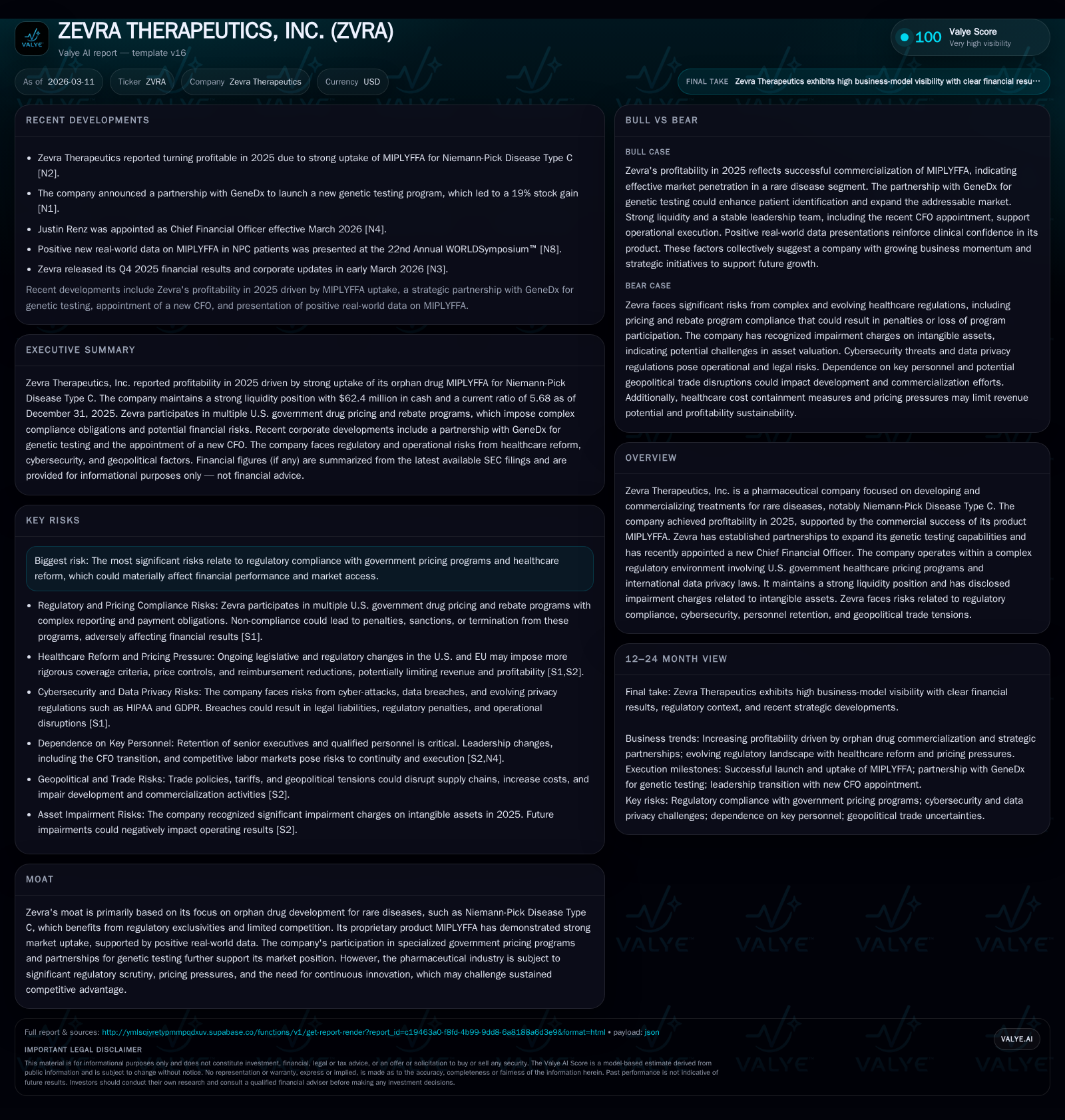
Zevra Therapeutics, Inc. secured a notable inflection point in 2025 with profitability driven primarily by strong market acceptance of its orphan drug MIPLYFFA for Niemann-Pick Disease Type C. However, operating losses persist amid significant non-cash impairment charges, and the company faces stringent U.S. government pricing regulations, data privacy demands, and geopolitical trade pressures that could impact future financial performance. With a strengthened liquidity position, a recent CFO appointment, and expanded genetic testing collaborations, Zevra’s growth outlook hinges on continued product uptake and successful navigation of evolving regulatory landscapes. Cash flows remain constrained, underscoring cautious capital deployment amidst industry headwinds.
Historical Performance and Growth Drivers
Zevra Therapeutics marked a pivotal transition in 2025 by achieving net profitability for the first time despite continuing operating losses exceeding $60 million (–$62.9 million) mainly from intangible asset impairments and operational costs as per its FY ending December 31, 2025 [F1]. This contrasts with net losses reported in prior years: –$105.5 million in 2024 through –$41.5 million in 2022 showing a trajectory of improving bottom-line metrics.
While precise revenue figures are undisclosed officially, management attributes this profit turnaround to strong commercial performance of MIPLYFFA®, their proprietary treatment targeting Niemann-Pick Disease Type C (NPC) — a rare genetic disorder [N9]. The orphan drug status confers regulatory exclusivities providing a competitive moat alongside positive real-world evidence presented at specialist symposia earlier in the year reinforcing product adoption trends [N10]. This niche focus limits direct competition but requires significant ongoing investment into clinical validation and market education.
The company’s balance sheet reflects enhanced liquidity post-profitability era with $62.4 million cash on hand and current assets at $223 million against liabilities of roughly $39 million, yielding a healthy current ratio of approximately 5.7x suggestive of solid short-term financial flexibility [F1]. Equity grew substantially to nearly $155 million from about $40 million the previous year revealing meaningful retained earnings accumulation or capital raises deployed effectively.
Historical performance (annual)
| FY | Net ($mm) | CFO ($mm) | OpInc ($mm) | Capex ($) | Net YoY |
|---|---|---|---|---|---|
| 2025 | 83 | -2 | -63 | 835000 | +178.9% |
| 2024 | -106 | -70 | -87 | 0 | -129.1% |
| 2023 | -46 | -34 | -50 | 296000 | -10.8% |
| 2022 | -42 | -19 | -43 | 93000 |
Source: SEC companyfacts cache [F1].
Capital returns and efficiency (annual)
| FY | Buybacks ($mm) | FCF ($mm) | ROE% |
|---|---|---|---|
| 2025 | -2 | 53.8 | |
| 2024 | 0 | -70 | -266.0 |
| 2023 | 3 | -34 | -74.4 |
| 2022 | 5 | -19 | -48.4 |
Source: SEC companyfacts cache [F1].
Table: Select annual financial metrics illustrating operating losses shrinking over time while net income turned positive in 2025.
Growth Prospects and Industry Positioning
Zevra’s future growth trajectory relies heavily on increasing penetration of MIPLYFFA within NPC patient populations globally coupled with expanding indications or related rare diseases leveraging similar therapeutic platforms. The company's recent partnership with GeneDx aims at enhancing genetic testing accessibility facilitating more timely diagnosis—fundamental to expanding the treatable patient pool—and reflects strategic extension beyond pure drug sales into adjacent diagnostics markets [N5].
Regulatory exclusivities granted under orphan drug pathways limit direct generic competition for periods typically up to seven years in the U.S., which affords Zevra some pricing power; however market access is tempered by pricing scrutiny from various government healthcare programs including Medicaid Drug Rebate Program (MDRP), Medicare Part B/D reimbursement policies introduced under legislation such as the Inflation Reduction Act (IRA), and EU Health Technology Assessments slated for phased application through 2030 [S1][S6][S25].
Ongoing healthcare reform presents layered complexity—while efforts incentivize innovation through exclusivities and expedited review pathways (e.g., orphan medicinal product designation), they concurrently increase demand for evidence-based pricing justifications underpinning reimbursement decisions affecting revenues. Zevra must maintain rigorous compliance reporting (AMPs and best price disclosures) under these frameworks to avoid costly penalties or program exclusions that could compromise federal funding eligibility for its products [S6][S9][S19].
Supply chain exposure due to heightened geopolitical trade tensions introduces risk regarding potential tariffs increasing production costs or disrupting raw material availability essential for manufacturing active pharmaceutical ingredients—a non-trivial factor given increasingly globalized biotech supply chains [S2][S27]. Furthermore international data privacy regimes impose expansive requirements on handling sensitive patient data collected during clinical trials or genetic testing services necessitating ongoing investments in cybersecurity protocols to mitigate breach risks that could erode trust or attract regulatory sanctions [S23][S26].
Forecasts and Milestones
Though Zevra has not publicly issued detailed forward guidance within provided reports or filings by early March 2026 [N1][S3], key milestones to monitor include:
- Expansion of MIPLYFFA approved indications beyond NPC.
- Progression or announcements related to pipeline candidates targeting additional rare diseases.
- Outcomes from the GeneDx collaboration on genetic test availability and adoption.
- Regulatory developments potentially impacting orphan drug market exclusivity duration or pricing formulas.
- Updates on real-world evidence dissemination supporting clinical benefits driving payer acceptance.
Investors should track quarterly sales trends post-2025 profitability announcement alongside any updates regarding legislative initiatives affecting U.S. Pharma reimbursement landscape.
Returns and Capital Allocation
Despite achieving net income gains in FY2025 ($83.2 million), operating income remains negative primarily due to impairment charges possibly linked to acquired intangibles or deferred development expenses [F1]. This divergence indicates non-operational accounting factors boosting net profits rather than core business margin expansion.
Operating cash flow remains negative but improved sharply year-over-year from –$69.7 million in FY2024 to –$1.6 million in FY2025 implying better working capital management or reduced discretionary spending though free cash flow was still slightly negative owing to modest capital expenditures (~$0.8M) invested likely into infrastructure or technology upgrades supporting research or commercial operations [F1].
Capital return programs remain dormant recently—no buybacks reported after modest repurchases totaling under $3.4 million over the past two years—pointing management’s prioritization toward reinvestment over shareholder distributions during this growth phase although future dividend initiation cannot be ruled out if operating profitability sustains [F1].
Return on equity stands near an estimated ~54% driven largely by improved earnings versus equity base growth but caution is warranted given the one-time effects influencing net income; sustainable ROE depends on translating revenues into positive operating margins eventually [F1].
Regulatory Compliance Risks
Zevra operates within highly regulated frameworks involving U.S government healthcare pricing programs like MDRP requiring precise monthly/quarterly reporting of average manufacturer price (AMP) and "best price" metrics essential for calculating rebates paid back to Medicaid programs. Non-compliance risks fines and exclusion from federal funding streams which are material components supporting commercial volumes especially for orphan drugs dispensed through government-covered beneficiaries [S1][S6][S11][S22].
Further scrutiny surrounds compliance with Public Health Service’s "340B drug pricing program" mandating ceiling prices charged to hospitals serving low-income populations—with specific exemptions applying to orphan drugs like MIPLYFFA but ongoing vigilance required due to evolving rules possibly narrowing exemptions or recalibrating rebates impacting revenue recognition [S14][S29].
Emerging state-level transparency laws increase obligations around price hikes disclosure potentially constraining pricing flexibility alongside expanding anti-fraud/enforcement activities focused on improper reporting implicating False Claims Act litigation risks requiring robust audit controls internally [S7][S10][S12][S21]. Cybersecurity remains another vector where failure to secure protected health information or personal data from breaches could invite regulatory investigations plus reputational damage negatively influencing patient/provider trust critical for sustained uptake of specialty therapies including genetic tests aligned with Zevra’s new offer sets [S23][N5],[S26].
Management Changes Driving Financial Discipline
Appointment of CFO Justin Renz signifies intentional strengthening of financial governance concomitant with scalability imperatives faced as Zevra transitions toward commercial maturity post-MIPLYFFA launch success [N6]. Effective capital stewardship is paramount given narrow free cash flows despite profitability emphasizing balancing investment against prudent liquidity maintenance given cyclical fund needs typical in bio-pharmaceutical companies focused on rare disorders.
Summary Analysis
Zevra Therapeutics has entered a crucial phase demonstrating through reported numbers a shift into profitability driven mainly by successful commercialization of MIPLYFFA targeting Niemann-Pick Disease Type C patients supported by orphan exclusivity protections and augmented diagnostic partnership expansions adding ecosystem value proposition.
Yet beneath headline profits operate lingering operational losses masked by impairments signaling ongoing cost structure challenges common across orphan drug developers striving towards sustainable margin profiles against stringent reimbursement climates increasingly shaped by political forces both domestically via Medicaid/Medicare reforms plus abroad through emerging common EU regulatory methodologies.
Adequate cash buffers alongside proactive leadership appointments provide basic foundations for navigating integration complexities inherent within biotech commercialization scaling but execution risks persist associated with regulatory compliance intricacies demanding strict adherence especially around complex drug rebate programs alongside cybersecurity safeguarding personal data across clinical/genetic domains vital to Zevra’s product lifecycles now spanning pharma plus diagnostics sectors.
Monitoring further quarterly updates focusing on revenue realization clarity alongside expanding indication dossiers will be crucial barometers assessing how effectively Zevra can convert early success into longer-term durable competitive advantages amidst evolving rarified pharmaceutical marketplaces offsetting macro regulatory headwinds observed industry-wide.
This report bases its analysis solely on publicly available data sources including SEC filings (10-K/10-Q/8-K), official press releases and Nasdaq reports without extrapolating unpublished figures or forward-looking projections beyond those explicitly disclosed. It does not constitute investment advice or recommendations.
Disclaimer: This is research-only, informational analysis and not investment advice. It may include AI-generated interpretation and general industry context. Always verify important details using primary sources.

Comments