
Codexis Advances Biocatalyst Leadership Amid Ongoing Investment and Cash Flow Challenges
Directed evolution technology fuels Codexis’s revenue growth, while operational risks and sustained investment drive ongoing losses.
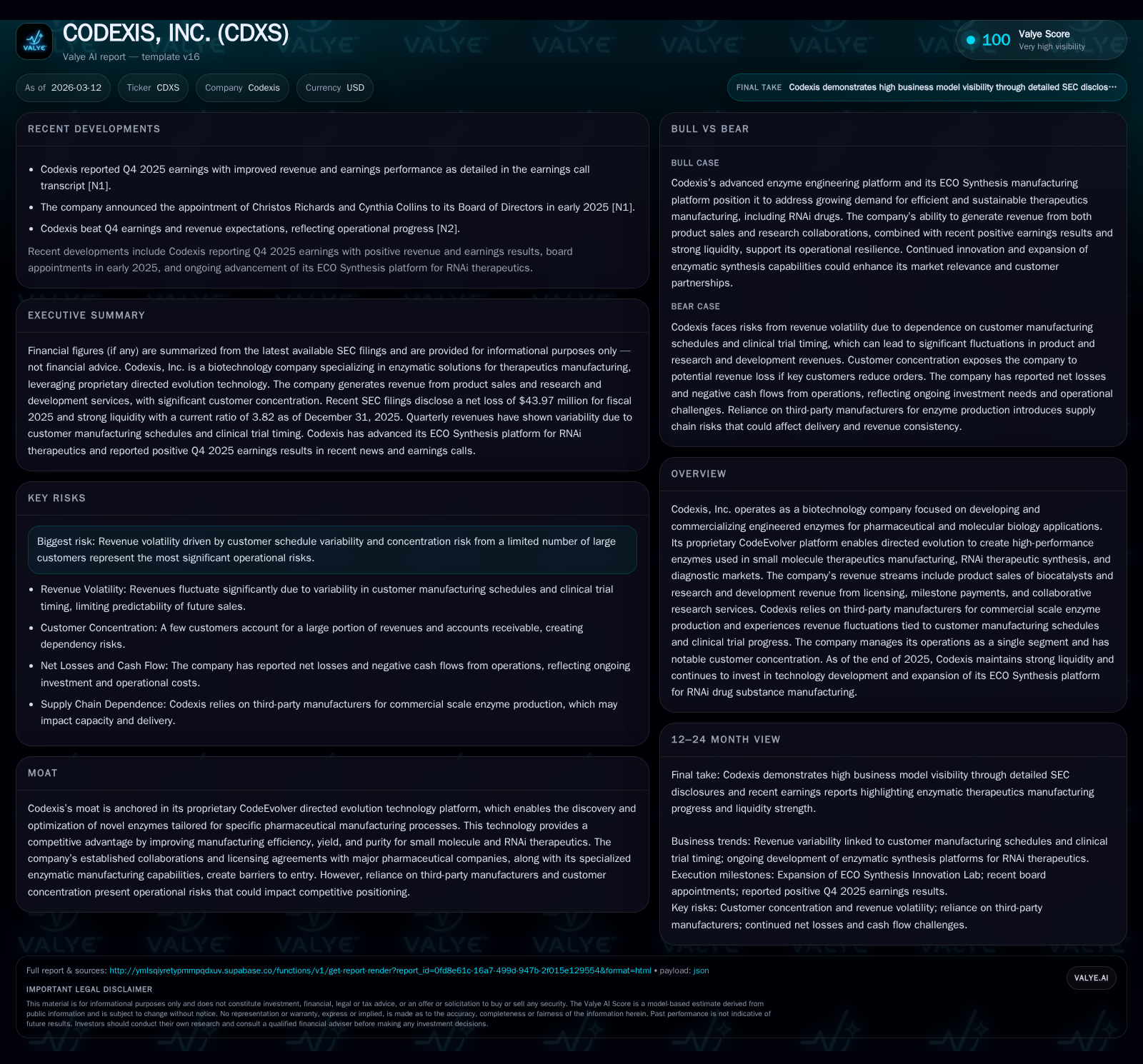
Codexis, Inc. has demonstrated strong revenue growth driven by its proprietary CodeEvolver platform, achieving a 32.3% increase in top-line revenue in FY2022 and continuing growth into FY2025. Despite this progress, the company remains unprofitable with operating losses narrowing from -$68.1 million in FY2023 to -$41.7 million in FY2025, reflecting continued heavy investment in R&D and strategic initiatives. The firm manages liquidity through a $40 million Innovatus term loan facility with milestone-linked drawdowns and maintains a robust current ratio near 3.8 at year-end 2025. Customer concentration and reliance on third-party enzyme manufacturing introduce revenue volatility and operational risks that investors should monitor alongside execution of enzymatic manufacturing scale-ups and collaboration milestones.
Sustained Revenue Growth Driven by Proprietary Enzyme Engineering
Codexis’s financial trajectory over recent years highlights robust growth powered by its CodeEvolver directed evolution platform, which enables the design of customized enzymes for pharmaceutical manufacturing applications. This technology underpins both biocatalyst product sales and collaborative research arrangements.
According to SEC XBRL company facts [F1], revenue increased from approximately $68.5 million in FY2019 to $138.6 million in FY2022, representing a compound growth trajectory. The company reported additional top-line expansion into FY2025 with an estimated year-over-year increase of 32.3% versus prior periods. This growth is driven by expanding demand for enzymatic catalysts used in small molecule drug synthesis and RNA interference (RNAi) therapeutic production.
Despite strong top-line momentum, Codexis remains unprofitable with operating losses narrowing from approximately -$68 million in FY2023 to -$41.7 million in FY2025 [F1]. The improvement reflects enhanced operational leverage combined with favorable product mix shifts toward higher-margin offerings and disciplined expense management despite increased investment in research innovation.
Historical performance (annual)
| FY | Net ($mm) | CFO ($mm) | OpInc ($mm) | Capex ($mm) | Net YoY |
|---|---|---|---|---|---|
| 2025 | -44 | -19 | -42 | 4 | +32.6% |
| 2024 | -65 | -49 | -59 | 4 | +14.4% |
| 2023 | -76 | -53 | -68 | 4 | -127.0% |
| 2022 | -34 | 11 | -35 | 8 |
Source: SEC companyfacts cache [F1].
Capital returns and efficiency (annual)
| FY | FCF ($mm) | ROE% |
|---|---|---|
| 2025 | -24 | -87.0 |
| 2024 | -54 | -97.5 |
| 2023 | -57 | -88.0 |
| 2022 | 3 | -23.2 |
Source: SEC companyfacts cache [F1].
Note: Financials for fiscal years 2023-2025 based on SEC filings reflecting ongoing operations [F1].
This table illustrates Codexis’s strong revenue gains alongside persistent but improving losses and negative operating cash flows.
Customer Concentration and Third-Party Manufacturing Risks
Codexis faces meaningful customer concentration risk; several large customers each accounted for over 30% of revenues during recent quarters ([S6], [S9], [S12]). For instance, one customer contributed about 34% of total revenues as of Q1 2025 [S6]. Such concentration exposes Codexis to fluctuations linked closely to individual customers’ clinical development timelines and purchasing patterns.
Additionally, the company relies exclusively on third-party contract manufacturers for commercial-scale enzyme production ([S21]). This outsourcing model introduces typical biotech supply chain challenges including dependency on manufacturers’ capacity constraints and process transferability issues that can impact timing of deliveries and revenue recognition.
Together these factors contribute to cyclical revenue patterns necessitating close monitoring by investors.
Recent Financial Performance: Improving Margins Amid Continued Losses
Q4 2025 results showed modest beats relative to expectations ([N1], [N2]), indicating steady execution progress.
Net income remained negative at approximately -$44 million for the full year ended December 31, 2025 [F1], consistent with the company’s ongoing focus on platform development and market expansion.
Operating losses narrowed notably thanks to better gross margins influenced by product mix changes favoring higher-margin products along with disciplined SG&A cost control ([S20]). Research & development expenses rose reflecting targeted investments in enzymatic innovation.
Innovation Focus and Market Opportunities
Codexis’s core innovation centers around its CodeEvolver platform engineering enzymes tailored for pharmaceutical applications including small molecule synthesis and RNAi therapeutic manufacture ([S21]).
These enzymatic catalysts offer advantages such as enhanced substrate specificity and improved process yields compared to traditional chemical methods — reducing impurities important for regulatory compliance.
The company is advancing its ECO Synthesis platform towards GMP-grade RNAi drug substance production through partnerships with large contract development manufacturing organizations (CDMOs), targeting scalable enzymatic manufacturing solutions ([S21]).
Expansion into diagnostic enzyme markets further diversifies end-use opportunities.
Capital Allocation and Liquidity Position
At year-end 2025 Codexis held approximately $50.8 million in cash and equivalents with total current assets of $96.8 million against current liabilities of $25.3 million — yielding a strong current ratio near 3.8 ([F1]).
Liquidity is bolstered by a five-year term loan facility up to $40 million from Innovatus Life Sciences Lending Fund I LP structured in two tranches: an initial $30 million funded early 2024 plus a second $10 million tranche drawn upon achieving certain revenue milestones by mid-2025 ([S6]–[S8]).
The loan carries an interest-only period through February 1, 2027 or potentially extended through February 1, 2028 upon meeting financial covenants ([S8]). Principal repayments commence thereafter ([S7], [S16]), supporting near-term liquidity while funding continued innovation.
Approximate return on equity stood near -87% at the end of fiscal year 2025 given net losses relative to equity totaling about $50.5 million ([F1]). This reflects the company's reinvestment phase prioritizing long-term growth over short-term profitability.
Key Investor Considerations Going Forward
While explicit forward guidance is limited publicly, investors should monitor:
- Achievement of milestone payments under collaboration agreements linked to partner clinical progress ([S4]);
- Execution of GMP-grade siRNA manufacturing scale-up via ECO Synthesis platform partnerships ([S21]);
- Efforts toward diversifying customer base to reduce concentration risk;
- Continued operating expense discipline supporting margin improvements;
- Management of supply chain dependencies inherent in outsourced enzyme production.
Given typical biotech uncertainties around clinical timelines impacting enzyme demand visibility these factors represent important watchpoints rather than precise forecasts.
Conclusion: Balancing Growth Potential With Operational Risks
Codexis combines proprietary directed evolution technology driving biocatalyst market expansion with ongoing investments fueling innovation pipelines aligned with pharmaceutical industry needs.
Robust liquidity supported by milestone-linked debt financing provides runway amid persistent operating losses.
However significant customer concentration coupled with third-party manufacturing dependencies injects revenue volatility requiring active management.
This analysis synthesizes public financial data alongside qualitative disclosures describing Codexis’ positioning without making investment recommendations.
Disclaimer: This is research-only, informational analysis and not investment advice. It may include AI-generated interpretation and general industry context. Always verify important details using primary sources.

Comments