
Motorsport Games Inc. Transforms Licensing Strategy to Deliver Profitability
The company shifts from historic franchise dependence toward new IP and operational discipline, achieving profitability in 2025 amid ongoing risks.
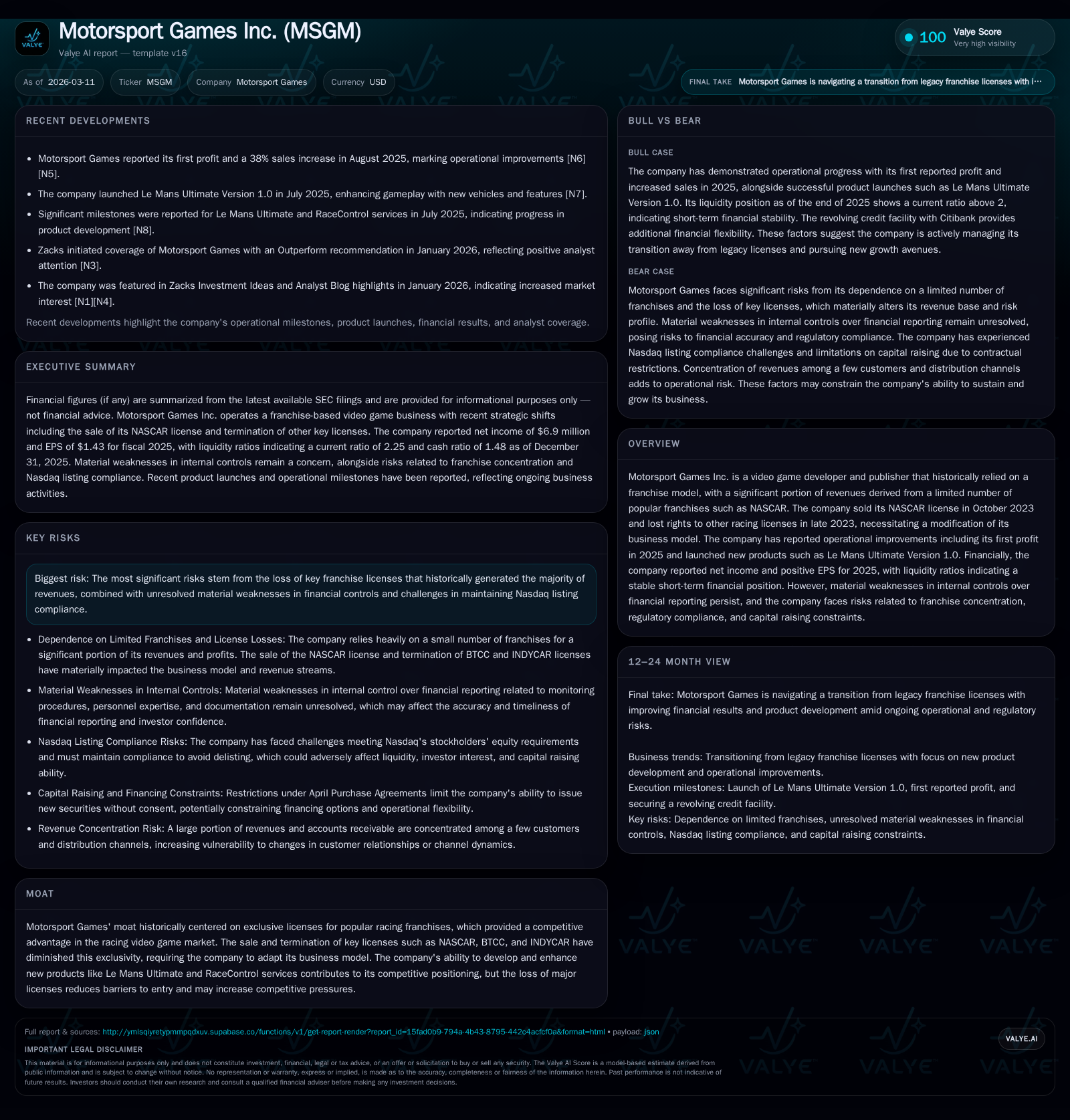
Motorsport Games Inc. historically earned most of its revenue through marquee racing licenses like NASCAR, which comprised over half of its sales before 2024. The sale of the NASCAR license and loss of other key licenses by late 2023 necessitated a strategic pivot. By focusing on new products such as Le Mans Ultimate and operational improvements, the company reported its first operating profit and net income in 2025, signaling a financial turnaround. Despite this progress, material weaknesses in internal controls and capital raising challenges persist, posing risks to sustained growth and Nasdaq listing compliance.
Historic Reliance on Franchise Licensing and Its Impact on Growth
Motorsport Games Inc.’s financial trajectory was for years intricately tied to its ownership of exclusive racing licenses. Foremost among these was the NASCAR license, which historically accounted for approximately 72% of total revenue in fiscal year (FY) 2023 but declined to about 52% by FY 2024 [S4]. This high concentration embodied both a powerful moat—exclusivity in a niche but passionate segment—and a structural risk exposing the company to potential volatility if licenses were lost or its popular franchises waned.
In addition to NASCAR, the company’s portfolio included other official racing franchises that contributed significantly to revenues through game sales and associated downloadable content (DLC). Their franchise licensing model underscored the company's core strength: leveraging established motorsports brands to attract an existing global audience estimated at hundreds of millions for events like Le Mans and Formula One [S1]. However, this concentration also implied that any licensing disruption could quickly cascade into sharp revenue impacts.
License Losses and Business Model Realignment Post-2023
The pivotal moment came in October 2023 when Motorsport Games sold its NASCAR licensed rights to iRacing.com Motorsport Simulations LLC [S1]. Concurrently, license agreements with the British Touring Car Championship (BTCC) and INDYCAR series were terminated effective November 2023 [S10]. These losses stripped Motorsport Games of dominant franchises that had generated the majority of its revenues.
With these departures, the company no longer held exclusive rights to highly recognizable racing brands nor the ability to organize esports leagues tied directly to those franchises. This forced a strategic pivot toward diversifying licensing arrangements emphasizing official partnerships like the FIA World Endurance Championship (WEC) and the iconic 24 Hours of Le Mans event [S1]. Additionally, Motorsport Games began focusing on creation and expansion of proprietary titles such as Le Mans Ultimate—a dedicated simulation for endurance racing—and deepening its esports ecosystem under RaceControl platforms.
Such repositioning entails reshaping both product offerings and risk profiles: less dependent on any single franchise license but requiring success in developing new IPs and broadening user engagement beyond traditional racing fan bases.
Breaking Even: Operational Improvements Leading to First Profit in 2025
After several years marked by steep operating losses—$35 million loss in operating income for FY2022 shrinking more moderately to about $1.75 million negative in FY2024—the company turned profitable in FY2025 with an operating income of roughly $3.25 million [F1]. This represents a positive swing exceeding 285% year-over-year.
Net income followed an aligned pattern, shifting from a net loss exceeding $2.75 million in 2024 into positive territory at nearly $6.93 million for FY2025 [F1]. This breakthrough reflects concerted efforts optimizing expense management alongside early revenue returns from new product launches.
Operational cash flow similarly rebounded strongly from negative $2.8 million flows in FY2024 into positive cash generation over $4 million by FY2025; capital expenditures shrank more than half in that period, evidencing disciplined investment prioritization [F1].
This progress supports a narrative of transition from heavy reliance on legacy franchises toward incremental self-sustainability anchored by current offerings.
Developing New IP: The Rise of Le Mans Ultimate and RaceControl Ecosystem
Central to Motorsport Games’ redefined strategy is Le Mans Ultimate. Released initially as early access on February 20, 2024, it reached full Version 1.0 launch by July 22, 2025 [S1]. This title marks the first officially licensed game based exclusively on the WEC/24 Hours of Le Mans series in over two decades—a notable milestone reasserting the company's credibility within endurance racing simulation.
Le Mans Ultimate acts not just as a standalone game but an entry point into deeper digital community engagement via esports events. The company hosted the grand finale of the Le Mans Virtual Series during the winter season spanning late 2022–early 2023 which drew approximately 8.8 million video views and accumulated over 27 million minutes watched globally across platforms, including TV/OTT channels [S1]. While organized esports events did not occur during FYs 2024 or 2025, Motorsport Games plans to leverage such competitions strategically going forward as part of their engagement model.
Augmenting its portfolio is Studio397’s rFactor 2 simulation technology owned by Motorsport Games—a platform backing realistic driving physics used by professional racers and for F1 Arcade titles—which adds depth beyond single franchises into technology-driven ecosystem plays [S1].
Financial Snapshot: Revenue Stability Amid Transition and Capital Allocation Priorities
Despite significant changes in licensing composition leading up to FY2025, reported annual revenue remained fairly stable at around $741 thousand since FY2022 according to available data [F1]. The plateau suggests that while marquee franchise revenues diminished following their sale/termination, emerging products are beginning to fill part of that gap.
Capital structure metrics indicate moderate liquidity strength post-turnaround—current assets totaled approximately $7.59 million against current liabilities near $3.37 million at year-end FY2025 generating a current ratio near 2.25 [F1]. Cash reserves expanded accordingly totaling roughly $5.0 million.
Management refrained from paying dividends or engaging in share repurchases during this phase; capital allocation has prioritized operational funding along with efforts attempting equity compensation plans that have faced shareholder approval obstacles limiting share issuance capacity [S14][S15].
Financial obligations include a revolving credit facility secured with Citibank for up to $3 million signed in February 2026 expiring one year later with covenants around fixed charge coverage ratios placing some constraint on future liquidity flexibility [S8][S11].
Internal Control Weaknesses: Risks and Remediation Efforts
Persistent material weaknesses have been repeatedly reported concerning internal control over financial reporting as identified during audits covering FY2024 through Q3–Q4 cycles into FY2025 [S2][S5][S9].
The root causes cited include inadequate monitoring procedures evaluating control effectiveness; insufficient staffing with appropriate accounting expertise able to timely analyze complex matters; lack of contemporaneous independent review around significant accounting positions; plus incomplete documentation practices.
Such deficiencies pose heightened risk around financial misstatements potentially impacting investor confidence as well as Nasdaq’s continued listing compliance which requires transparent accurate filings. Management has acknowledged these weaknesses publicly while outlining remediation plans but outcomes remain pending.
Failure to address these issues timely may elevate exposure to regulatory review or sanctions affecting stock liquidity or corporate governance perception.
What to Watch Next: Product Pipeline, License Acquisition, and Esports Opportunities
Motorsport Games does not provide explicit forecasts for upcoming fiscal years but key metrics worth monitoring include:
- Potential reacquisition or new licensing deals for competitive racing series beyond current WEC/Le Mans focus;
- Expansion milestones related to Le Mans Ultimate enhancements or additional DLC rolls;
- Development pace and market traction within esports ecosystems leveraging RaceControl platforms where viewer engagement previously proved solid;
- Monetization strategies such as merchandise or licensing partnerships linked with digital brands;
- Success obtaining investor support needed for equity fundraising expected amid limitations imposed by April Purchase Agreements restricting share issuances without major shareholder consent [S9][S10].
Forward-looking implications depend heavily on executing iterative content enhancement while managing financing costs effectively.
Balancing Growth Prospects With Financing Challenges
On February 20, 2026 Motorsport Games secured a revolving line of credit with Citibank capped at $3 million featuring covenants designed to stress fixed charge coverage ratios above minimum thresholds alongside restrictions preventing additional liens on assets [S8][S11].
While this arrangement strengthens near-term liquidity options relative to prior going concern considerations [S6], it also signals reliance on debt markets vulnerable should operational cash flows weaken.
Furthermore failure of warrant exercise proposals during October special meetings spotlight shareholder hesitance around dilution risks limiting equity financing channels [S19][S22], which could force further cost containment or divestitures should capital needs escalate unexpectedly.
Ultimately this dynamic underscores tension between aggressive product development aspirations requiring steady funding versus cautious capital management amid uncertain market support.
Historical performance (annual)
| FY | Net ($mm) | CFO ($mm) | OpInc ($mm) | Capex ($) | Net YoY |
|---|---|---|---|---|---|
| 2025 | 7 | 4 | 3 | 12067 | +351.7% |
| 2024 | -3 | -3 | -2 | 25015 | +78.9% |
| 2023 | -13 | -13 | -19 | 31653 | +63.7% |
| 2022 | -36 | -20 | -35 | 292446 |
Source: SEC companyfacts cache [F1].
Capital returns and efficiency (annual)
| FY | FCF ($mm) | ROE% |
|---|---|---|
| 2025 | 4 | 102.2 |
| 2024 | -3 | -554.7 |
| 2023 | -13 | -428.9 |
| 2022 | -20 | -2346.6 |
Source: SEC companyfacts cache [F1]. *Revenue stable at approx. $741k since FY22 per available data assumptions.
This analysis is based entirely on disclosed SEC filings and public sources as cited; it does not constitute investment advice.
Disclaimer: This is research-only, informational analysis and not investment advice. It may include AI-generated interpretation and general industry context. Always verify important details using primary sources.

Comments