
Core Molding Technologies Navigates Market Cyclicality and Customer Transitions Impacting 2025 Performance
Core Molding Technologies faces headwinds from reduced truck market demand and customer program transitions while investing in capacity expansion in Mexico.
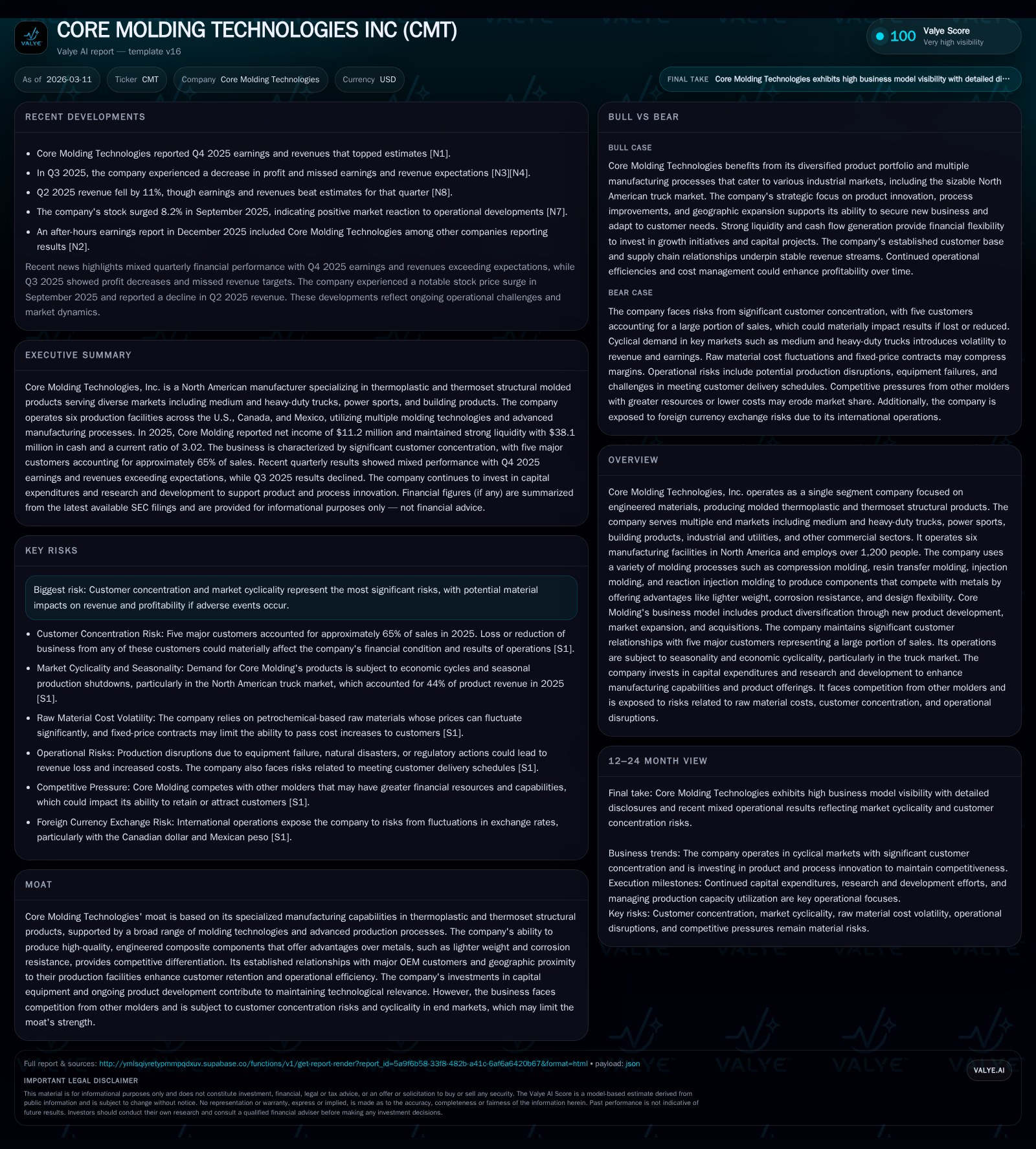
Core Molding Technologies, Inc., a North American molder of engineered thermoplastic and thermoset products, reported a 9% revenue decline to $273.8 million in 2025, driven by lower sales in its largest market—medium and heavy-duty trucks—and the transition of Volvo programs. Operating income improved over threefold to $3.6 million, supported by pricing actions and cost efficiencies, despite a 45% decline in operating cash flow due to working capital build. The company is investing $18–20 million in expanding Mexican manufacturing capacity in 2026, with expected one-time SG&A costs of about $2.5 million early in the year. Management forecasts modest revenue growth of up to 5% in 2026 with stronger second half performance amid ongoing program launches. Significant customer concentration and cyclical demand remain key risks.
Company Overview
Core Molding Technologies, Inc. operates as a single reporting segment specializing in engineered thermoplastic and thermoset structural products using compression molding, resin transfer molding, injection molding, and reaction injection molding processes. Its product portfolio serves diverse markets including medium and heavy-duty trucks—the largest segment—power sports, building products, industrial/utilities, and other commercial applications [S1].
Headquartered in Columbus, Ohio, Core Molding runs six manufacturing facilities across the U.S., Canada, and Mexico employing over 1,200 staff. Its molded components offer advantages over metals such as lighter weight, corrosion resistance, design flexibility, part consolidation potential, dent resistance, and competitive cost structures [S1].
Historical Financial Performance
For fiscal year ended December 31, 2025, Core Molding reported net sales of approximately $273.8 million compared with $302.4 million in 2024—a decline of about 9%. Tooling project revenues contributed significantly more in 2025 ($41.6 million) than the prior year ($11.3 million), which are sporadic by nature. Excluding tooling sales, product revenues dropped approximately 20% to $232.2 million from $291.1 million primarily reflecting reduced demand from medium and heavy-duty trucks and power sports segments along with the winding down of Volvo programs not supported under new contracts starting mid-2024 through continuing transitions into 2026 [S1][F1].
Historical performance (annual)
| FY | Net ($mm) | CFO ($mm) | OpInc ($mm) | Capex ($mm) |
|---|---|---|---|---|
| 2025 | 3 | 19 | 4 | 17 |
| 2023 | 0 | 35 | 1 | 12 |
| 2021 | 5 | 19 | 3 | 17 |
| 2020 | 28 | 4 |
Source: SEC companyfacts cache [F1].
Capital returns and efficiency (annual)
| FY | Buybacks ($mm) | FCF ($mm) | ROE% |
|---|---|---|---|
| 2025 | 3 | 2 | 1.9 |
| 2023 | 3 | 24 | -0.0 |
| 2021 | 0 | 2 | 4.2 |
| 2020 | 0 | 24 |
Source: SEC companyfacts cache [F1].
Gross margin remained relatively stable at approximately 17.4% versus 17.6% a year prior despite an unfavorable product mix impact estimated at about one percentage point; this was partially offset by pricing actions and raw material cost pass-through mechanisms embedded in many contracts [S15][F1].
Operating income rose significantly by over threefold to approximately $3.6 million from roughly $0.9 million the prior year as fixed cost leverage improved amid volume declines alongside pricing benefits and operational efficiencies [F1]. Net income reversed prior slight losses reaching about $3.08 million for the year [F1].
Operating cash flow declined approximately 45%, totaling around $19.2 million primarily due to working capital increases related to inventory build as sales softened during the period [F1][S16]. Capital expenditures increased notably to nearly $17.3 million reflecting investments including capacity expansion projects such as the Mexico facility upgrade [F1][S6]. Returns on equity were modest at roughly 2%, based on net income relative to shareholders' equity near $158 million at year-end [F1].
Business Drivers and Risks
Core Molding's performance remains heavily influenced by cyclicality within its primary markets—particularly medium/heavy-duty trucks which represented about 44% of product revenues in fiscal year 2025—and is subject to fluctuations tied closely to macroeconomic factors such as freight demand linked to economic activity levels; regulatory changes affecting emissions standards requiring OEM adaptation; interest rates impacting fleet capital spending; tariffs influencing supply chain costs; fuel price volatility affecting transportation economics; plus seasonal shutdowns common among OEMs leading to typical third- and fourth-quarter demand dips [S10][S20].
The company faces substantial customer concentration risk: five customers accounted for approximately two-thirds of total sales including BRP (powersports), PACCAR (trucks), International Motors LLC (medium/heavy trucks), Yamaha (powersports), and Volvo Group North America (trucks). Accounts receivable exposure similarly reflects this concentration profile [S20][S13]. The ongoing decline in Volvo-related business introduces uncertainty regarding revenue replacement.
Input cost volatility—especially raw material inflation exacerbated by geopolitical tensions such as those involving Iran—remains a challenge but is mitigated somewhat through contractual price adjustment clauses allowing pass-through of material cost changes to customers [S15][S22].
Manufacturing efficiency is critical given fixed overhead costs inherent in molding operations that utilize a large installed press base across six facilities with presses ranging from approximately 250 to 5,500 tons tonnage distributed between U.S., Canadian, and Mexican plants [S12]. New program launches require significant upfront tooling development leading to initial start-up inefficiencies impacting margins until process stabilization occurs over time.
Competition is intense with notable players such as Molded Fiber Glass Companies, CSP Industries, Ashley Industrial Molding among others offering similar composite solutions limiting pricing flexibility as OEMs exert downward pricing pressure while demanding quality improvements necessitating continuous investment into technology enhancements and close customer collaboration throughout development cycles [S14].
Risks also include intellectual property protection challenges given proprietary composite formulations requiring trade secret safeguarding alongside potential product liability exposure intrinsic to automotive safety components necessitating comprehensive insurance coverage though gaps may exist [S21]. Environmental regulations targeting climate change could increase energy-related manufacturing costs indirectly pressuring profitability via OEM price sensitivity.
Growth Outlook
Management anticipates revenues for calendar year 2026 will grow modestly between flat and +5% compared with fiscal 2025 driven mainly by new program launches underway combined with price increases balanced against continuing cyclical headwinds especially within the truck segment as Volvo transition effects normalize post ramp-down phase.
The company expects stronger second half performance relative to first half due partly to seasonality plus temporary disruptions associated with Mexico facility expansion including an estimated $2.5 million of incremental one-time SG&A expenses primarily related to press relocations plus overlapping leases during transition periods along with approximately $1 million related to succession planning initiatives incurred predominantly early in H1/2026 [S22][S1].
Execution risks remain around converting new program awards into volume while achieving targeted manufacturing efficiency gains necessary for sustaining competitive gross margins amid shrinking legacy product volumes or reduced customer reliance amplifying fixed cost absorption challenges.
Efforts continue toward market diversification beyond core truck/powersports verticals including expanded penetration into building products or industrial components offering incremental upside if successful alongside potential bolt-on acquisitions consistent with Core’s engineered materials expertise although integration complexities may affect operational focus temporarily [S13].
Capital Allocation & Liquidity Profile
Core Molding maintains solid liquidity supported by cash balances near $38 million complemented by revolving credit facilities aggregating up to $50 million providing financial flexibility for strategic investments plus buffers against unforeseen events amid economic uncertainty [F1][S6].
During fiscal 2025 the company repurchased approximately $3.2 million of treasury stock reflecting shareholder return initiatives balanced against capital-intensive growth investments including nearly $17 million deployed toward property plant equipment focused on capacity expansion projects such as Mexican operations ramp-up [F1][S28].
Long-term debt totaled approximately $19.8 million primarily under the Huntington Credit Agreement amortizing through July 2027 supported by interest rate swaps hedging variable rate exposure preserving manageable financing costs near mid-5% range consistent with recent benchmark rates while maintaining covenant compliance assuring continued access barring material adverse financial deviations .
No dividends have been paid since at least fiscal years prior to 2019 indicating reinvestment preference aligned with growth objectives amid inherent cyclicality within served markets suggesting dividend policy remains dormant pending normalized profitability trends.
Milestones & Monitoring Points
Key areas for investors’ attention include:
- Progression and stabilization of Mexico manufacturing facility expansion including integration outcomes post press relocation and lease overlap phases.
- Success replacing lost Volvo volume via new program wins or alternative customer expansions clarifying future revenue stability.
- Raw material inflation trends relative to contractual pass-through effectiveness impacting earnings quality.
- Execution capabilities on new program launches achieving gross margin targets amid startup inefficiencies.
- Order patterns signaling commercial vehicle market cyclicality effects on demand normalization or deterioration.
- Operating leverage dynamics translating top-line changes into operating income shifts demonstrating management’s cost discipline.
- Capital expenditure stewardship balancing growth enablement against free cash flow sustainability.
- Competitive landscape developments affecting pricing power or technology adoption altering Core’s market positioning.
- Regulatory impacts tied to environmental laws influencing input costs or necessitating manufacturing process modifications elevating expenses.
- Continuous evaluation of customer credit quality mitigating bad debt risks important given concentrated customer base.
This analysis is based exclusively on publicly disclosed information without projecting investment recommendations or price targets.
Disclaimer: This is research-only, informational analysis and not investment advice. It may include AI-generated interpretation and general industry context. Always verify important details using primary sources.

Comments