
Cadre Holdings: Growth Momentum from Acquisitions and Recurring Demand
Cadre Holdings advances through targeted acquisitions, recurring equipment refresh cycles, and disciplined capital use in critical safety markets.
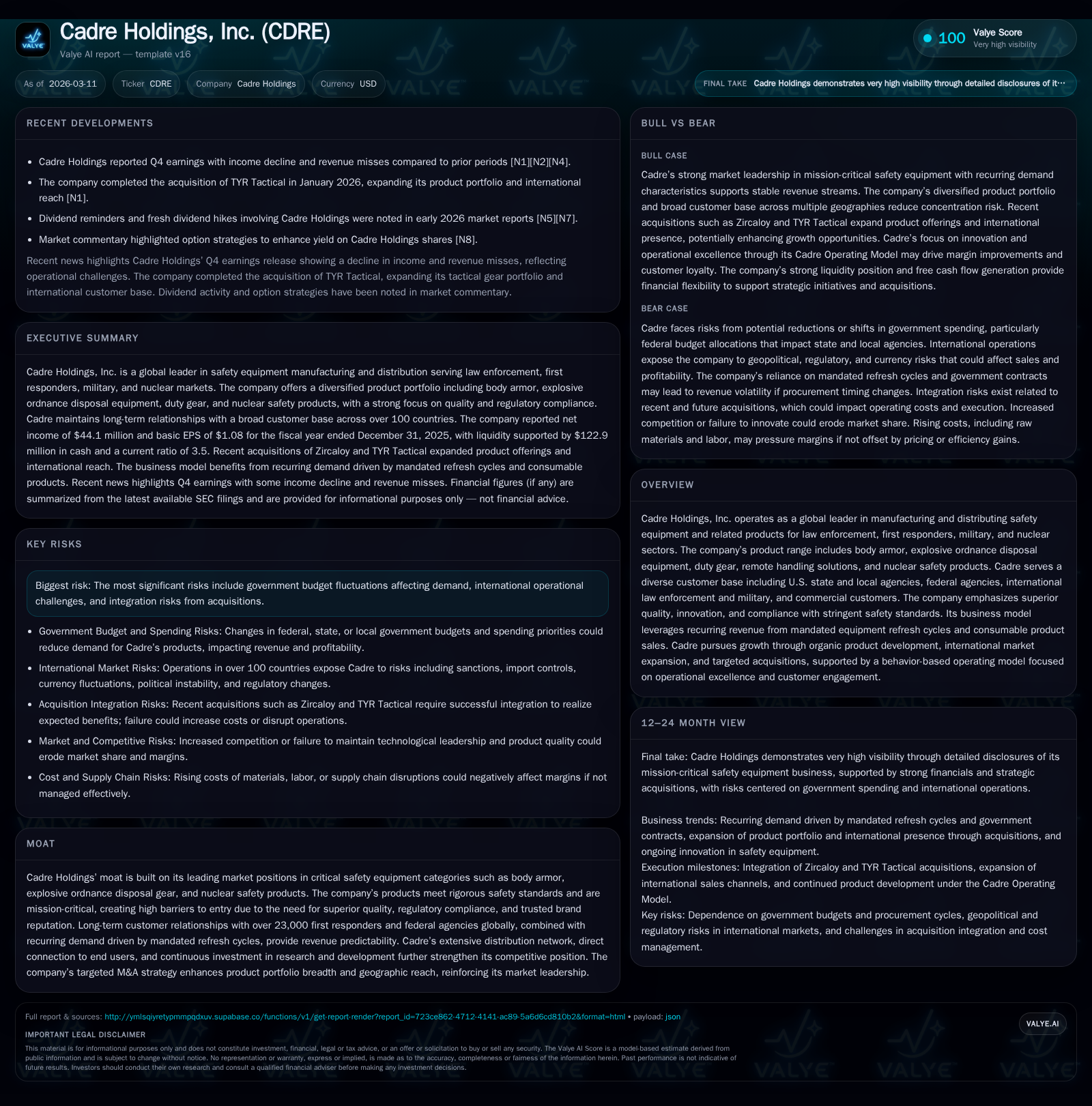
Cadre Holdings, a leader in manufacturing safety equipment for governmental and commercial markets, demonstrated solid financial growth in 2025 driven by strategic acquisitions and steady organic demand from mandated refresh cycles. The company expanded its portfolio with the Zircaloy and TYR Tactical acquisitions, adding $42.7 million to net sales year over year, particularly boosting duty gear revenues. Operating cash flow doubled, supporting these investments while maintaining a robust liquidity position. Risks include government budget variability and integration challenges, but Cadre’s market-leading positions and recurring revenue streams underpin stability in an evolving regulatory landscape.
From Organic Growth to Acquisition-Led Expansion: Tracing Cadre’s Financial Trajectory
Cadre Holdings has steadily built momentum through a combination of solid organic growth complemented by two significant acquisitions within the past year — Zircaloy ($98.9 million purchase in April 2025) and TYR Tactical ($174 million acquired January 2026) [S1][S2]. This strategy has been instrumental in expanding both product offerings and geographic reach.
Financially, net sales for the full year ended December 31, 2025 reached approximately $610.3 million, marking a $42.7 million (7.5%) increase from the prior year’s $567.6 million [F1]. This uptick largely stems from incremental revenues contributed by the new acquisitions alongside elevated demand for duty gear products domestically [S1]. Conversely, some legacy segments such as explosive ordnance disposal (EOD) equipment saw slight declines partially offsetting gains.
Profitability improved notably as net income grew to $44.1 million in 2025—up 22.2% versus $36.1 million in 2024—demonstrating operating leverage despite ramping SG&A expenses driven by integration costs, higher interest expense on increased debt levels, and stock-based compensation [F1][S1]. Operating income registered a modest 0.9% rise to $67.4 million from $66.8 million the prior year, reflecting tight margin management amid inflationary pressures.
Adjusted EBITDA increased by nearly $7 million year over year to about $111.7 million; this non-GAAP metric underscores enhanced operational performance fueled by scale efficiencies following recent M&A activity together with effectiveness of pricing strategies offsetting raw material cost inflation [S1][S18].
Decoding Market Drivers: Innovation Meets Regulation in Safety Equipment Demand
Cadre serves critical markets requiring compliance with rigorous regulatory standards spanning law enforcement, military explosive ordnance disposal specialists, first responders, and nuclear sectors with their specialized safety solutions [S1][S16].
A substantial portion of Cadre’s revenues are derived from recurring purchases driven by mandatory equipment refresh cycles typically ranging from five to ten years tied to body armor, duty gear, explosive ordnance disposal tools, and nuclear safety products—creating predictable demand patterns insulated from one-off project volatility [S1][S16].
Technology advancement is another underlying growth factor with continuous R&D investments enabling product innovation that enhances protection levels or operational ergonomics—a critical edge recognized by repeat governmental customers aiming to meet evolving threat profiles.
Strategic Footprint: Insights into Key Segments and Customer Concentration
Customer diversification remains a strategic strength for Cadre. Its client composition includes U.S. state and local agencies (domestic law enforcement departments including major cities), multiple federal government agencies (DoD branches including Army, Air Force), international law enforcement and military bodies extending across more than 100 countries, plus a commercial segment serving first responder direct-to-consumer channels [S4][S23].
No single customer accounted for more than 10% of total revenue last fiscal year mitigating direct revenue concentration risk albeit the company is exposed indirectly through government budget cycles affecting aggregate procurement funding [S23]. Bi-layered distribution networks incorporating third-party partners combined with owned distribution platforms amplify Cadre’s market penetration capabilities.
Near-Term Outlook: Navigating Demand Volatility and Post-Acquisition Integrations
Despite full-year gains in 2025, Q4 results fell short of Wall Street expectations on both top-line and earnings fronts due to softer-than-anticipated demand in certain categories coupled with ongoing acquisition integration costs tied predominantly to TYR Tactical and Zircaloy purchases finalized late last year/early this year respectively [N1][N2][S26].
Company guidance emphasizes cautious optimism balancing an expanded product portfolio against external headwinds such as fluctuating government procurement budgets amid national economic uncertainties. Backlog levels remain a useful indicator though municipal appropriations clauses introduce unpredictability acknowledging possible order deferrals or cancellations under budget cuts.
Management signals continued focus on operational synergies arising from acquisitions alongside penetrating underdeveloped international regions leveraging these expanded capabilities [S26].
Capital Deployment and Shareholder Returns: Assessing ROE, Cash Flows, Dividends, and Buybacks
Cadre demonstrates disciplined capital allocation highlighted by steady double-digit ROE approximating 13.9%, supported by efficient use of equity base that expanded moderately following the recent acquisitions priced above book multiples [F1].
Operating cash flow doubled markedly from about $31.8 million in 2024 to $63.7 million in 2025 reflecting robust profitability conversion supported by working capital improvements despite elevated debt servicing obligations accompanying M&A financing events.
Capital expenditures rose modestly (+21%) to nearly $6.9 million sustaining manufacturing capabilities essential for scalable production of high-complexity products requiring stringent quality controls [F1].
Dividend payments advanced steadily reaching approximately $15.4 million paid out during 2025 illustrating commitment to returning capital even amid growth investments; share buybacks have not been prominently disclosed signaling focus remains on balance sheet strength while absorbing recent acquisition costs [F1][S5][S7].
Operating Efficiency under Scrutiny: Cost Pressures and Margin Dynamics
Acquisition-related integration efforts drove notable increases in selling, general & administrative expenses (+34% YoY for Q3 alone) largely due to professional fees, payroll costs including stock comp programs enhancing retention incentives amid labor market competition [S18][S1].
Cost of goods sold rose commensurately with volume increases alongside inflationary headwinds impacting raw materials; however favorable pricing dynamics partially mitigated margin pressure as reflected in adjusted EBITDA enhancements.
Interest expense climbed consistent with higher debt levels used as acquisition funding sources; nonetheless coverage ratios remain compliant with restrictive covenants imposed by recent credit agreements ensuring financial discipline continuity [S7][S9].
Governance and Risk Factors: Managing Product Liability and Integration Challenges
Cadre operates within inherently high-risk safety equipment sectors where defective performance could lead to severe bodily injury or death; accordingly exposure includes pending litigation relating to product liability claims demanding vigilant quality assurance and comprehensive insurance coverage frameworks [S22].
Complexity inherent in integrating acquired companies poses execution risk involving cultural assimilation challenges along with systems harmonization necessary for sustaining operational synergies without disrupting customer service levels.
Regulatory compliance across multi-jurisdictional territories imposes ongoing administrative burdens including export controls particularly affecting international sales potential where authorization delays or restrictions can materially impair revenue streams [S22]. Concentrated ownership structure also limits external influence on corporate governance matters potentially influencing strategic decisions.
Key Performance Indicators Table: Revenue, Operating Income, Net Income, Cash Flow, Capex & YoY Changes
Historical performance (annual)
| FY | Net ($mm) | CFO ($mm) | OpInc ($mm) | Capex ($mm) | Net YoY |
|---|---|---|---|---|---|
| 2025 | 44 | 64 | 67 | 7 | +22.2% |
| 2024 | 36 | 32 | 67 | 6 | -6.5% |
| 2023 | 39 | 73 | 57 | 7 | +563.9% |
| 2022 | 6 | 46 | 17 | 4 |
Source: SEC companyfacts cache [F1].
Capital returns and efficiency (annual)
| FY | Div ($mm) | FCF ($mm) | ROE% |
|---|---|---|---|
| 2025 | 15 | 57 | 13.9 |
| 2024 | 14 | 26 | 11.6 |
| 2023 | 12 | 66 | 19.6 |
| 2022 | 12 | 42 | 3.5 |
Source: SEC companyfacts cache [F1]. (Note: All values rounded; CFO = Operating Cash Flow)
This analysis relies solely on publicly available filings as of March 11, 2026 including SEC reports (10-Ks/10-Qs), press releases discussing earnings results, company factual data extrapolated directly from XBRL instances ([F1]) as well as narrative excerpts ([S#], [N#]). Forward-looking commentary reflects company disclosures without speculative extrapolation beyond stated guidance or risks presented therein.
Investors are advised that while this report covers key operational metrics comprehensively, unforeseen macroeconomic changes or shifts in government spending priorities could materially affect future outcomes referenced here.
Disclaimer: This is research-only, informational analysis and not investment advice. It may include AI-generated interpretation and general industry context. Always verify important details using primary sources.

Comments