
Skye Bioscience’s Breakthrough Approach to CB1 Modulation and Clinical Challenges Ahead
Skye Bioscience develops nimacimab, a peripheral CB1 receptor-targeting antibody for obesity and metabolic disorders, while navigating significant financial and regulatory challenges in its clinical-stage development.
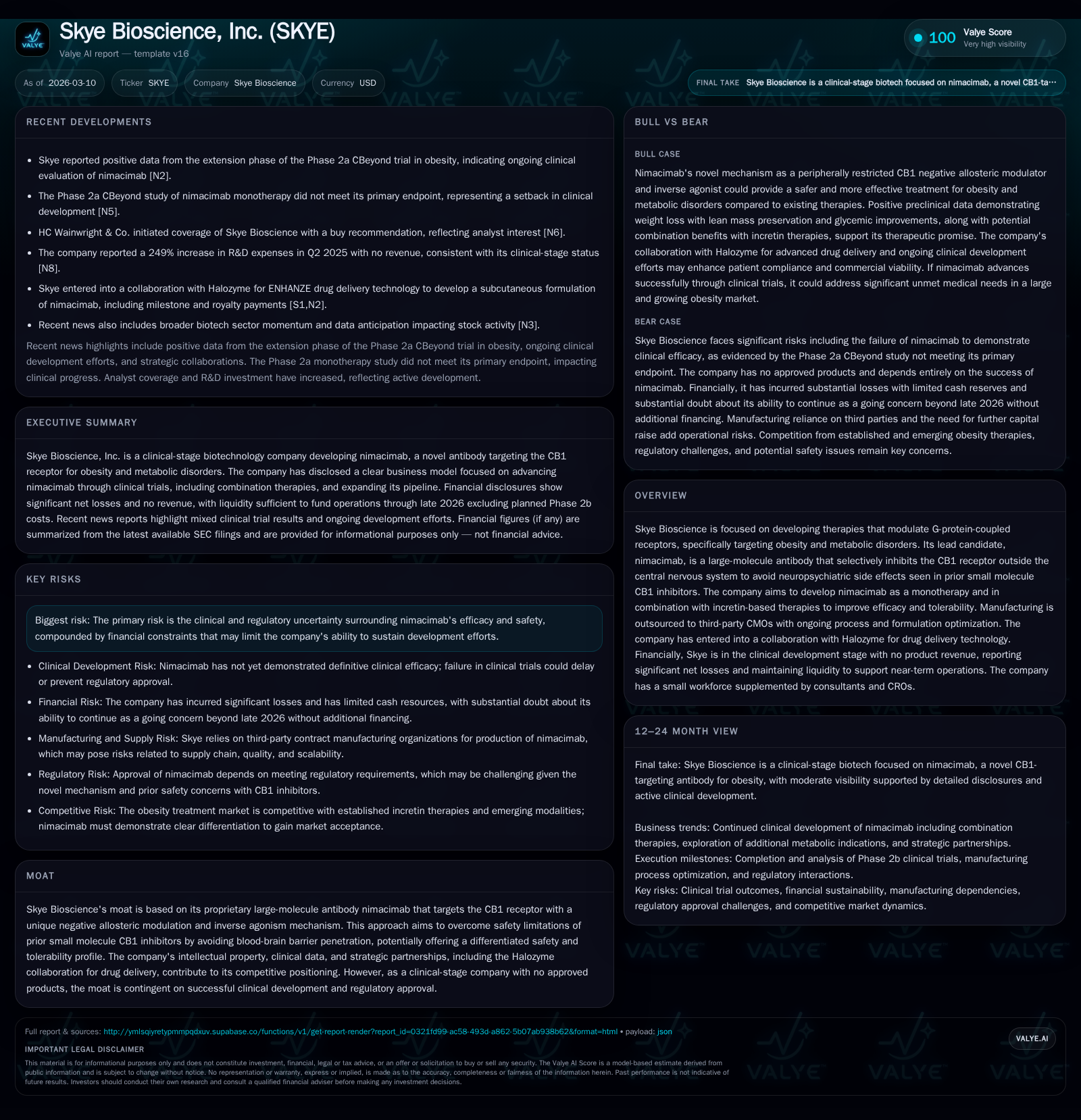
Skye Bioscience is advancing nimacimab, a novel antibody designed to selectively inhibit peripheral CB1 receptors implicated in metabolic dysfunction without CNS side effects. The company’s financials reflect substantial operating losses and cash burn typical of clinical-stage biotechs without product revenue, raising liquidity concerns. Recent positive Phase 2a trial data support nimacimab’s potential, but ongoing risks include regulatory hurdles and material litigation. Near-term success depends on clinical progress, capital raises, and managing legal exposures.
Skye’s Innovative Approach to Combatting Obesity via Peripheral CB1 Inhibition
Skye Bioscience is developing nimacimab, a humanized IgG4 antibody that targets the cannabinoid type 1 (CB1) receptor with peripheral restriction, aiming to avoid central nervous system side effects seen with prior small molecule CB1 inhibitors [S1][F1]. Nimacimab operates through negative allosteric modulation combined with inverse agonism to selectively inhibit peripheral CB1 receptors implicated in metabolic regulation and obesity-related inflammation.
Obesity is characterized by chronic energy surplus coupled with systemic inflammation and fibrosis in adipose tissue. Nimacimab's mechanism targets these pathways by modulating GPCR signaling relevant to metabolic disorders beyond obesity itself. The company is also exploring combination approaches pairing nimacimab with incretin-based therapies to enhance efficacy and tolerability [S1].
Financial Trends Reflect Intensified Clinical Development Focus
Skye's financial profile exhibits characteristics typical of early-stage biopharmaceutical companies engaged heavily in clinical research. Operating income declined from -$18.3 million in FY2022 to -$58.2 million in FY2025, reflecting increased trial costs and expansion efforts [F1]. Net income followed a similar trend, worsening from -$19.5 million to nearly -$56 million over the same period.
Operating cash flow deteriorated substantially, moving from approximately -$12.7 million in FY2022 to around -$43 million by FY2025, indicative of escalating development expenditures. Capital expenditures remain minimal (approximately $6K in FY2025), consistent with reliance on third-party contract manufacturing organizations (CMOs) [F1].
The company reported positive equity of about $20 million at year-end 2025 after prior deficits; however, return on equity remains deeply negative at an approximate -279%, highlighting absence of profitability or returns generation currently [F1].
Historical performance (annual)
| FY | Net ($mm) | CFO ($mm) | OpInc ($mm) | Capex ($) | Net YoY |
|---|---|---|---|---|---|
| 2025 | -56 | -43 | -58 | 6312 | -110.5% |
| 2024 | -27 | -25 | -30 | 1604027 | +29.4% |
| 2023 | -38 | -14 | -35 | 12550 | -93.2% |
| 2022 | -19 | -13 | -18 | 28060 |
Source: SEC companyfacts cache [F1].
Capital returns and efficiency (annual)
| FY | FCF ($mm) | ROE% |
|---|---|---|
| 2025 | -43 | -279.3 |
| 2024 | -27 | -39.0 |
| 2023 | -14 | 1765.9 |
| 2022 | -13 | 647.6 |
Source: SEC companyfacts cache [F1].
Operating losses expanded markedly due to increased late-stage clinical activities; capital expenditures are low owing to outsourced manufacturing.
Clinical Progress and Strategic Partnerships
In February 2026, Skye announced positive results from the extension phase of its Phase 2a CBeyond trial evaluating nimacimab for obesity treatment [N2]. These data provide preliminary evidence supporting efficacy potential alongside a favorable tolerability profile relative to previous CB1-targeting agents.
The company has also advanced a collaboration with Halozyme Therapeutics focused on proprietary drug delivery technology aimed at enhancing nimacimab's formulation stability and absorption characteristics—key factors for biologics targeting extracellular receptors involved in metabolic diseases [S1].
Management continues exploring combination regimens pairing nimacimab with incretin-based peptides to improve glucose control while minimizing adverse events associated with monotherapies.
Capital Structure and Liquidity Outlook
As of December 31, 2025, Skye held approximately $5.9 million in cash and equivalents supported by total current assets near $27 million against current liabilities around $8 million, yielding a current ratio of approximately 3.3 [F1]. However, the company's independent auditor has expressed substantial doubt regarding its ability to continue as a going concern beyond late 2026 without securing additional financing [S9][S18].
Management estimates available funds will sustain operations through the fourth quarter of 2026 excluding unbudgeted expenses related to anticipated Phase 2b studies or increased manufacturing supply commitments [S9]. Escalating operating cash outflows exceeding $43 million annually underscore the urgency for new equity or alternative capital sources despite an existing Equity Distribution Agreement authorized up to $100 million that remains unused [S22].
Potential capital market volatility or delays due to ongoing litigation or clinical progress could constrain near-term development plans.
Intellectual Property and Competitive Positioning
Skye's competitive moat is anchored by nimacimab’s unique pharmacological profile combining negative allosteric modulation with inverse agonism for selective peripheral CB1 antagonism—a strategy distinct from earlier small molecule competitors whose CNS penetration caused safety issues [S1][F1].
The partnership with Halozyme further enhances this positioning through advanced drug delivery technologies facilitating subcutaneous administration.
Patent protections cover composition-of-matter claims on the antibody sequence as well as method-of-use patents targeting metabolic inflammation and fibrosis indications beyond obesity based on translational research models described by management [S1][F1].
Operational reliance on third-party CMOs highlights the importance of robust supplier relationships for scaling production efficiently.
Regulatory and Legal Risks
Skye faces significant regulatory risks inherent in clinical-stage pharmaceutical development including patient enrollment challenges and uncertainties around marketing approval timelines under FDA frameworks . Delays or failures could materially impact commercial prospects.
Ongoing litigation includes wrongful termination claims invoking whistleblower protections along with securities class action lawsuits alleging misleading disclosures regarding nimacimab [S6][S7]. These legal proceedings may impose financial costs and divert management attention from core development activities.
Compliance obligations under federal healthcare laws such as Anti-Kickback Statutes, False Claims Act provisions, HIPAA privacy regulations, among others, require continued vigilance throughout clinical trials and future commercialization efforts [S4]. Non-compliance risks penalties including fines or exclusion from government healthcare programs critical for product reimbursement post-approval.
Outlook: Milestones and Financing Catalysts Ahead
While specific guidance on upcoming nimacimab trial endpoints or regulatory submission timelines is limited within public disclosures, stakeholders should monitor updates on ongoing Phase 2/2a studies including extension cohorts assessing dose optimization or combination therapies [N2][N1]. Positive data releases will be pivotal for validating therapeutic value.
Capital raising initiatives represent another critical focus given the limited cash runway into late 2026 absent fresh funding [S9]. Announcements regarding successful equity financings or strategic collaborations would signal enhanced capacity for sustained development.
Resolution of existing litigations also bears watching due to potential impacts on executive stability and investor confidence independent of scientific progress.
Disclaimer: This analysis reflects information publicly available as of March 10, 2026, without offering investment advice.
Disclaimer: This is research-only, informational analysis and not investment advice. It may include AI-generated interpretation and general industry context. Always verify important details using primary sources.

Comments