
Artiva Biotherapeutics’ AlloNK Platform Progresses with Focus on B-Cell Diseases and Autoimmune Disorders
The clinical-stage biotech pursues trials for refractory rheumatoid arthritis and B-cell NHL amid financial headwinds.
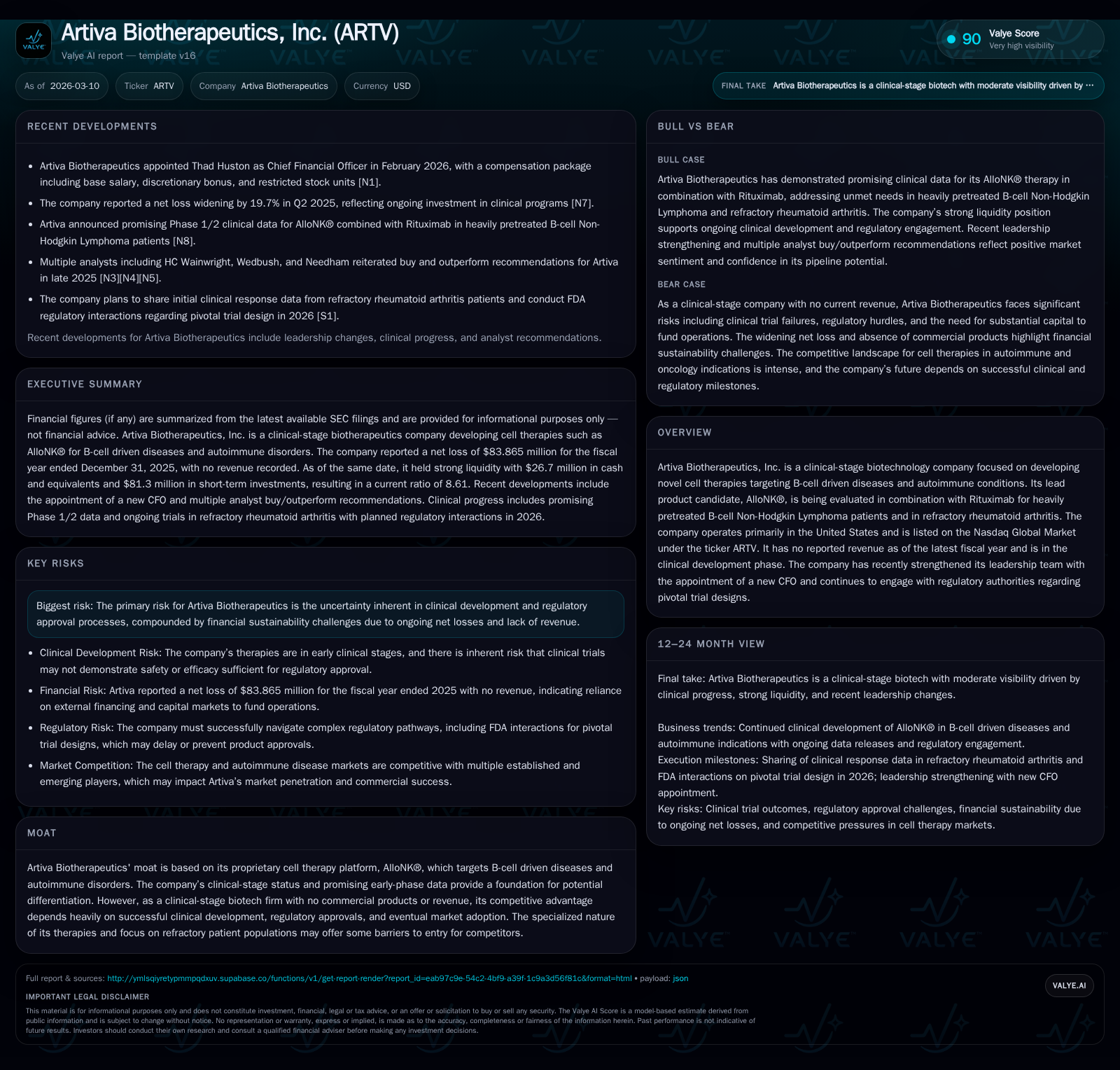
Artiva Biotherapeutics, Inc. is advancing its proprietary AlloNK® cell therapy platform targeting B-cell driven diseases, particularly refractory rheumatoid arthritis (RA) and heavily pretreated B-cell Non-Hodgkin Lymphoma (NHL). While it has yet to generate revenue, early clinical data indicate promising safety and efficacy signals in combination with anti-CD20 monoclonal antibodies, supporting potential differentiation versus existing therapies. The company faces typical clinical-stage biotech risks including ongoing net losses, capital needs, and regulatory uncertainties but recently strengthened its leadership by appointing an experienced CFO to oversee financial strategy. Key milestones in 2026 include sharing clinical response data and initiating discussions with the FDA about pivotal trial design.
Company Overview
Artiva Biotherapeutics, Inc. operates as a clinical-stage biotechnology company specializing in innovative cell therapies that target B-cell driven diseases and autoimmune disorders. The company’s core asset is AlloNK®, an allogeneic natural killer (NK) cell therapy currently under evaluation primarily in combination with CD20-targeting monoclonal antibodies such as rituximab. Its lead clinical programs encompass treatment for heavily pretreated B-cell Non-Hodgkin Lymphoma (NHL) patients as well as refractory rheumatoid arthritis (RA), reflecting an ambition to address substantial unmet medical needs through deep B-cell depletion strategies [S1][N1].
Situated within the United States and listed on Nasdaq under ARTV, Artiva remains without commercial products or revenues as it focuses on advancing clinical development activities [F1].
Historical Performance and Financial Trajectory
Artiva’s financials characterize a quintessential early-stage biotech profile: zero revenues in 2025 following minimal revenue of $251 thousand in 2024, reflecting the absence of commercialized therapies [F1]. Operating expenses intensified alongside clinical progress, resulting in an operating loss of approximately $89.8 million in 2025 compared to $67.3 million in the prior year — a growth in losses by about 33.5% year-over-year. Similarly, net loss widened from roughly $65.4 million in 2024 to $83.9 million in 2025 (-28.3% YoY reduction), underscoring expanding investments in R&D and operational infrastructure required at this stage [F1].
Operating cash flow demonstrated sustained negative trends with a burn increasing from $55 million in 2024 to about $76.8 million last year (-39.5%), exacerbating liquidity demands faced by the company [F1]. Capital expenditures rose markedly but remain modest relative to overall spend ($2.6 million vs. $642 thousand prior year), likely linked to biomanufacturing scale-up or facility improvements.
Equity contracted from $186.6 million at the end of 2024 to approximately $110 million by end-2025, illustrating dilution effects from financing activities required to fund operations amidst ongoing losses [F1]. The company reports no dividends or share repurchases during this period [S15]. Artiva’s current ratio stands at a healthy 8.61x as of December 31, 2025 — indicating adequate short-term liquidity buffering but underscoring the critical importance of capital raises or strategic partnerships moving forward [F1][S13].
Historical performance (annual)
| FY | Rev ($) | Net ($mm) | CFO ($mm) | OpInc ($mm) | Rev YoY | Net YoY |
|---|---|---|---|---|---|---|
| 2025 | 0 | -84 | -77 | -90 | -100.0% | -28.3% |
| 2024 | 251000 | -65 | -55 | -67 |
Source: SEC companyfacts cache [F1].
Capital returns and efficiency (annual)
| FY | FCF ($mm) | ROE% |
|---|---|---|
| 2025 | -79 | -76.3 |
| 2024 | -56 | -35.0 |
Source: SEC companyfacts cache [F1].
All figures USD; YoY percentages derived where applicable [F1]
Pipeline Development and Future Growth Prospects
At its core lies AlloNK®, designed to deliver robust depletion of pathogenic B-cells through a mechanism distinct yet comparable in effect size to chimeric antigen receptor T-cells (CAR-T), but potentially offering enhanced tolerability and practicality of administration. Recent safety data affirm manageable adverse events predominantly related to conditioning agents cyclophosphamide (Cy) and fludarabine (Flu), without new serious toxicities like cytokine release syndrome or graft-versus-host disease typically associated with cellular immunotherapies [S23][S21]. The outpatient delivery model at community rheumatology sites further hints at favorable operational scalability.
Initial translational analyses showcased non-quantifiable peripheral CD19+ B-cell levels by day 13 post-treatment across evaluated subjects, indicating deep depletion congruent with therapeutic intent [S23]. In refractory RA—characterized by substantial unmet need especially among patients failing multiple biologic therapies—early results suggest the combination approach may yield ACR50 response improvements worthy of pivotal exploration given historically low response rates (~10–20%) on approved agents [S14].
By mid-2026, Artiva aims to communicate initial clinical responses from more than fifteen refractory RA patients with significant follow-up durations while pursuing FDA discussions targeting agreement on pivotal trial design parameters—a crucial step towards registrational studies [S14][N1]. Concurrently, ongoing trials continue evaluating AlloNK® across systemic lupus erythematosus (SLE), Sjögren’s syndrome (SjD), systemic sclerosis (SSc), lupus nephritis (LN), building a broader autoimmune pipeline.
Notably absent is any reported top-line revenue or commercialization timeline at this juncture; progression remains contingent upon demonstrating robust efficacy signals coupled with regulatory milestone attainment.
Returns and Capital Allocation Strategy
With no product revenues nor positive earnings expected imminently, Artiva's focus remains on managing the balance sheet amid substantial operating losses linked directly to R&D intensity typical for cell therapy development stages. The approximate return on equity based on latest fiscal metrics is negative at circa -76%, aligning with capital consumed relative to equity [F1].
Operating cash flow deficits reflect continued investment ahead of commercial readiness; free cash flow estimates match negative operating flows minus capital expenditure ($79 million net cash outflow) pointing toward aggressive funding burn fueling clinical advancement [F1].
To bolster employee retention amidst challenging market conditions, management implemented an option-for-RSU exchange program replacing underwater stock options for key executives including CEO Fred Aslan and COO Jennifer Bush—enhancing alignment with shareholder interests without immediate cash impact [S15].
No dividend distributions or share repurchase programs are disclosed; these remain unlikely until sustainable profitability emerges.
Management & Strategic Positioning
A pivotal corporate move includes appointment of Thad Huston as CFO effective February 18, 2026 — an executive bringing over three decades of cross-sector leadership experience from entities such as Galapagos NV, Kite Pharma (Gilead subsidiary), LivaNova PLC, and Johnson & Johnson medical device divisions [N1][S24]. Huston’s background emphasizes finance transformation during strategic pivots in oncology-focused biotechnologies accompanied by operational controls implementation—a timely addition enhancing Artiva's ability to navigate complex developmental financing requirements.
Moat & Competitive Considerations
Artiva’s core differentiation resides in its proprietary AlloNK® platform that offers allogeneic NK cell therapies aiming for deep and durable B-cell depletion beyond standard anti-CD20 antibody monotherapy effects seen with rituximab alone [S23][S14]. Compared against CAR-T approaches—which require specialized infrastructure and carry higher toxicity risks—AlloNK® seeks improved outpatient compatibility alongside broad applicability across hematologic malignancies and autoimmune conditions.
However, competitive pressures remain intense given crowded pipelines featuring CAR-T regimens targeting similar indications plus emerging bispecific antibodies tackling resistant B-cell disease populations. Regulatory approval hurdles persist given nascent clinical data.
Risks Outlook
The customary risks confronting early-stage biotech companies are pronounced here: dependence on successful Phase II/III trial outcomes; navigating evolving FDA expectations around cell therapeutics approvals; sustaining capital adequacy against rapidly increasing burn rates; plus inherent complexities surrounding manufacturing scale-up for an allogeneic NK platform [S6][S7][S21]. Market adoption post-approval also requires validation considering patient heterogeneity and competing modalities.
Adverse events beyond those currently documented could delay development timelines or impose additional cost burdens.[S21][S23]
Prudent monitoring should focus on upcoming interim data releases slated for first half of calendar year 2026 along with details arising from regulatory engagements which will clarify viability of proposed pivotal study pathways.
What To Watch For (Analysis)
- Clinical readouts from refractory RA cohorts assessing durability and depth of response relative to existing DMARD treatment options,
- Progression towards FDA alignment meetings concerning pivotal trial designs that shape registration path,
- Additional safety observations or emergent adverse event profiles impacting dosing or patient selection,
- Financial updates revealing runway adequacy beyond late-2026 amidst scaling R&D spending,
- Operational execution under new CFO stewardship impacting cost control and fundraising capacity.
Conclusion
Artiva Biotherapeutics presents a compelling case study of an emerging cell therapy player dedicated to challenging refractory autoimmune conditions and hematologic cancers through innovative NK cell platforms paired with established antibody agents. Their progress underscores advances made possible by novel allogeneic approaches offering outpatient administration feasibility alongside early-phase evidence supporting potent biological activity.
Yet the road ahead remains laced with intrinsic risk typical of clinical-stage biotechs lacking revenue streams—mandating close attention to developmental milestones achievable within constrained liquidity frameworks under newly fortified finance leadership.
--- This report focuses exclusively on publicly available facts without offering investment recommendations.
Disclaimer: This is research-only, informational analysis and not investment advice. It may include AI-generated interpretation and general industry context. Always verify important details using primary sources.

Comments