
Cardiff Lexington’s Orthopedic Clinic Expansion and Cash Flow Challenges
Cardiff Lexington pursues growth through niche healthcare acquisitions amidst significant liquidity and extended payment cycle risks.
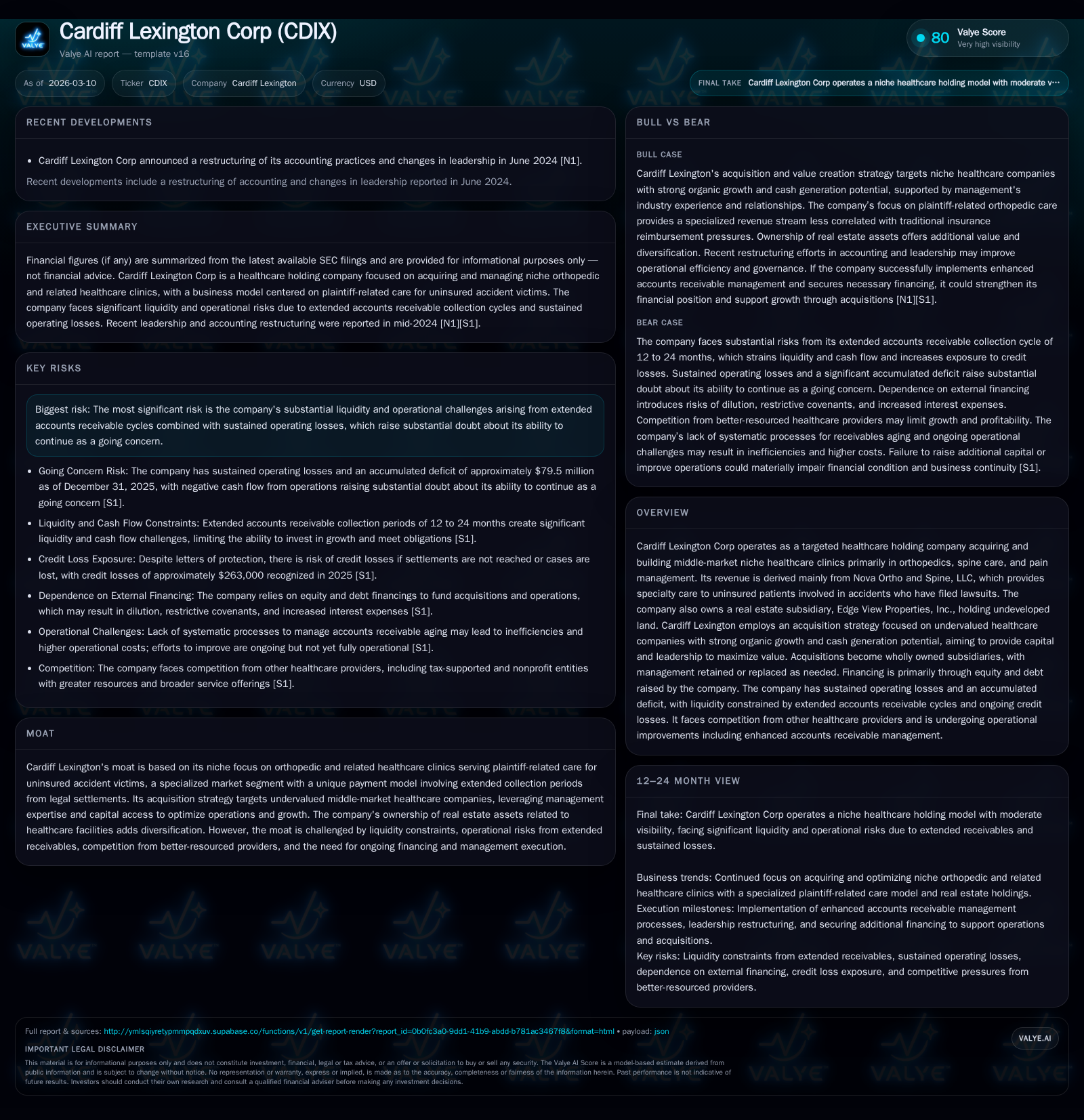
Cardiff Lexington Corp focuses on acquiring and building middle-market orthopedic and plaintiff-related healthcare clinics, with revenue primarily derived from its Nova Ortho and Spine subsidiary. Despite organic growth initiatives and geographic expansion prospects, the company faces ongoing liquidity constraints driven by an extended accounts receivable cycle of 12 to 24 months inherent in serving uninsured accident victims awaiting legal settlements. Historical financials show volatility with improving operating income overshadowed by sustained net losses and negative operating cash flows, raising substantial doubt about going concern status. Capital allocation remains challenged by negative equity and absent dividends or buybacks, while future growth is contingent on additional financing estimated between $5 million and $10 million.
Focused Healthcare Niche Driving Historical Growth
Cardiff Lexington Corp operates as a focused healthcare holding entity emphasizing acquisitions and growth of middle-market niche clinics predominantly in orthopedics, spine care, and pain management. Its primary revenue source is Nova Ortho and Spine, LLC, acquired in mid-2021, which provides specialty care mainly to uninsured patients involved in accidents who have initiated lawsuits against responsible parties [S1]. This plaintiff-related care model is highly specialized; patient payment depends on settlements with defendant insurance companies, resulting in atypical long payment cycles.
Together with clinical services, Cardiff Lexington owns Edge View Properties—a real estate subsidiary holding undeveloped residential land parcels—which provides some asset diversification but minimal current income [S1]. The company cultivates a partnership-driven culture prioritizing service quality alongside acquisition-led expansion across synergistic avenues: recurring physician practice cash flows, healthcare real estate holdings, and managing personal injury receivables to generate long-term value [S1].
Year-Over-Year Operating Performance: Trends and Volatility
The historical financial data from fiscal years (FY) 2022 through 2025 reveal a business marked by revenue fluctuations alongside volatile profitability and challenging cash flow profiles [F1]:
Historical performance (annual)
| FY | Rev ($mm) | Net ($mm) | OpInc ($mm) | Rev YoY | Net YoY |
|---|---|---|---|---|---|
| 2025 | 12 | -6 | 1 | +39.5% | -66.7% |
| 2024 | 8 | -3 | 0 | -30.2% | -209.1% |
| 2023 | 12 | 3 | 5 | -1.2% | +155.8% |
| 2022 | 12 | -5 | 2 |
Source: SEC companyfacts cache [F1].
Capital returns and efficiency (annual)
| FY | ROE% |
|---|---|
| 2025 | 223.0 |
| 2024 | -123.0 |
| 2023 | 414.0 |
| 2022 |
Source: SEC companyfacts cache [F1].
This volatility includes a meaningful operating income rebound in FY2025 but persistent net losses deepened due to non-operating costs or impairment charges not fully detailed here [F1]. Notably absent is positive operating cash flow; FY2023 saw approximately negative $1.7 million in CFO—a pattern consistent for prior years as well—underscoring liquidity demands tied to elongated accounts receivable collection [F1],[S1]. Capital expenditures have been minimal recently with no capex recorded in the latest reporting period [F1].
Capital Structure and Liquidity Pressures
Liquidity presents an existential challenge for Cardiff Lexington [S1][S4][S6][F1]. Current liabilities at year-end FY2025 slightly exceed current assets with a current ratio of roughly 0.87 indicating insufficient short-term coverage [F1]. The company carries an accumulated deficit approaching $79.5 million reflecting sustained operating losses since inception [S1]. The independent auditor issued a going concern explanatory paragraph citing these factors alongside recurring negative cash flow from operations [S1].
Cardiff Lexington depends heavily on external financing sources including equity raises and potential credit facilities to fund ongoing operations and acquisitions [S6][S8]. Debt covenants related to such financings may impose restrictive terms potentially limiting operational flexibility [S6]. Given the unpredictability of acquisition timing and size versus capital availability on acceptable terms poses substantial execution risk [S17]. Subsidiary entities generate operational revenues; however funds for parent obligations rely upon dividends or intercompany transfers which may be constrained legally or contractually [S6].
Acquisition Strategy: Organic Growth and Geographic Expansion
The company pursues a deliberate acquisition model targeting niche middle-market healthcare companies exhibiting strong organic growth prospects and robust cash generation potential [S1][S7][S8]. Upon acquisition—typically full ownership post-closing—subsidiaries retain existing management or transition to appointed executives to ensure continuity or operational improvements [S7]. A formal due diligence process evaluates target intrinsic value including financial analysis and external consultations [S7].
Expansion concentrates initially within Florida and Georgia with ambitions to replicate this regional footprint leveraging management’s relationships and sector knowledge [S7][S21]. Financings for acquisitions principally come from Cardiff Lexington’s general capital pool rather than deal-specific borrowing to reduce delays typical in isolated transactions [S8]. Nonetheless reliance on timely additional capital injections complicates exploiting attractive acquisition opportunities as needed [S17].
Risks Tied to Extended Receivables and Legal Payment Cycles
A signature challenge is the extended accounts receivable cycle—from service provision through patient lawsuit resolution—spanning typically 12 to 24 months or longer due to reliance on legal claim settlements for payment collection [S1][S11][S19]. This contrasts sharply with standard healthcare providers who collect payments within shorter timeframes.
Such protracted cycles strain liquidity severely by delaying inflows relative to operational outflows needed for payrolls and overheads [S11]. There is also credit loss exposure when cases resolve unfavorably against plaintiffs resulting in unpaid balances partially mitigated by letters of protection but not eliminated entirely [S19]. These factors distort key financial metrics such as days sales outstanding (DSO) and working capital ratios negatively impacting investor perspectives as well as creditworthiness assessments [S19]. Operational inefficiencies stem from legacy lack of systematic AR aging controls necessitating planned investments in collections infrastructure [S19].
Future Prospects Based on Management’s Business Plan
Management envisions incremental funding requirements ranging from $5 million up to $10 million depending on purchase price structures negotiated for prospective acquisitions—specifically whether sellers accept significant non-cash compensation forms such as seller notes or equity stakes in subsidiaries which could mitigate upfront cash needs [S1][S24].
Organic growth opportunities exist through expanded utilization of existing clinic locations plus potential new sites facilitated by acquired expertise [S7]. However step changes toward operational profitability sufficient to reduce going concern risk remain contingent upon successful integration projects driven by seasoned executive placements coupled with improved revenue scale efficiencies [S21].
Expectations and Watchpoints for Capital Raises and Financing
No explicit forward-looking revenue or earnings guidance has been provided by management suggesting considerable uncertainty surrounding near-term performance targets amid needed capital markets access. Key variables include timing/cost of debt facilities bearing floating rate interest exposing earnings sensitivity if borrowing rates exceed incremental operational cash flow growth[S6][S13]. Equity dilution risk also looms given necessity for ongoing issuance subject to market conditions possibly unfavorable for shareholders [S8]. Monitoring company's ability to maintain compliance with covenants will be critical given potential acceleration triggers harming liquidity available for operations.
Capital Allocation: Returns, Dividends, and Cash Flow Dynamics
Financial returns are notably impacted by accounting distortions rooted in negative equity balances at fiscal year-end approximating negative $2.47 million despite improving operating margins overall thereby producing a misleadingly elevated return-on-equity measure close to +223%, reflecting net losses against minimal or adverse shareholder equity rather than genuine profitability[F1].
No dividends nor share repurchases have been reported recently consistent with loss positions restricting discretionary cash distributions[F1]. Capital expenditure outlays declined sharply marking zero spend in recent reported periods signaling either cautious capex stance or limited investment capacity[F1]. Negative free cash flow persists driven chiefly by continued operating cash flow deficits.[F1]
Overall capital allocation reflects prioritization toward sustaining liquidity for acquisition execution over shareholder returns currently.
Concluding Assessment: Balancing Specialized Opportunity Against Financial Strains
Cardiff Lexington’s strategic emphasis on acquiring orthopedic-focused clinics serving plaintiff-related care provides differentiated positioning within a uniquely specialized segment characterized by long invoice-to-cash conversion intervals requiring profound liquidity discipline[S1][S11]. While the company has demonstrated the ability to grow revenues organically plus via acquisitions evidenced through notable YOY sales spikes[F1], the extended receivables cycle amplifies working capital pressures placing considerable strain on consistent positive cash generation vital for ongoing viability.
Accessing committed external financing remains both cornerstone enabler of future growth initiatives yet principal risk exposure given prevailing operating losses accumulating large deficits challenging credit profiles.[S6][S17][S24] Execution risks associated with integration complexities further complicate realizing full economic benefits.
Absent meaningful improvements in collection efficiency alongside securing fresh capital resources aligning pricing structures favorably with seller expectations the path toward sustainable profitability continues fraught.
Investors should weigh the distinct market opportunity presented by plaintiff-related care niche against demonstrable financial constraints that significantly temper near-term optimism.
DISCLAIMER: This analysis is based solely on information publicly available as of March 10, 2026 (principally SEC filings), without any projection or investment advice offered herein.
Disclaimer: This is research-only, informational analysis and not investment advice. It may include AI-generated interpretation and general industry context. Always verify important details using primary sources.

Comments