
International Money Express’ Shifting Earnings and Strategic Transition
Intermex faces volatile earnings amid merger preparations while maintaining focus on remittance services for immigrant populations.
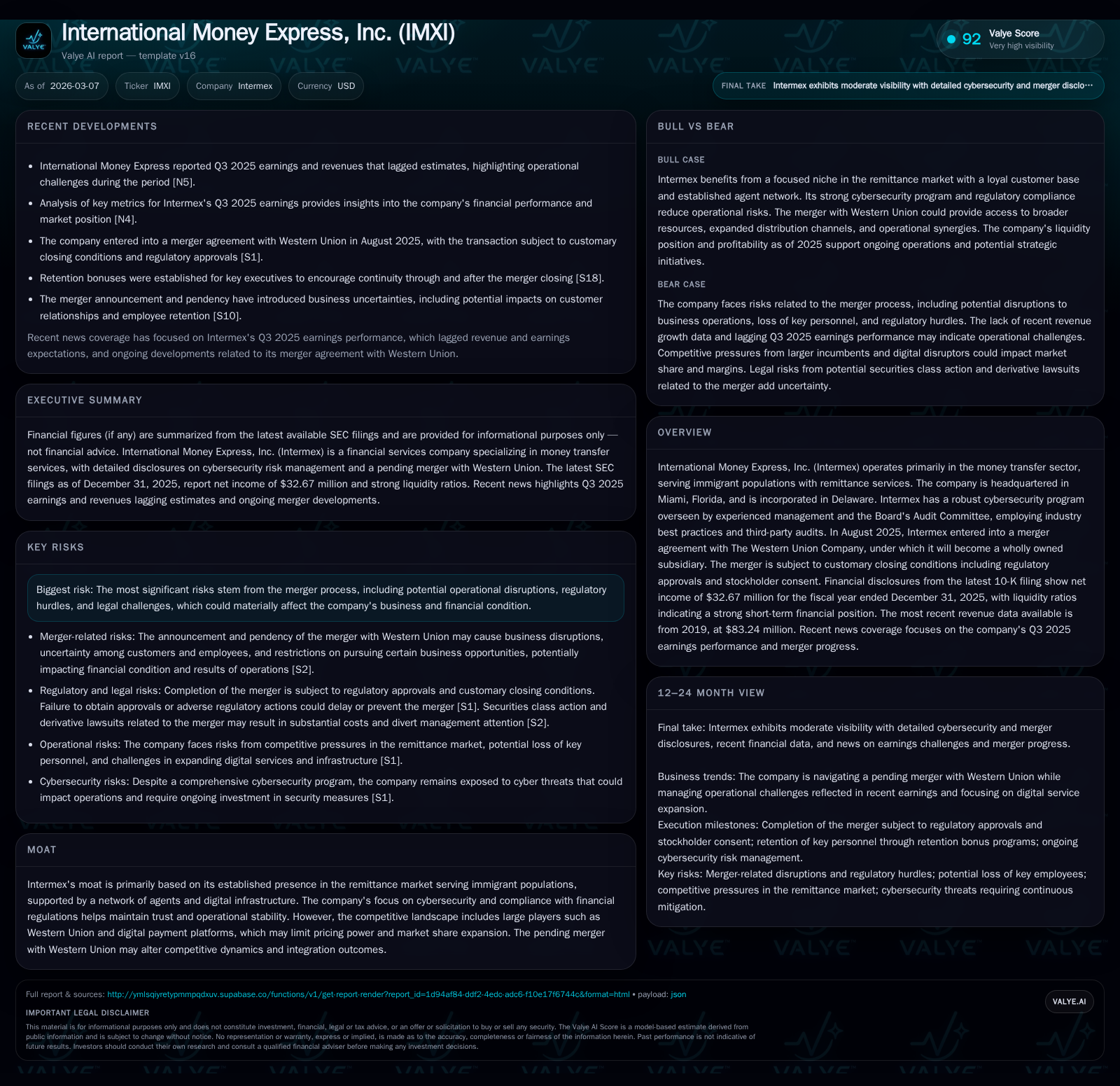
International Money Express, Inc. (Intermex) has exhibited contrasting financial performance with revenue growth of approximately 10.9% from 2024 to 2025 but a steep decline in operating income by 41.4% over the same period, reflecting merger-related operational challenges. The company’s pending acquisition by Western Union introduces regulatory and integration risks that may impact business continuity and growth prospects. Intermex’s robust cybersecurity program underpins operational stability in a competitive remittance niche served through its agent network and digital platform, despite margin pressures. Monitoring regulatory approvals, shareholder votes, and integration milestones will be critical in assessing the merger's ultimate impact on Intermex’s strategic positioning and financial outlook.
Revenue Growth Amidst Operating Income Volatility
International Money Express (Intermex) reported contrasting financial results for fiscal year 2025, marked by robust revenue advancement alongside sharp declines in profitability metrics [F1]. Revenues grew about 10.9% year-over-year from $50.22 million in FY2024 to approximately $55.65 million in FY2025, indicating stable demand within their core immigrant remittance niche despite broader sector competition.
However, operating income declined markedly by 41.4%, dropping from $95.02 million to $55.65 million, evidencing significant operating margin compression [F1]. Net income similarly fell by 44.5% year-over-year to $32.67 million. This divergence suggests increased costs associated with the pending merger integration activities, professional fees, and transactional expenses as disclosed in company filings [S4][S5]. Capital expenditure spending was cut nearly 30% to $21.07 million in FY2025 from $29.99 million the prior year, implying reduced reinvestment possibly tied to strategic waiting ahead of consolidation [F1]. The operating cash flow shrinkage of roughly 30% to $36.89 million reinforces these themes of constrained operational efficiency during this transitional phase.
Historical performance (annual)
| FY | Net ($mm) | CFO ($mm) | OpInc ($mm) | Capex ($mm) | Net YoY |
|---|---|---|---|---|---|
| 2025 | 33 | 37 | 56 | 21 | -44.5% |
| 2024 | 59 | 53 | 95 | 30 | -1.2% |
| 2023 | 60 | 144 | 95 | 13 | +3.8% |
| 2022 | 57 | 15 | 83 | 12 |
Source: SEC companyfacts cache [F1].
Capital returns and efficiency (annual)
| FY | Buybacks ($mm) | FCF ($mm) | ROE% |
|---|---|---|---|
| 2025 | 16 | 16 | 20.3 |
| 2024 | 75 | 23 | 43.6 |
| 2023 | 66 | 131 | 39.9 |
| 2022 | 54 | 3 | 38.2 |
Source: SEC companyfacts cache [F1].
Table: Intermex annual financial summary highlighting revenue growth against profitability declines [F1]
Merger Agreement with Western Union: Risks and Implications
In August 2025, Intermex entered into a definitive merger agreement with The Western Union Company whereby Intermex will become a wholly owned subsidiary post-closing [S4][S25]. While this transaction opens opportunities for enhanced scale in digital remittances and broader market access, it brings substantial execution risks.
Key issues highlighted include potential operational disruptions as management attention diverts toward merger execution activities which could lead to customer dissatisfaction or attrition among agents and partners anxious about future stability [S4][S6]. The company cautions that costs related to professional fees and integration may pressure earnings further.
Regulatory approval under multiple jurisdictions is customary but uncertain; Hart-Scott-Rodino Act clearance remains pending alongside other domestic and international consents [S6][S10]. The filing warns of litigation risks from securities class actions challenging the transaction that may further delay or increase costs [S5]. Failure to consummate the deal could trigger a $19.8 million termination fee payable by Intermex [S27], potentially impacting liquidity.
Should the merger falter or stall indefinitely, adverse publicity and loss of business confidence could damage ongoing revenues and profit sustainability.
Cybersecurity Initiatives Supporting Operational Stability
Given Intermex operates within a highly regulated financial remit involving cross-border money transfers for immigrant customers, information security is paramount.
The company maintains an advanced Cybersecurity Program managed by a CIO with over two decades of experience specifically in financial services cybersecurity compliance [S1][S7]. This program follows industry-recognized best practices anchored on the Center for Internet Security (CIS) Critical Security Controls Framework—a prioritized set of safeguards recognized across legal and regulatory domains.
Quarterly updates on cybersecurity risks are reported directly to the Board’s Audit Committee ensuring high-level oversight.
Annual third-party audits verify adherence to controls while penetration testing identifies vulnerabilities proactively [S12][S15]. This sector-native approach aligns with what leading payment facilitators employ given persistent threats targeting transaction platforms where trust is a key competitive asset.
Capital Structure, Cash Flow Trends, and Shareholder Returns
Intermex ended FY2025 with a strong liquidity position exhibiting a current ratio exceeding 2.5x (current assets at $353 million vs liabilities at $141 million), providing balance sheet resilience through the transition phase [F1]. Although operating cash flows declined alongside capex reductions—likely reflecting expenditure restraint ahead of merger closure—the firm generated positive free cash flow (~$15.8 million).
Intermex has not declared dividends historically or recently but has engaged in share repurchase programs totaling $16.3 million in FY2025 down from $75 million previously [F1][S22][S27], suggesting conservative capital returns as it conserves cash for potential transaction-related expenses.
Equity expanded moderately reflecting retained earnings adjustments despite net income contraction: Approximate ROE for FY2025 stands near 20% based on net income relative to total equity of $161 million [F1].
Market Position and Competitive Challenges in Remittances
Intermex's moat arises from its specialized focus on immigrant populations requiring dependable remittance corridors back home—a segment reliant on trust facilitated through physical agents coupled with growing digital infrastructure support .
The company's distribution footprint includes an agent network enabling broad access even among less tech-savvy customers—an advantage against purely digital newcomers but under pressure from large incumbents like Western Union itself.
Competitive dynamics limit pricing power as market participants jockey for share amid fintech entrants innovating service delivery models that appeal especially to younger demographics.
Network effects bolster Intermex's position since scale enhances transaction volume attractiveness verses cost structures; however, sustainability requires continual investment in customer experience enhancements within compliance bounds.
Future Growth Opportunities and Constraints Under New Ownership
Post-merger prospects hinge heavily upon Western Union’s capability to integrate Intermex's operations efficiently without eroding agent relationships or customer retention levels [N#][S4][S10].
Successful approval of stockholder votes cleared path towards deal completion; however regulatory reviews remain key bottlenecks that could delay anticipated synergies or restrict certain operational freedoms during pendency [S22][S25].
Growth vectors include leveraging combined networks for cross-selling newer digital products while rationalizing overlapping infrastructures which could yield cost saves but involve short-term disruption.
Conversely, lingering uncertainties around immigration law enforcement may impact remittance volumes indirectly due to changing immigrant employment dynamics influencing disposable incomes sending funds abroad [S25].
Key Milestones to Monitor in Merger Execution
Critical upcoming events comprise:
- Final regulatory clearances mandated under antitrust laws including Hart-Scott-Rodino Act review timelines remain uncertain though procedural progress is underway [S6][S10].
- Potential outcome of any securities litigations or governmental injunctions that could stall closing or increase costs materially [S5][S25].
- Integration planning disclosures detailing how agent relationships and IT systems will merge post-close will be instrumental for stakeholders seeking assurance around continuity.
- Monitoring management retention signals as leadership turnover risks noted could impede seamless transitions impacting day-to-day operations temporarily [S4].
- Watch for updates on transaction costs exceeding initial estimates which can pressure liquidity or divert resources away from core business functions.
These items collectively form focal points driving near-term investor and stakeholder sentiment absent explicit guidance from management beyond transaction disclosures.
Conclusion: Balancing Transition Risks With Strategic Potential
International Money Express finds itself at a pivotal juncture defined by shifting earnings amid strategic repositioning triggered by its pending acquisition by Western Union. Despite commendable revenue growth rooted in its entrenched immigrant remittance niche supported by a reliable agent network and fortified cybersecurity posture conforming with CIS Controls Framework best practices, profitability pressures reflect inherent transitional challenges associated with complex mergers. The company’s solid liquidity cushions immediate operational needs yet sustained success depends critically on navigating regulatory approvals smoothly while preserving key relationships throughout integration phases. As customers await clarity on service continuity post-merger alongside migration paths towards combined digital offerings under new ownership structures, cautious optimism is warranted around longer-term growth aligned with scale benefits tempered judiciously against execution risks outlined explicitly within company disclosures. Stakeholders should maintain vigilant observation around milestone developments such as regulatory clearance outcomes and litigation progressions which will materially influence degree of operational disruption or opportunity realization going forward.
This analysis is based exclusively on publicly available filings from International Money Express as of early March 2026 along with recent news reports without any speculative forecasts or investment recommendations.
Disclaimer: This is research-only, informational analysis and not investment advice. It may include AI-generated interpretation and general industry context. Always verify important details using primary sources.

Comments