
Cracker Barrel Old Country Store Steadies Operations While Adapting to Cost Pressures
Cracker Barrel maintains its unique dual restaurant-retail model while addressing profitability constraints amid rising costs and moderating traffic.
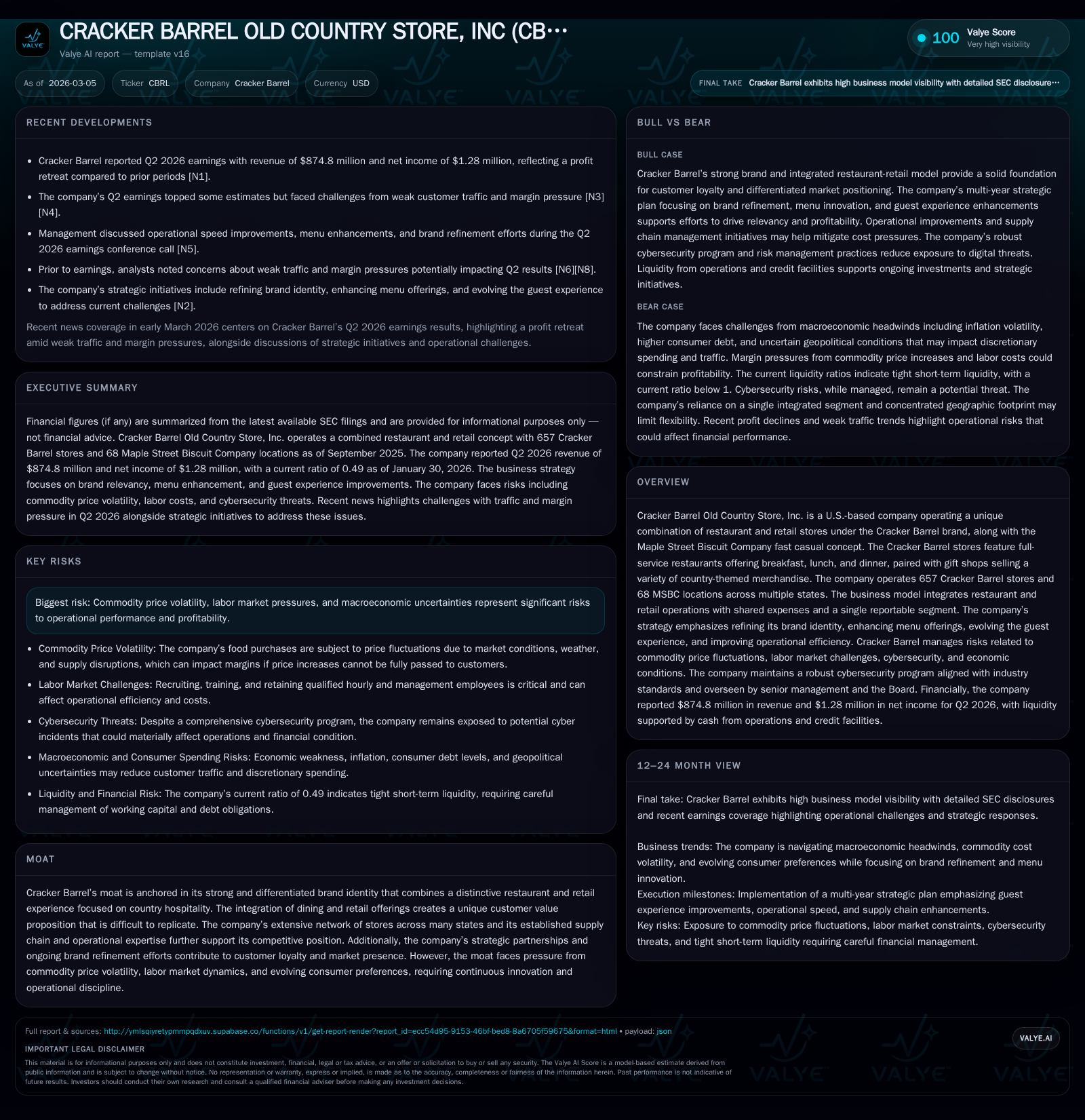
Cracker Barrel Old Country Store, Inc. continues to leverage its distinctive integrated restaurant and retail format to navigate a challenging environment marked by input cost inflation and labor market tightness. The company recorded a 22% increase in operating income and a 13.3% rise in net income for FY2025, driven by menu innovation and guest experience enhancements. Rising commodity prices and wage inflation have pressured margins, prompting strategic initiatives focused on menu evolution and operational efficiency. Capital allocation balances dividends and share repurchases within debt covenant constraints while generating positive free cash flow supporting maintenance capital expenditures.
Distinctive Business Model and Historical Operating Performance
Historical performance (annual)
| FY | Net ($mm) | CFO ($mm) | OpInc ($mm) | Capex ($mm) | Net YoY |
|---|---|---|---|---|---|
| 2025 | 46 | 219 | 55 | 159 | +13.3% |
| 2024 | 41 | 169 | 45 | 128 | -58.7% |
| 2023 | 99 | 250 | 121 | 127 | -24.9% |
| 2022 | 132 | 205 | 153 | 98 |
Source: SEC companyfacts cache [F1].
Capital returns and efficiency (annual)
| FY | Div ($mm) | Buybacks ($mm) | FCF ($mm) |
|---|---|---|---|
| 2025 | 23 | 17 | 60 |
| 2024 | 116 | 17 | 41 |
| 2023 | 116 | 17 | 123 |
| 2022 | 115 | 132 | 107 |
Source: SEC companyfacts cache [F1].
Cracker Barrel Old Country Store operates as a single reportable segment integrating full-service restaurants with retail stores selling country-themed merchandise. This dual revenue stream is supported by an extensive network of 657 Cracker Barrel locations complemented by 68 Maple Street Biscuit Company fast casual outlets across multiple U.S. states [N1][S1]. Operating expenses are shared between the restaurant and retail product lines within each store.
Financially, the company experienced earnings volatility influenced by external pressures such as economic shifts and input cost fluctuations. Operating income declined from $153 million in FY2022 to approximately $45 million in FY2024 before rebounding 22% year-over-year to about $55 million in FY2025 [F1]. Net income followed a comparable pattern, decreasing from around $132 million in FY2022 to near $41 million in FY2024 before increasing to approximately $46 million in FY2025.
This variability reflects both the resilience of the brand’s differentiated model and exposure to commodity prices, labor costs, and discretionary consumer spending.
Growth Drivers and Recent Performance Volatility
Management attributes improvements primarily to focused efforts on menu development and guest experience upgrades at both Cracker Barrel stores and Maple Street Biscuit Company locations. These initiatives aim to reinforce brand identity amidst heightened competition within casual dining categories [N1].
The reported 22% increase in operating income for FY2025 alongside a 13.3% rise in net income signals successful operational adjustments. However, recent earnings transcripts indicate softening customer traffic that challenges volume growth momentum [N1][N2]. Rising commodity costs alongside this softness have capped top-line expansion potential.
Rising Cost Pressures Impacting Margins
Commodity price volatility remains a key risk affecting gross margins due to fluctuations in key food staples such as protein cuts, dairy products, and packaging materials [S15]. Management applies inventory controls but cannot fully offset these cost increases.
Labor market tightness adds margin compression through wage inflation as competitive demand increases hourly wage rates critical for front- and back-of-house roles. Recent commentary highlighted operational leverage compression from these wage pressures alongside higher utility costs tempering profitability gains [N5][N11].
Strategic Initiatives: Menu Evolution and Guest Experience Enhancements
Management is evolving menu offerings emphasizing innovation while preserving core comfort-food appeal central to Cracker Barrel’s value proposition. Both flagship stores and Maple Street Biscuit Company menus have expanded selections designed to attract diverse demographics while maintaining signature dishes that nurture repeat patronage [N1][S2].
Store ambience upgrades coupled with digital enhancements such as improved app ordering seek experiential differentiation within a fragmented fast casual sector.
Capital Structure Overview and Financial Covenants Compliance
As of January 30, 2026, the company had outstanding borrowings of approximately $45.5 million under its 2025 Revolving Credit Facility with total capacity of $550 million including sub-facilities for letters of credit ($75 million) and swingline loans ($25 million). Borrowing availability was approximately $496 million after accounting for standby letters of credit [S4][S16].
Interest rates on borrowings are tied either to Term SOFR plus applicable margins or base rates plus margins adjusted for consolidated leverage ratios; the weighted average interest rate was about 6.18%. The company elected during Q2 fiscal 2026 to implement the consolidated senior secured leverage ratio covenant which it complied with comfortably at January-end dates [S4][S16].
Restrictions on dividends and share repurchases apply contingent on leverage thresholds aligned with capital stewardship.
Capital Allocation: Dividends, Buybacks, Investment
In FY2025 Cracker Barrel paid dividends totaling about $23 million while executing modest stock repurchases near $17 million primarily reflecting prior authorizations [F1][S13][S21]. This scale-down relative to previous years indicates capital conservation amid margin pressures alongside reinvestment into remodels and technology related to customer engagement enhancements.
Cash Flow Generation and Free Cash Flow
Operating cash flow increased nearly 30% year-over-year reaching about $219 million in FY2025 reflecting improved profitability trajectories along with optimized working capital cycles [F1]. Capital expenditures rose significantly to roughly $159 million driven by maintenance capex for store renovations plus technology upgrades underpinning strategic initiatives [F1][S23]. The resulting free cash flow estimate is near $60 million.
Risks: Commodity Costs, Labor Market Tightness, Cybersecurity, Macroeconomics
Commodity price swings remain an uncertainty that can erode margins absent offsetting pricing or productivity gains. Labor market conditions may continue tightening wage structures further compressing operational leverage.
Cybersecurity risks are managed through adoption of the NIST Cybersecurity Framework (CSF), routine employee training addressing ransomware/social engineering threats, annual penetration testing by third parties, plus cyberinsurance coverage mitigating breach impact liability risks [S1].
Macroeconomic factors such as inflation affecting discretionary consumer spending remain important determinants shaping near-term top-line momentum.
Investor Considerations: Metrics and Milestones Ahead
Investors should monitor quarterly traffic trends given recent softness reported on earnings calls as any sustained recovery would support margin stability or growth [N3][N12]. Monitoring commodity inflation controls alongside wage expense trends remains critical for profit outlook visibility.
Maintaining compliance with debt covenants tied closely to dividend policies will influence cash return potential versus reinvestment trade-offs essential for long-term brand execution.
This analysis synthesizes publicly filed SEC documents alongside recent earnings commentary without offering investment recommendations or forward-looking guidance beyond disclosed facts.
Disclaimer: This is research-only, informational analysis and not investment advice. It may include AI-generated interpretation and general industry context. Always verify important details using primary sources.

Comments