
APi Group Strengthens Recurring Revenue Growth through Inspection-First Service Model and Strategic Acquisitions
APi Group’s latest quarter confirms resilient growth driven by a diversified, regulation-driven service portfolio and disciplined acquisition integration.
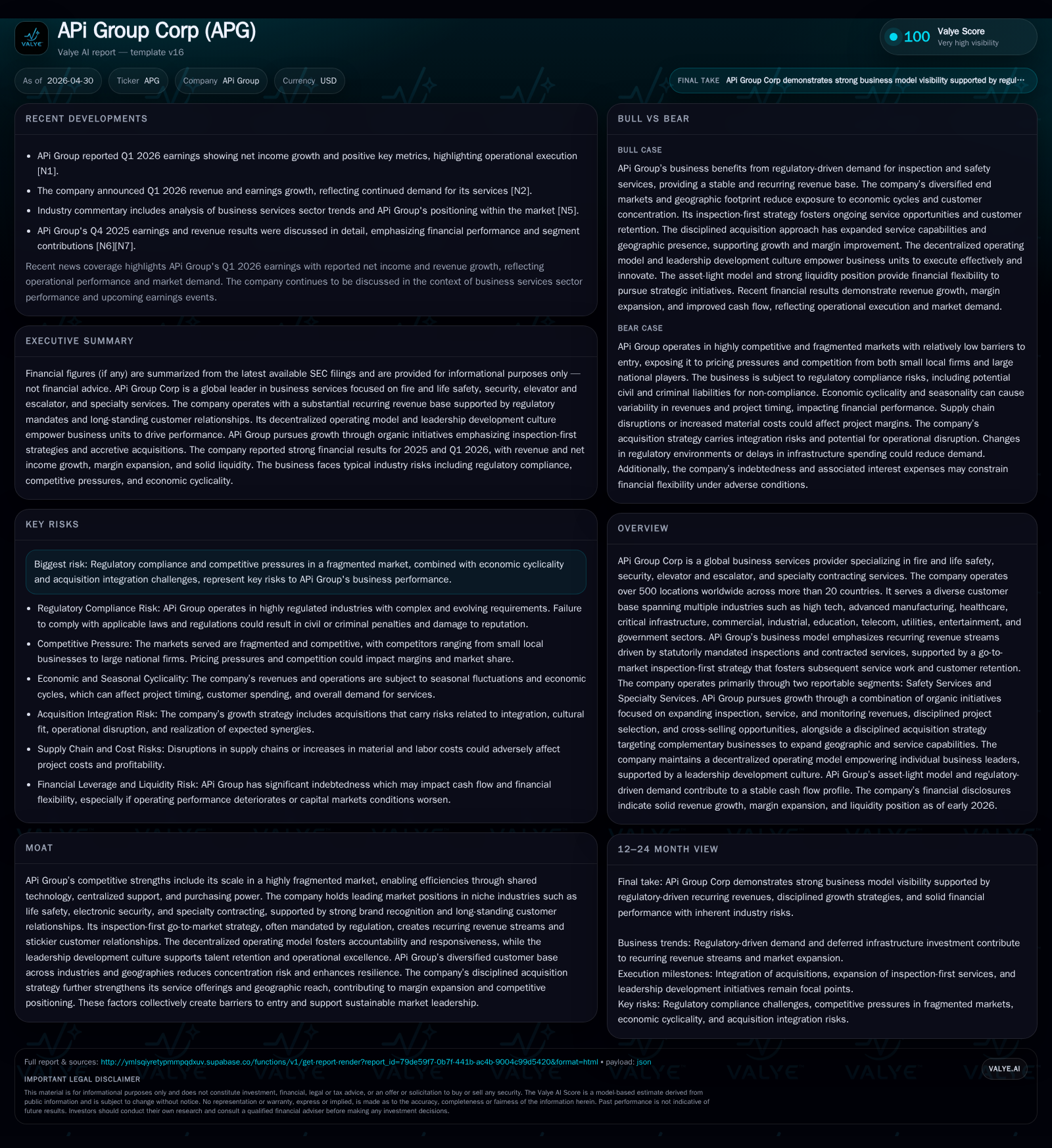
In Q1 2026, APi Group Corp continued to leverage its inspection-first strategy and regulatory mandate-driven recurring revenue model to boost organic and acquisition-fueled growth. The company’s Safety Services and Specialty Services segments delivered solid expansion amid steady margin improvement and operational efficiencies. APi’s decentralized operating structure, scale advantages in a fragmented market, and leadership culture support resilience against cyclical pressures and integration challenges. Key growth drivers include expanding inspection and monitoring contracts, cross-selling across end markets, and operational digitization. Watch for backlog evolution, acquisition pipeline progress, and margin trajectory in upcoming quarters.
Recent Operating Update
APi Group Corp's Q1 2026 10-Q filing ([S2]) presents a continuation of robust operating performance aligned with its strategic playbook: leveraging recurring revenue from statutory inspection mandates coupled with contract service work. The company reported organic revenue growth aided by ongoing acquisitions completed in 2025—14 new buys totaling $233 million—and benefiting from improved pricing discipline. Operating margins showed incremental expansion particularly in the Safety Services segment which delivered strong double-digit revenue gains alongside margin uplift. Specialty Services also posted solid top-line growth though faced some headwinds from increased project starts mixed with elevated material input costs.
The accompanying April 30th 8-K release ([S3], [N2]) highlighted that APi exceeded both earnings and revenue consensus marks in Q1, underscoring the strength of its inspection-first go-to-market approach which continues to fuel stickier customer contracts. Management emphasized operational excellence initiatives to drive productivity alongside investments in technology enablement that are synergistic with their scale advantage.
Business Model Overview
APi Group operates as a global market leader providing fire and life safety solutions, electronic security systems, elevator/escalator services, and specialty contracting. Its business model is built around recurring revenue streams predominantly arising from statutorily mandated inspections—legally required for compliance or insurance purposes—and contracted maintenance or upgrades that follow inspection engagements ([S1], [S23]).
Revenues flow mainly from two reportable segments:
- Safety Services: encompassing installation, inspection, servicing, and monitoring of fire protection systems, electronic security devices, and vertical transportation equipment.
- Specialty Services: focusing on specialized contracting including HVAC work realigned under this segment since 2025.
The company’s core strength lies in its "inspection-first" strategy where providing mandatory inspections creates a gateway for ongoing maintenance services—a cross-sell mechanism deeply integrated within a long-standing industrial customer base across diverse end markets such as healthcare, tech manufacturing, critical infrastructure, telecoms, utilities, entertainment venues, education institutions, and government sectors ([S1], [S23]).
Contracts typically feature varying terms but tend toward short-term (days to months), often renewed due to regulatory requirements ensuring high visibility into future revenues. This mix supports stable gross margins bolstered by selective project work that commands higher pricing power where complexity or specialization matters.
Industry Structure and Competitive Position
The fire/life safety and specialty contracting industry is highly fragmented with numerous small regional players. APi Group’s scale (500+ locations across 20+ countries) grants it procurement leverage leading to cost advantages via volume discounts ([S22]). Centralized support functions enhance operational efficiency while still preserving autonomy at the business unit level to foster market responsiveness—a key differentiation versus monolithic competitors.
Its brand recognition combined with embedded long-term customer relationships anchored by regulatory necessity creates significant switching barriers—especially given the technical certification requirements in safety-critical installations ([S23]). APi consistently ranks among top-five specialty contractors in North America for certain verticals.
Further competitiveness stems from a leadership development culture dubbed “Building Great Leaders®” aimed at talent retention critical for skilled labor availability amid industry-wide shortages ([S1]). The company also invests in technology platforms that enable efficient routing for field service teams and real-time compliance tracking for customers.
Growth Drivers
Organic Expansion Through Inspection & Monitoring Focus
Inspection contracts provide a steady inflow of repeat business; marginally growing this base fuels both consistent cash flow and future upsell of maintenance services ([S12],[S23]). Cross-selling multiple service lines at existing client sites enhances wallet share.
Project Selection Discipline
APi adopts disciplined project selection prioritizing profitable engagements aligned with strategic markets (e.g., healthcare facility retrofits). This curates higher-margin backlog contributing to earnings stability ([S12],[S14]).
Acquisition Strategy
Recent activity underscores an aggressive yet disciplined M&A approach targeting companies that complement geographical or service line gaps. The ongoing integration emphasizes preserving customer continuity while rolling out APi’s inspection-first methodology along with operational best practices ([S1],[S24]).
Technological Enablement & Scale Economies
Leveraging scale platform investments spanning purchasing programs to enterprise resource planning (ERP) upgrades improves margins incrementally through cost reductions over time ([S1]). Central data analytics capabilities support predictive maintenance offerings increasingly demanded by customers aiming to mitigate downtime risks.
Risks / Watchpoints / Growth Constraints
- Regulatory Compliance Complexity: Constantly evolving codes necessitate investments in training/resources; non-compliance risks penalties and reputational damage ([S19],[S25]).
- Competitive Pricing Pressure: Given fragmentation, smaller rivals may undercut; maintaining premium pricing requires sustained quality leadership.
- Labor Market Tightness: Skilled technician shortages can inflate wages reducing margin potential or cause delays impacting customer satisfaction ([S19]).
- Acquisition Integration: Cultural misalignments or failure to realize synergies could impair return on recent investments ([S1],[S24]).
- Supply Chain & Material Cost Volatility: Escalating raw material prices challenge bid accuracy on projects potentially compressing margins ([S14]).
- Interest Rate Sensitivity: Non-trivial debt requires careful refinancing management amid rate fluctuations although current leverage remains manageable ([F1],).
What To Watch Next
Key upcoming indicators include:
- Quarterly trends in inspection revenue growth as a barometer of recurring fee traction.
- Integration progress of recently acquired businesses measured by margin improvement trajectories.
- Backlog composition changes signaling shift between recurring vs project-based work.
- Operating expense leverage relative to revenue scaling amid investments into enabling technology.
- Execution pace against the share repurchase program authorized for up to $1 billion indicating capital allocation confidence ([S16]).
Financial Profile Summary
Latest financial snapshot
As of December 31, 2025 ([F1]): FY-End 2025 |
The balance sheet shows substantial liquidity supported by nearly $912 million in cash balances plus unused revolver capacity of $745 million per year-end disclosures ([S4],[F1]), positioning APi well for opportunistic investments or weathering temporary macroeconomic headwinds. Leverage metrics remain controlled relative to covenant limits; interest expenses declined slightly due to lower floating rates while no scheduled principal repayments remain for the term loan after early prepayments ([S6],[F1]).
Disclaimer: This analysis is based solely on publicly available filings and news sources as cited. It does not constitute investment advice or recommendation. Any forward-looking statements herein are grounded only on disclosed company communications without projection or speculation beyond stated facts.
Disclaimer: This is research-only, informational analysis and not investment advice. It may include AI-generated interpretation and general industry context. Always verify important details using primary sources.

Comments