
ECOPETROL’s Strategic Update Highlights Operational Resilience and Regional Dynamics
The latest quarterly disclosures underline Ecopetrol’s sustained integrated operations amid supply chain tensions and evolving regional political risks.
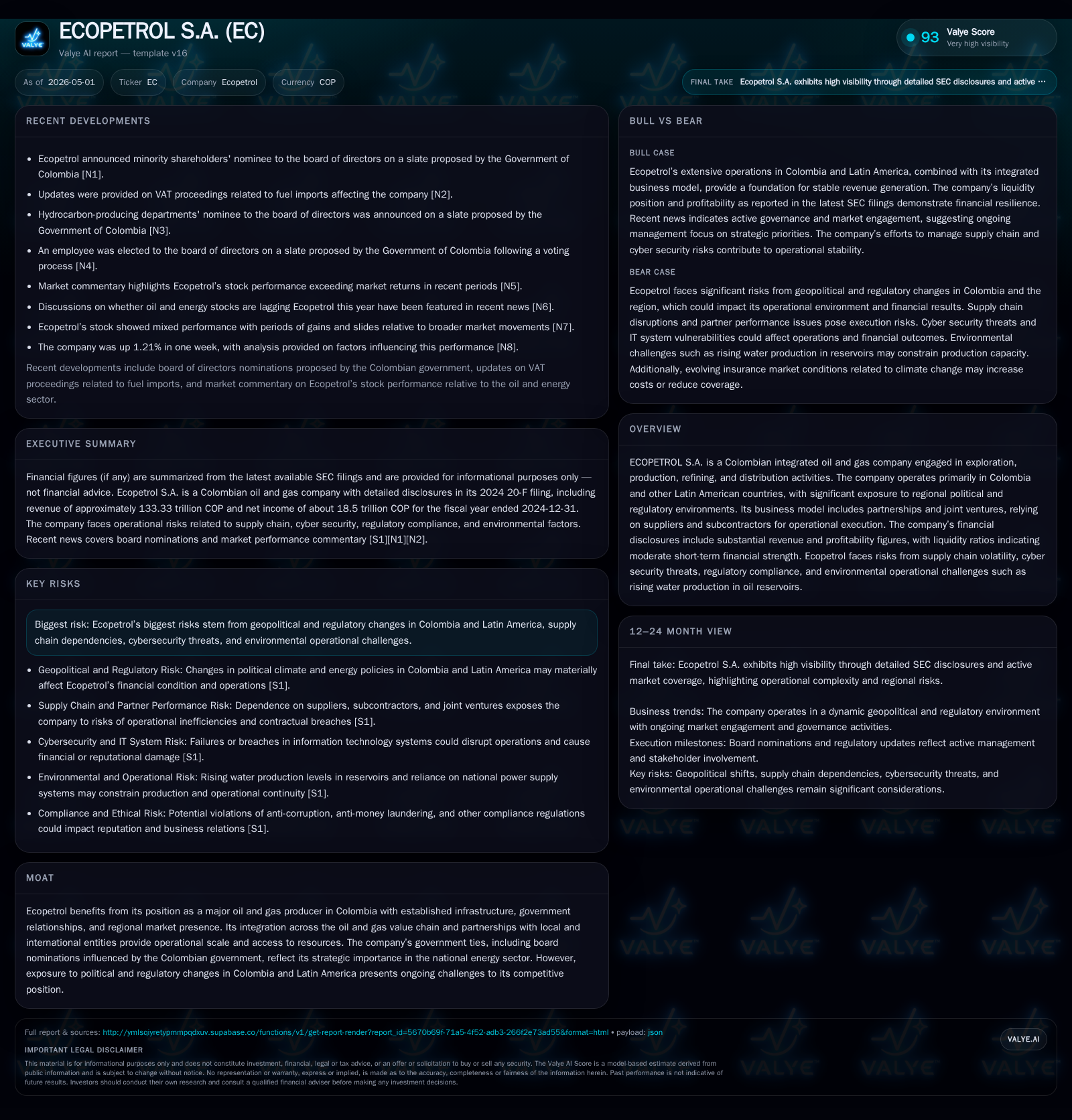
Ecopetrol’s April 29, 2026 quarterly update reinforces its operational resilience with ongoing production capacity and project executions despite global supply chain volatility and geopolitical complexities in Latin America. The company’s vertically integrated model spanning exploration through refining and distribution underpins stable revenue streams, supported by strategic government relationships and joint ventures. Key growth avenues emerge from production expansion and infrastructure upgrades, tempered by risks around regulatory shifts, supplier disruptions, and environmental challenges. Financially, moderate liquidity with a current ratio above 1.5 bolsters its capacity to navigate these headwinds while pursuing growth opportunities.
Latest Quarterly Operational Highlights and Significance
Ecopetrol’s latest Form 6-K filed April 29, 2026 ([S2]) reflects operational steadiness amidst complex macroeconomic conditions. The filing confirms continued production levels aligned with prior disclosures ([S3]) while emphasizing ongoing efforts to mitigate inflation-driven cost pressures attributed to supply chain volatility and labor escalations. These factors stem from heightened geopolitical tensions and trade disruptions reshaping global commodity flows, especially impacting oilfield services suppliers critical to Ecopetrol’s upstream operations.
Notably, the recent filings acknowledge that some supplier segments face financial strains or regulatory uncertainties that could affect contract fulfillment timelines. This scenario represents an elevated risk for project delays or increased operating expenses. Nevertheless, Ecopetrol continues to manage these effects via diversified supplier bases and contractual oversight.
Such operational updates are crucial as they set the near-term tone: the company must balance maintaining production volumes—a key revenue driver—with navigating cost inflation potentially compressing margins. This balancing act plays out against a backdrop of moderately stable Brent crude prices projected between $50-$58 per barrel ([S1]), providing a workable commodity price floor for planning.
Ecopetrol’s Integrated Business Model and Product Suite
Ecopetrol operates as a fully integrated oil and gas entity in Colombia and other Latin American markets, spanning exploration & production (E&P), refining, midstream logistics, and downstream marketing ([S1], [F1]). Its upstream activities focus on hydrocarbon recovery primarily within Colombia using both operated assets and joint ventures where partner operators play key roles. Midstream pipelines facilitate transport to refining complexes where refined products including gasoline, diesel, LPG, and petrochemicals are manufactured.
Revenue flows derive primarily from crude oil sales mixed with refined product distribution revenues, enhanced by value retention within the refining segment. The vertical integration enables Ecopetrol to capture margin beyond raw hydrocarbon extraction—an important buffer amidst price fluctuations in commodities.
This multi-segment operation depends on an extensive network of subcontractors and third-party service providers for drilling rigs, maintenance services, logistics support, etc., introducing exposed operational points influenced by supplier financial health and compliance capabilities ([S1]).
Overall, the business model benefits from asset scale across the value chain allowing internal consumption of feedstock products while also competing in local fuel markets requiring regulatory adherence yet offering pricing pass-through potential.
Competitive Positioning Within Latin America’s Energy Sector
Ecopetrol stands as Colombia's dominant energy player benefiting from entrenched infrastructure, scale economies, established government relations, and vast reserves ([S1], [F1]). This confers significant barriers to entry for potential competitors given the capital intensity of upstream developments plus the logistical complexity of refining/pipelines networks.
Government influence is evidenced through board appointments reflecting national strategic interests supporting stable access to licenses but simultaneously exposing Ecopetrol to political risk if policy agendas shift—especially regarding environmental regulation or fiscal regimes ([S1]).
Its customer base enjoys high switching costs due to limited alternative domestic suppliers and logistical constraints unique to Latin America’s geography. However, regional competitiveness hinges on maintaining operational reliability amid infrastructure aging concerns and supply chain risks which could cede advantage to international producers investing in Venezuela or Brazil.
Growth Catalysts: Expanding Production Amid Infrastructure and Partnership Strengths
Growth prospects center on upstream reserve development driven by new drilling campaigns incorporated in joint ventures with international partners allowing risk sharing ([S2], [S1]). Additionally, midstream infrastructure enhancements aim to reduce bottlenecks restricting crude transport capacity boosting overall utilization rates.
Targeted capital investment appears prioritized toward projects increasing production volumes sustainably while managing water cut issues—a persistent challenge requiring technological solutions to maintain reservoir productivity without escalating costs ([S1]).
Downstream expansion initiatives include refinery upgrades enhancing product yield quality aligned with evolving environmental standards fostering higher-margin specialty fuels production.
Strategic alliances with both Colombian state entities and multinational corporations enable leveraging technological expertise vital for deepwater exploratory successes and energy transition projects—even if core revenue remains rooted in hydrocarbons currently.
Risks and Constraints: Supply Chain, Regulatory, and Environmental Considerations
Supply chain disruption remains a top concern due to the intertwined nature of global commodity markets impacted by geopolitical tensions leading to price inflations in critical inputs such as chemicals, steel pipes, oilfield machinery ([S1]). Supplier defaults or non-performance translate into project delays or increased operational costs directly pressuring earnings.
Regulatory risk within Colombia reflects potential changes in tax policies, environmental restrictions including methane emissions controls or water management regulations specifically governing rising water volumes in producing wells—a factor affecting well economics progressively ([S1]).
Cybersecurity threats targeting critical infrastructure add an intangible yet material risk dimension threatening operational continuity if mitigations fail ([S1]).
Environmental liabilities remain partially uninsured leaving exposure gaps should incidents occur implying reputational damage alongside financial costs. The tight labor market contributes wage inflation pressure adding another cost layer difficult to fully offset by operational efficiencies ([S1]).
Upcoming Milestones and What to Monitor Next
Key upcoming indicators include subsequent quarterly results expected mid-2026 tracking production volume trends in context of supplier challenges ([S2], [S3]). Project completion statuses on pipeline upgrades or refinery modernization will offer clarity on capacity enhancement timing.
Regulatory developments warrant close attention given their potential impact on fiscal terms or environmental compliance costs directly influencing margins. Regional political dynamics especially shifts related to Columbia’s energy policy or Venezuela reactivation progress carry sector-wide implications.
Tracking Brent crude price trajectories alongside inflation metrics provides essential context for forecasting revenue potential vs cost pressures affecting profitability outlooks.
Concise Financial Health Overview Anchored on Latest Data
At year-end 2024 balance-sheet indicators provide meaningful context for Ecopetrol’s financial flexibility relevant today: cash & equivalents stood at approximately COP 14.05 trillion while current assets exceeded liabilities leading to a current ratio near 1.53 suggesting adequate short-term liquidity cushioning against disruptions ([F1]).
Latest quarterly filings do not disclose material changes suggesting continuity in capital resource availability supporting ongoing capex commitments targeting growth projects described earlier ([S2], [S3], [S1]). Revenues reached COP 133 trillion in 2024 underpinning scale but are sensitive to commodity price swings highlighted above.
Operating expenses are influenced heavily by inflationary trends notably wages, regulated input costs, translating into margin pressure unless product pricing adjustments can be passed through effectively within Colombian market parameters ([S1]).
Overall, financial health combined with operational scale equips Ecopetrol reasonably well to manage near-term execution risks while funding strategic initiatives essential for sustaining its dominant regional position.
Disclaimer: This report is for informational purposes only based on publicly available filings as of May 2026. It does not constitute investment advice or recommendations regarding Ecopetrol S.A.'s securities or prospects.
Disclaimer: This is research-only, informational analysis and not investment advice. It may include AI-generated interpretation and general industry context. Always verify important details using primary sources.

Comments