
Shentel’s Q1 2026: Balancing Fiber Expansion with Margin Pressure
Shentel’s aggressive capital deployment on Glo Fiber drives revenue growth but widens operating losses amid stiff competition and legacy declines.
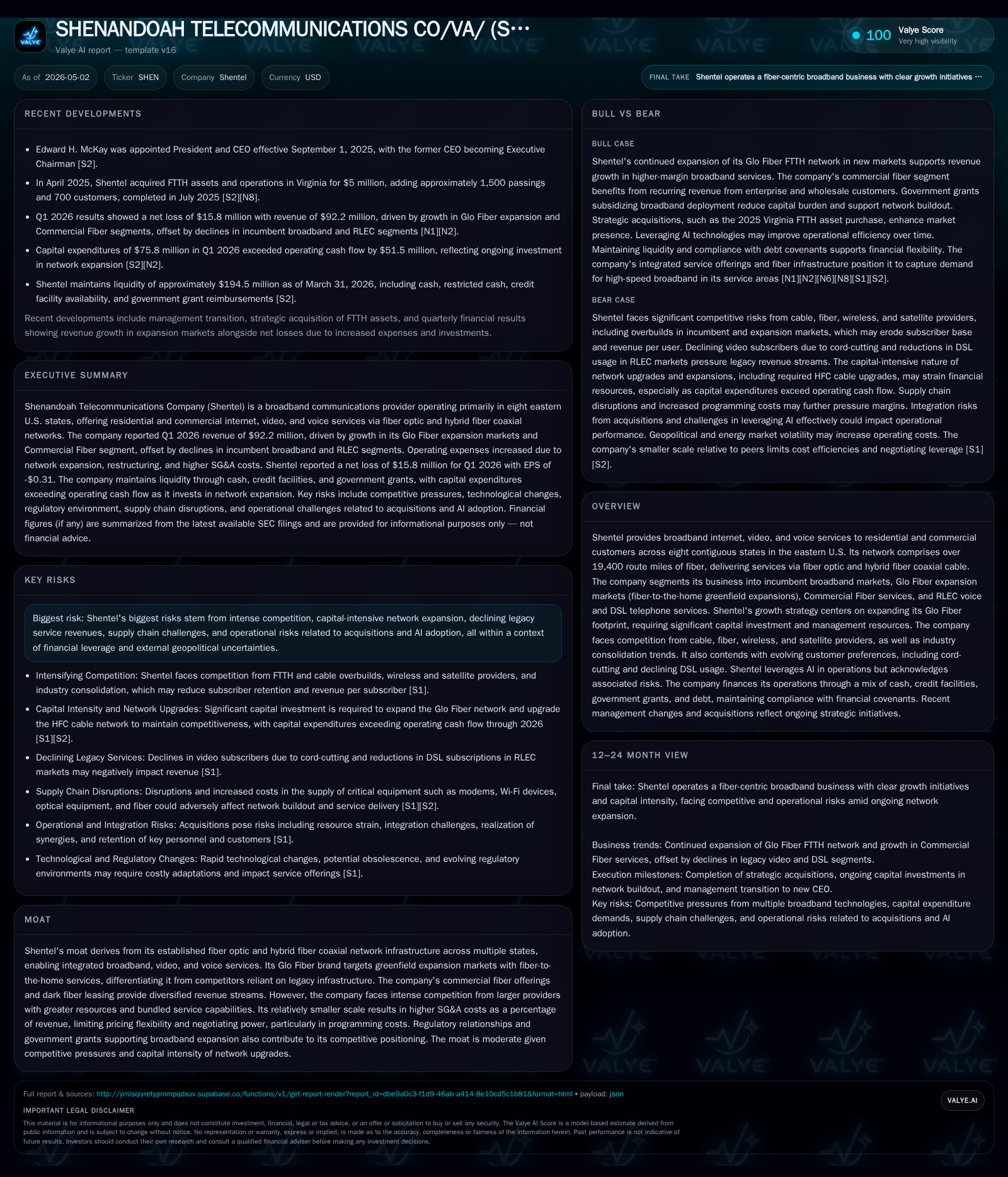
In Q1 2026, Shenandoah Telecommunications Company (Shentel) intensified its investment in the Glo Fiber broadband expansion, with capital expenditures significantly exceeding operational cash flows. While commercial fiber revenue grew moderately, the company grappled with margin pressure from higher expenses and legacy service declines. Facing a competitive broadband landscape marked by cable overbuilds and wireless convergence, Shentel leverages its integrated fiber and HFC network but must navigate capital intensity and evolving customer preferences. Future growth hinges on execution of fiber expansion milestones and managing operating leverage as the market consolidates.
Q1 2026 Operating Update: Investment Outruns Cash Flow
Shentel's first quarter results disclose a clear tension between growth ambitions and financial performance. Capital expenditures soared to $75.8 million—outstripping net cash generated from operations by $51.5 million—as the company aggressively expanded its Glo Fiber FTTH footprint [S2]. This dynamic persists as management expects capex to surpass operating cash flow for the entire year 2026 given ongoing buildout efforts.
Revenue for the quarter was up 4.8% year-over-year at $92.15 million driven primarily by a robust 34.6% increase in sales within Glo Fiber expansion markets ($24.8 million) alongside a modest 4.7% rise in Commercial Fiber revenues ($20.5 million) reflecting incremental circuit additions sold to existing customers [S2]. However, ramped-up expenses pressured margins: total operating expenses climbed 9.2%, including a notable jump in selling, general & administrative (SG&A) costs (+7.7%) and restructuring/integration expenses multiplying nearly fourfold due to post-construction workforce reductions planned for later in the year.
Depreciation & amortization surged 18.7%, underscoring heavy investment in network assets that directly feed future revenue potential but depress current earnings. Consequently, an operating loss of $10.47 million manifested—a steep increase of approximately 72% versus last year’s comparable period—while interest expense almost doubled reflecting debt service on recent financing arrangements [S2].
Overall, this quarter crystallizes Shentel's tradeoff between pursuing fiber-based growth opportunities while absorbing immediate margin pressure.
Shentel’s Business Model: Diverse Fiber and Broadband Services
Shentel operates an integrated regional broadband network spanning eight eastern U.S states via approximately 19,400 route miles of fiber-optic cable complemented by hybrid fiber-coaxial (HFC) infrastructure facilitating incumbent broadband services [S1]. Its business segregates into several key segments:
- Incumbent Broadband Markets: Serving residential and SMB customers primarily through legacy HFC or fiber where established; these markets experience some competitive overbuilds but retain significant share.
- Glo Fiber Expansion Markets: Greenfield FTTH builds targeting unserved or underserved areas aiming for superior bandwidth competitiveness but demanding heavy upfront capex commitments;
- Commercial Fiber Services: Providing Ethernet, dedicated internet access, wavelength services, dark fiber leasing and managed network solutions to enterprise customers with recurring revenue contracts contributing steadily growing top-line contributions;
- RLEC Voice & DSL: Traditional rural local exchange carrier voice services and DSL facilities; this segment is shrinking due to customer migration away from legacy voice lines and dial-up data.
The company's revenue mechanics involve recurring monthly fees paid by end customers for bundled internet/video/voice plans across residential/small biz sectors combined with contractual commercial purchases of bandwidth circuits and dark fiber leases [S1], [S2], [F1]. Price realization depends on competitive positioning in each geography; volume growth is driven structurally by broadband penetration especially via Glo Fiber expansions plus retention efforts against cord-cutting trends.
Bundled service offerings help mitigate churn risks though transitioning consumer video consumption increasingly favors OTT platforms posing headwinds to video subscriber counts historically supportive of ARPU mix.
Competitive Landscape and Industry Dynamics in Rural Broadband
Shentel faces a fragmented but intensifying competitive landscape:
- In incumbent areas, it confronts aggressive cable overbuild initiatives from large MSOs deploying upgraded DOCSIS standards aiming to protect share.
- Its Glo Fiber expansion markets encounter entrenched cable providers along with emerging FTTH competitors; roughly 30% of Shentel’s incumbent passings have FTTH or cable rivals impacting pricing flexibility.
- Wireless operators are entering broadband via fixed wireless access (FWA) technologies occasionally bundling telecom/wireless service packages that attract price-sensitive segments.
- Satellite services also represent alternative access methods particularly in very rural zones but face technological latency constraints leaving some room for terrestrial providers.
- Industry consolidation is underway with strategic mergers between wireless carriers and fixed broadband players possibly increasing resource asymmetry vs Shentel’s mid-tier scale.
This mooted scale disadvantage inflates Shentel’s SG&A costs percentage-wise limiting its ability to aggressively discount or subsidize customer acquisition while negotiating elevated programming costs weighing on video service profitability [S1], analysis.
Moreover, regulatory obligations around franchising and pole attachment agreements add operational friction potentially delaying timely infrastructure upgrades or expansions especially underground cabling requiring utility coordination [S1].
Growth Catalysts: Glo Fiber Expansion and Commercial Fiber Momentum
The centerpiece of Shentel’s strategy remains disciplined expansion of its Glo Fiber fiber-to-the-home network targeting unserved domiciles within its contiguous footprint covering ~307,000 passings contributed to ABS entities as collateral supporting securitized debt issuance [S2]. This approach aims to capture structural demand shifts toward gigabit-capable broadband in increasingly digital lifestyles bolstered during COVID-era work-from-home normalization.
Commercial Fiber simultaneously provides steady incremental growth leveraging existing enterprise relationships selling high-margin dedicated circuit services; Q1 showed +4.7% revenue improvement underscoring recurring contract stability despite general market headwinds [S2]. Its dark fiber leasing portfolio supplements diversification into wholesale connectivity plus MAN/WAN managed network solutions broadening addressable markets.
Scaling these segments effectively promises operating leverage benefits long term if deployment schedules maintain pace aided by government grants offsetting initial capital burdens yet requires careful cost management given upfront construction outlays dominating cash profiles through this year [S2], analysis.
Risks and Constraints: Capital Intensity, Competition, and Legacy Decline
The principal constraints inhibiting Shentel's near-term profitability include:
- Capital expenditure intensity remains elevated as expansion phases necessitate outsized spending exceeding operational cash generation; sustained reliance on financing may pressure balance sheet metrics absent stronger free cash flow conversion [S2].
- Competitive dynamics threaten market share sustainability as cable FTTH/cable hybrids seek overbuild parity or superiority; bundled wireless entrants could erode loyalty further alongside cord-cutting diminishing video ARPU weightings—a long-term structural shift reducing bundled revenue potential.
- Legacy DSL / voice erosion persists lowering RLEC revenues negatively impacting contribution margins overall; partial mitigation depends on offsetting new fiber revenues which require successful deployments coinciding with market adoption cycles.
- Regulatory complexity around pole attachments, local franchises compounded by supply chain challenges could delay rollout timelines increasing cost overruns or opportunity losses relative to rivals with more streamlined processes.
- Geopolitical fuel price volatility injects cost uncertainty elevating transportation expenses impacting installation crews particularly as rural deployment involves extensive travel/distances [S1], analysis.
- Anticipated necessary HFC upgrades impose additional capital demand risks if not completed timely risking accelerated customer defection risks to advanced FTTH offerings elsewhere.
These factors collectively augment operational execution risk amid sizeable leverage levels necessitating vigilant covenant compliance monitoring tied to ABS notes financing structures favoring stable asset-backed cash flows [S6].
Strategic Watchpoints: Execution Milestones and Market Signals
Market participants should focus attention on:
- Glo Fiber construction velocity: Tracking installation completions vs management schedules signaling achievable scale;
- Commercial circuit bookings: Incremental contract wins or renewals clarifying enterprise market traction;
- Margin development: Whether expected operating leverage materializes or if SG&A inflation / depreciation dampen progress;
- Customer subscriber trends: Net adds/losses in incumbent versus greenfield markets indicating resistance/resilience amidst competition;
- Regulatory approvals / subsidies: Any material changes in government funding programs (e.g., BEAD grants) enabling smoother CAPEX pacing or improving return projections;
- Commentary on future capex budgets aligned against EBITDA trajectories,
- Potential impacts from technological transitions like DOCSIS evolutions influencing incumbent competitiveness,
- Monitoring external macroeconomic events influencing input prices especially fuel affecting field operations logistics.- These signals collectively mark the viability of Shentel’s blueprint bridging growth aspirations against embedded financial pressures observed in early FY2026 disclosures.[S2],[N2]
Financial Snapshot: Liquidity, Debt Structure, and Operating Losses
Latest financial snapshot
| Metric | Value | Period |
|---|---|---|
| Cash & equivalents | $44mm | |
| 2026-03-31 | ||
| Current assets | $114mm | |
| 2026-03-31 | ||
| Current liabilities | $102mm | |
| 2026-03-31 | ||
| Current ratio | 1.12x | |
| 2026-03-31 |
Source: SEC companyfacts cache [F1].
This snapshot highlights a liquidity position supported by about $71 million in combined unrestricted plus restricted cash balances providing near-term runway for operations. The company's current ratio of 1.12x indicates a modest short-term balance sheet cushion amidst aggressive capex spend anticipated to continue exceeding operating inflows throughout calendar year 2026 reflecting sustained investment cycle execution priorities rather than cyclical distress signals [S2].
Disclaimer: This analysis is prepared solely for informational purposes based on publicly available SEC filings and related disclosures as of May 2026 without any investment recommendation or opinion regarding securities transactions.
Disclaimer: This is research-only, informational analysis and not investment advice. It may include AI-generated interpretation and general industry context. Always verify important details using primary sources.

Comments