
Four Corners Property Trust Advances Portfolio Growth with New $200M Term Loan and High Occupancy Net-Leased Assets
FCPT’s latest quarter underscores stable cash flow from a diversified restaurant and retail net-lease portfolio backed by new financing to fuel strategic acquisitions.
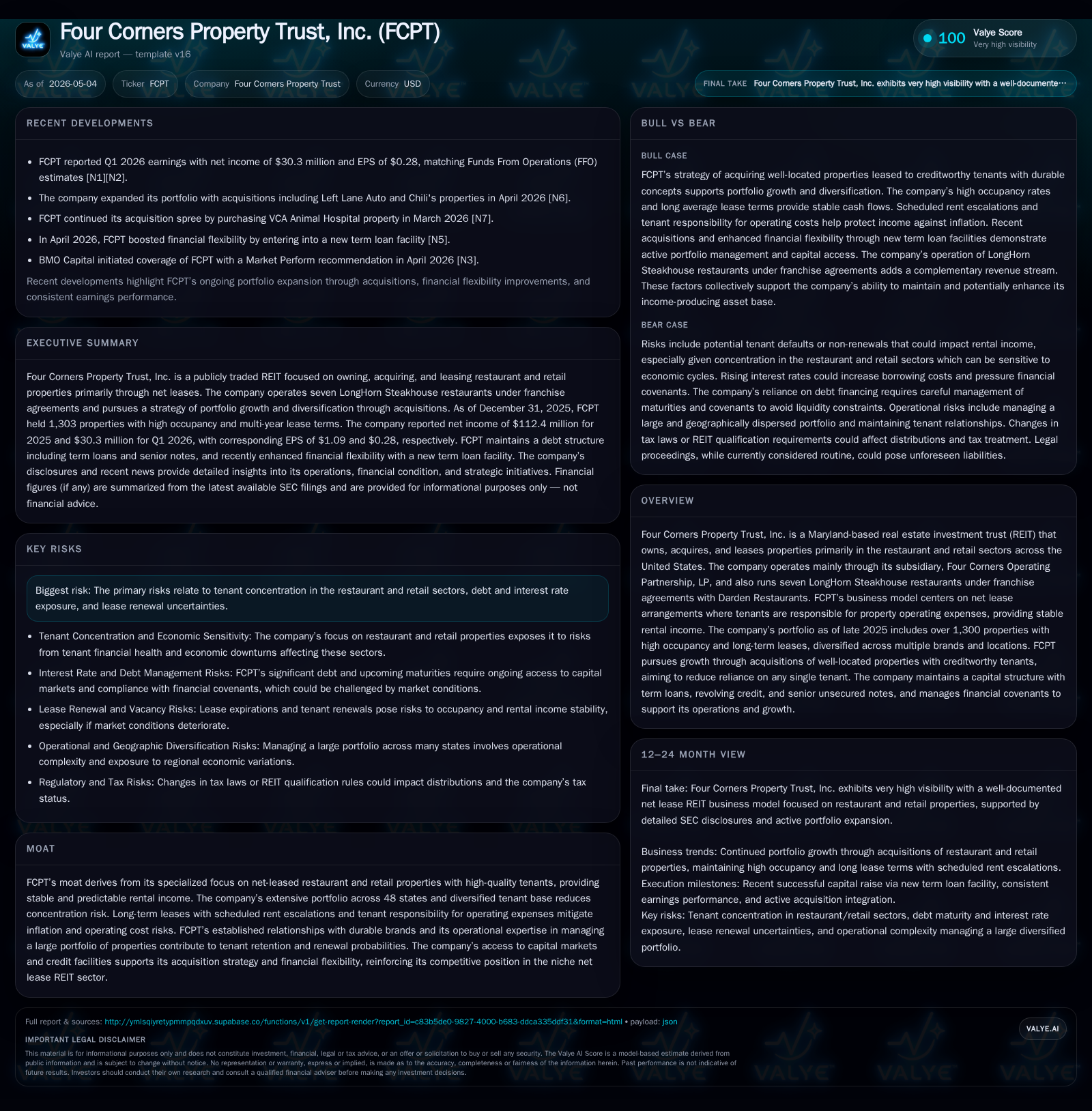
Four Corners Property Trust, Inc. reported steady operating performance in Q1 2026, supported by its high-occupancy net-leased restaurant and retail portfolio. The company enhanced financial flexibility through a $200 million senior unsecured delayed draw term loan facility, positioning itself for continued accretive growth via acquisitions. FCPT’s business model leverages long-term leases with creditworthy tenants responsible for operating expenses, which provides durable rental income insulated from inflationary pressures. Key growth drivers include targeted property acquisitions across varied brands and geographies and opportunistic capital deployment supported by strong tenant credit profiles.
Recent Operating Update: Q1 2026 Performance and Financing
In its latest quarterly filing dated April 30, 2026 [S2], Four Corners Property Trust (FCPT) affirmed consistent operating stability characteristic of its net lease restaurant and retail portfolio. Occupancy remains robust at approximately 99.6%, reinforcing cash flow visibility on over 1,300 properties totaling nearly 8.8 million square feet [S1]. Average lease duration weighted by annualized rent stands at about 6.9 years, complemented by fixed annual rent escalations averaging roughly 1.5% through the end of this decade.
Critically, FCPT solidified its capital structure by securing a senior unsecured delayed draw term loan facility totaling $200 million ($50 million funded at close) with The Huntington National Bank as administrative agent [S10][S17][S24]. The term loan features an accordion option that permits the company to raise an additional $100 million under certain conditions [S24]. Interest rates under this facility tie to SOFR plus a rating-based margin, offering potential for competitive financing costs relative to market benchmarks.
This fresh liquidity enhances FCPT's financial flexibility to pursue accretive acquisitions aligned with its strategy of growing a diversified portfolio leased to creditworthy tenants. The absence of amortization prior to maturity (April 2033) also preserves balance sheet stability amid evolving market conditions.
Business Model: Net Lease Focus on Restaurant and Retail Properties
FCPT operates primarily as a net lease REIT specializing in real estate leased mostly to restaurant and retail operators under triple-net lease agreements where tenants pay property taxes, insurance, and maintenance costs [S1]. This structure minimizes FCPT’s exposure to operating expense inflation while providing predictable rental income streams supported by contractual escalations.
Beyond property leasing, FCPT owns seven LongHorn Steakhouse locations operated under franchise agreements with Darden Restaurants, though management aims to reduce reliance on this single tenant group over time by broadening tenant diversity [S1]. Revenue stems predominantly from base rents collected under long-term leases; thus, the revenue mechanics depend heavily on occupancy levels, lease renewals, rent escalations embedded in contracts, and tenant financial health.
FCPT’s acquisition criteria emphasize well-located properties occupied by tenants whose operating cash flows substantially exceed their rent obligations — enhancing the likelihood of lease renewals and mitigating default risk [S1]. This selective approach supports portfolio quality and tenant longevity.
Industry Structure and Competitive Position
Operating within the niche net-leased real estate segment focused on restaurants and retail properties places FCPT among specialized REIT peers catering to consumer-facing operators who value owning rather than leasing real estate separately from operations.
FCPT’s moat is fortified by its expansive footprint spanning 48 states and diversified exposure across more than three dozen brands [S1]. Its sizeable asset base coupled with highly enforceable triple-net leases reduces geographic or brand-specific concentration risk compared to smaller or less diversified peers.
The company's established relationships with durable tenant brands—including franchise operations—foster retention advantages. Moreover, scheduled rent increases embedded in leases provide partial protection against inflation without requiring renegotiation or re-leasing efforts.
Growth Drivers
Acquisition-Driven Portfolio Expansion
FCPT continues actively investing in accretive property acquisitions targeting operators across multiple restaurant concepts (e.g., Chuy's, Hawaiian Bros) and retail sectors (e.g., United Rentals) [N6][N8][S1]. These transactions add scale, spread operational risk across diverse tenants and enhance rental income bases.
Capital Access via Fresh Term Loan Facility
The new $200 million term loan facility closed in Q1 strengthens FCPT’s ability to capitalize on attractive acquisition opportunities without immediate dilution or overreliance on existing revolving credit capacity [S17][N5]. The delayed draw structure allows capital deployment flexibility aligned with acquisition pipelines.
Tenant Quality and Lease Economics
Continued focus on tenants with strong cash flow coverage relative to rent sustains high renewal probabilities. Average annual rent escalations of ~1.5% provide structural revenue growth supporting dividends and reinvestment capacity [S13][S1].
Stable Operating Expenses through Triple-Net Leases
Tenant responsibility for operating expenses insulates FCPT from inflationary cost pressures—a critical advantage given volatility in property taxes, insurance markets, and maintenance overheads.
Risks / Watchpoints / Growth Constraints
- Tenant Concentration in Restaurant Sector: Although diversified across many tenants, a significant portion of revenue derives from restaurant operators who can be sensitive to economic cycles and consumer discretionary spending shifts [S1]. Economic downturns or changing consumer habits could impact tenant viability.
- Debt Maturities & Refinancing Risk: Scheduled maturities aggregate approximately $150 million in late 2026 and over $250 million in 2027 [S7][S19]. While management has extension options and available revolving capacity (~$350 million unused as of year-end) [S4], timely refinancing under favorable terms remains essential.
- Lease Renewal Uncertainties: Despite selectivity in acquiring properties with high operator profitability relative to rent, actual renewal outcomes hinge on future market conditions.
- Interest Rate Sensitivity: Though mitigated by hedging strategies, prolonged periods of rising interest rates could elevate borrowing costs upon refinancing existing debt or deploying new capital [S20].
What to Watch Next
Investors should monitor:
- Uptake on the delayed draw feature of the term loan facility indicating pipeline strength for new acquisitions.
- Quarterly updates on occupancy rates given economic variability in consumer sectors affecting restaurants/retail tenants.
- Lease renewal statistics particularly for leases maturing within next few years signaling underlying tenant health.
- Management commentary during earnings calls or presentations regarding acquisition targets, capital deployment pace, refinancing plans for upcoming debt maturities.
- Impact of macroeconomic factors such as interest rate movements on financing costs despite current hedging structures.
Financial Profile Summary (Q1 2026)
Latest financial snapshot
| Metric | Value | Period |
|---|---|---|
| Cash & equivalents | $29.6 million | |
| 2026-03-31 | ||
| Total debt | $1.215 billion | |
| 2026-03-31 | ||
| Net debt | ~$1.185 billion | |
| 2026-03-31 |
Source: SEC companyfacts cache [F1].
The company maintains liquidity through substantial cash reserves supplemented by undrawn revolving credit capacity ($350 million at end-2025) alongside the newly closed $200 million term loan facility providing extended runway for strategic investment without near-term pressure on cash flow ratios [F1][S2][S4][S17].
This analysis is based solely on publicly filed SEC documents up to April 30, 2026 ([S1]-[S29]), supplemented by timely news reports ([N1]-[N8]) without incorporating investment advice or forward-looking price targets.
Disclaimer: This is research-only, informational analysis and not investment advice. It may include AI-generated interpretation and general industry context. Always verify important details using primary sources.

Comments