
Middlesex Water Accelerates Infrastructure Investment with Regulatory Support and Targeted Acquisitions
Regulatory approvals and capital spending plans underpin Middlesex Water's sustained utility growth across New Jersey and Delaware.
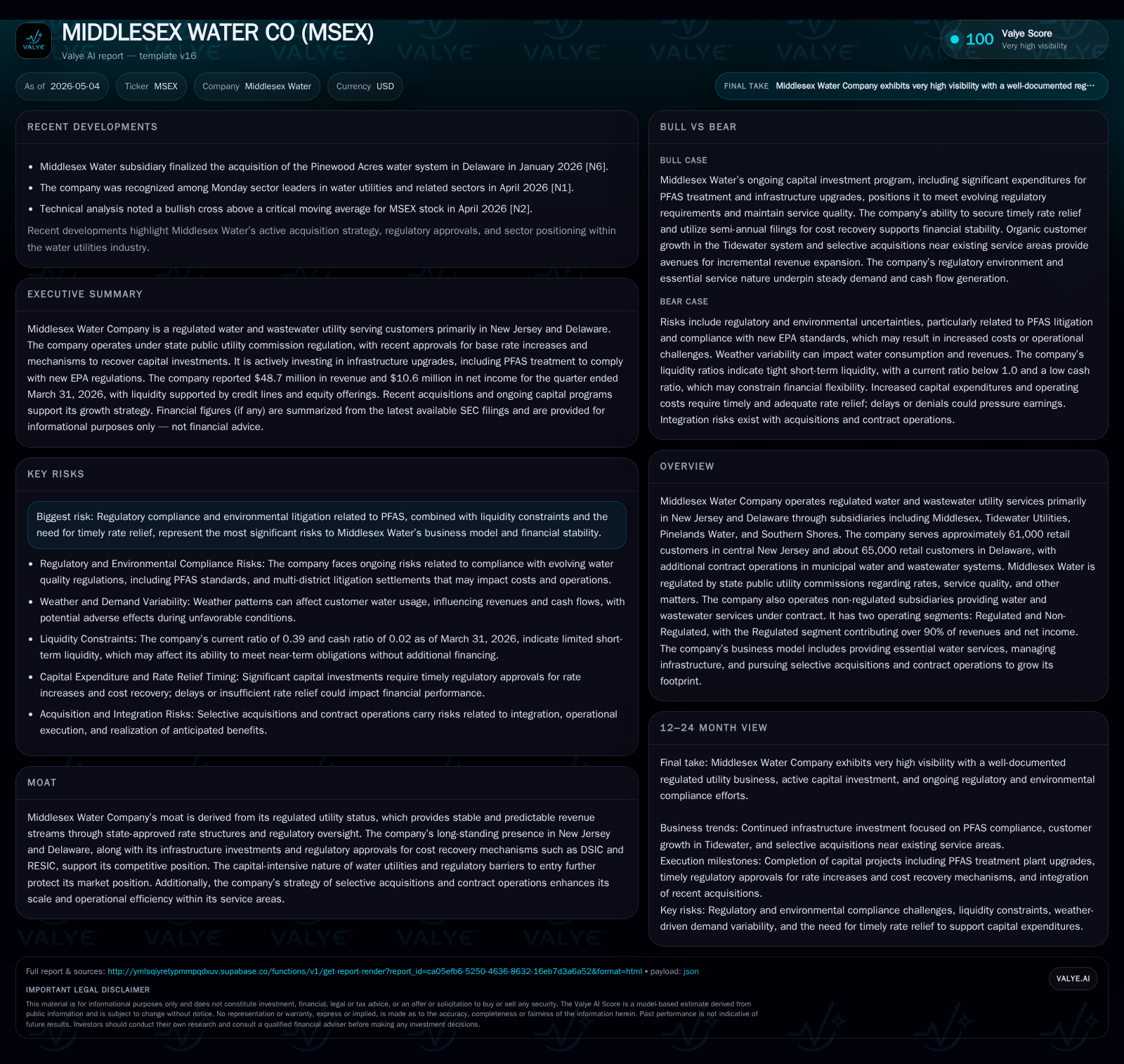
Middlesex Water Company reported operational continuity and financial stability for Q1 2026, supported by recent rate increases and regulatory approvals that enable recovery of infrastructure investment costs. The company serves roughly 126,000 retail customers primarily in New Jersey and Delaware and continues to focus on upgrading treatment facilities, including mandated PFAS removal, alongside strategic acquisitions in Delaware. Its regulated utility business dominates revenues and profits, while non-regulated contract operations supplement growth. Key risks include environmental compliance costs and maintaining timely rate relief amid liquidity constraints. Capital expenditures exceeding $500 million over three years underpin network resiliency and regulatory compliance.
Recent Operating Update
Middlesex Water Company’s first quarter ending March 31, 2026, reinforced operational stability supported by regulatory rate mechanisms and continuous capital deployment. The company filed its quarterly Form 10-Q and a related Form 8-K disclosing the quarter’s results [S2][S3]. Key highlights include the implementation of a $14.5 million base rate increase authorized by the New Jersey Board of Public Utilities (NJBPU) effective February 23, 2026, bolstering recovery of operating costs in the Middlesex System and Pinelands subsidiaries [S1][S24]. Additionally, the Delaware Public Service Commission had approved a $5.5 million base increase effective July 3, 2025 for Tidewater Utilities [S1][S24].
Moreover, foundational filings for Resiliency and Environmental System Improvement Charge (RESIC) and Distribution System Improvement Charge (DSIC) allow Middlesex to recover capital expenses between general rate cases. These regulatory charges cover investments addressing water quality standards, environmental compliance—including PFAS contamination—and system resiliency [S1]. This approach reduces lag in cost recovery which is critical given significant ongoing infrastructure spending.
Complementing regulatory support is the recent merger of Pinelands Water into Middlesex pursuant to NJBPU approval in January 2026 that streamlines operations under one corporate structure [S1][S24]. The company continues acquiring smaller utilities, such as the assets of Ocean View and Pinewood Acres in Delaware completed in April 2025 and January 2026 respectively [S1][S24]. These tuck-in acquisitions expand footprint incrementally within proximate service areas to enhance scale efficiencies.
Business Model
Middlesex Water’s business model centers on regulated water delivery services primarily across New Jersey (via Middlesex System) and Delaware (through Tidewater Utilities and Southern Shores). Serving roughly 126,000 retail customers collectively—with around 61,000 in central New Jersey and approximately 65,000 in Delaware—it provides potable water for domestic, commercial, industrial, municipal use along with fire protection services [S1].
The company's revenue derives mainly from tariffed rates determined and approved by respective state public utility commissions (NJ BPU & DE PSC), contributing over 90% of total revenues through long-term regulated contracts [S1]. These rates recover fixed operating costs plus allowed returns on invested capital ensuring stable cash flows typical of regulated monopolies.
Non-regulated subsidiaries operate under management contracts servicing municipal water/wastewater systems (such as utilities management contracts for Perth Amboy NJ until 2028) or contractual service arrangements including marketing partnerships with HomeServe USA Corp., which offers maintenance services through residential programs [S1]. These ancillary activities provide complementary revenue streams albeit at lower margins compared to utility operations.
Strategically, Middlesex invests heavily into its systems’ reliability via capital-intensive projects funded through internally generated cash flow coupled with periodic long-term debt issuances authorized by regulators—leveraging government-backed low-cost funding such as State Revolving Fund (SRF) loans—and equity sales under an ATM program [S1][S4][S25]. Regulatory structures like DSIC & RESIC enhance timely cost recovery aligning earnings with capital deployment.
Industry Structure and Competitive Position
The U.S. water utility industry is characterized by substantial barriers to entry including high infrastructure costs, stringent health/environmental regulations (federal & state level), extensive permitting processes, and regulatory scrutiny over price setting. Middlesex’s longstanding incumbency since 1897 in New Jersey plus acquisition-driven expansion into Delaware imbue durable market positions protected by state-issued franchises.
Middlesex competes primarily against investor-owned water utilities with overlapping geographic footprints but faces limited direct competition due to exclusive territorial rights granted by regulators. Its competitive advantages include established multi-decade regulatory relationships enabling consistent rate case outcomes aligned with capital needs; experienced operational management overseeing regulated assets; robust infrastructure replacement initiatives; and supplementary non-regulated service offerings that enhance customer engagement.
Like other water utilities subject to evolving environmental regulations such as PFAS contaminant limits imposed by the EPA starting April 2024—with lower maximum contaminant levels than previous state thresholds—Middlesex is required to invest substantially in treatment upgrades escalating capital intensity industry-wide. However, regulatory approval to recover these costs mitigates margin erosion while helping maintain service standards amid tightening water quality mandates [S14][S27][S29].
Growth Drivers
Capital Investment Program: Middlesex plans approximately $506 million of combined spending from 2026 through 2028 focused principally on distribution/network system upgrades ($175 million), production system enhancements including PFAS treatment ($310 million), IT system improvements ($5 million), plus other infrastructure needs ($16 million). Specific flagship projects include the RENEW Program for main replacements (
$12 million annual spend), transmission main replacement in Metuchen NJ ($16 million over two years), elevated storage tanks in Tidewater (~$22 million total), plus full-scale PFAS removal upgrades at the CJO Treatment Plant totaling ~$255 million across three years [S1][S19][S26].Regulatory Cost Recovery Mechanisms: The combination of base rate cases together with DSIC and RESIC filings enables faster pass-through of qualifying capital expenses reducing margin compression risks. This mechanism sustains cash flow visibility vital during periods of heavy capex.
Customer Base Expansion: Organic residential growth stands at ~3% annually in the Tidewater franchise area driven partially by new home construction amid an expanding franchise territory offsetting potential volume variability from weather or conservation efforts [S26]. Strategic tuck-in acquisitions like Ocean View further augment customer count incrementally while leveraging operating scale.
Non-Regulated Contract Operations: Contracted management of municipal utilities adds modest but stable service revenue enhancing overall earnings diversity.
Risks / Watchpoints / Growth Constraints
Regulatory Uncertainty and Rate Relief Timing: While recent approvals mitigate immediate risk, any unforeseen delays or denials of future rate increases could compress margins given rising O&M costs linked to inflationary pressures or expanded environmental compliance.
Environmental Litigation Exposure: Ongoing participation in multi-district PFAS litigation involves settlement uncertainties although prior settlements have been approved with reimbursements funneled back to customers limiting financial impact. Still, emerging regulation changes or unforeseen contaminants could introduce new remediation obligations elevating capex burden beyond current planning horizons [S27][S29].
Liquidity & Leverage Position: As of March 31, 2026, Middlesex Water holds $2.04 million in cash equivalents against total debt approximating $378 million resulting in a net debt position near $376 million [F1]. Current assets total approximately $46.8 million compared to current liabilities of about $119.7 million, indicating a current ratio of roughly 0.39 [F1]. This reflects a constrained short-term liquidity position requiring prudent working capital management.
Demand Volatility: Weather-related fluctuations may affect volumetric water sales impacting throughput-based revenues despite pricing mechanisms designed primarily on fixed charges.
Capital Execution Risk: Large-scale upgrades involve complex project management subject to cost overruns or scheduling delays potentially challenging earnings consistency.
What to Watch Next
- Progress on PFAS removal plant construction timelines particularly at CJO Plant as this represents both a major capex milestone and a test case for regulatory cost recovery efficacy.
- Semiannual DSIC/RESIC filing approvals providing insights into investment pacing versus amortization recoveries impacting near-term profitability.
- Announcements regarding additional small acquisition targets within existing franchise areas that could signal continued inorganic growth ambitions.
- Timing and magnitude of upcoming general rate cases covering New Jersey Middelsex System as well as Tidewater Delaware segments reflecting evolving cost structure dynamics.
- Quarterly updates on weather-driven consumption trends offering early indicators on demand stability or surprises impacting volumes.
- Any developments relating to PFAS multi-district litigation settlements beyond initial phase claims potentially influencing provisions or contingent liabilities disclosed.
Financial Profile Summary
Latest financial snapshot
| Metric | Value | Period |
|---|---|---|
| Cash & equivalents | $2mm | |
| 2026-03-31 | ||
| Total debt | $378mm | |
| 2026-03-31 | ||
| Net debt | $376mm | |
| 2026-03-31 | ||
| Current assets | $47mm | |
| 2026-03-31 | ||
| Current liabilities | $120mm | |
| 2026-03-31 | ||
| Current ratio | 0.39x | |
| 2026-03-31 |
Source: SEC companyfacts cache [F1].
As per the latest data as of March 31, 2026 [F1], Middlesex Water holds $2.04 million in cash equivalents against total debt approximating $378 million resulting in a net debt position near $376 million. This reflects a constrained short-term liquidity position requiring prudent working capital management.
Maintaining a balanced capital structure remains vital given substantial multi-year investment commitments estimated at over half a billion dollars through FY2028 alongside elevated regulatory scrutiny requiring demonstrated financial discipline.
Source: Latest available data from SEC filings ([F1],[S2],[S3]).
This analysis does not constitute investment advice or recommendations. It is based solely on publicly available information up to May 4, 2026.
Disclaimer: This is research-only, informational analysis and not investment advice. It may include AI-generated interpretation and general industry context. Always verify important details using primary sources.

Comments