
Mineralys Therapeutics Advances Toward FDA Decision with Lorundrostat NDA
The company highlights FDA NDA acceptance for lorundrostat with a PDUFA date set in December 2026, marking a pivotal regulatory milestone amid ongoing clinical validations.
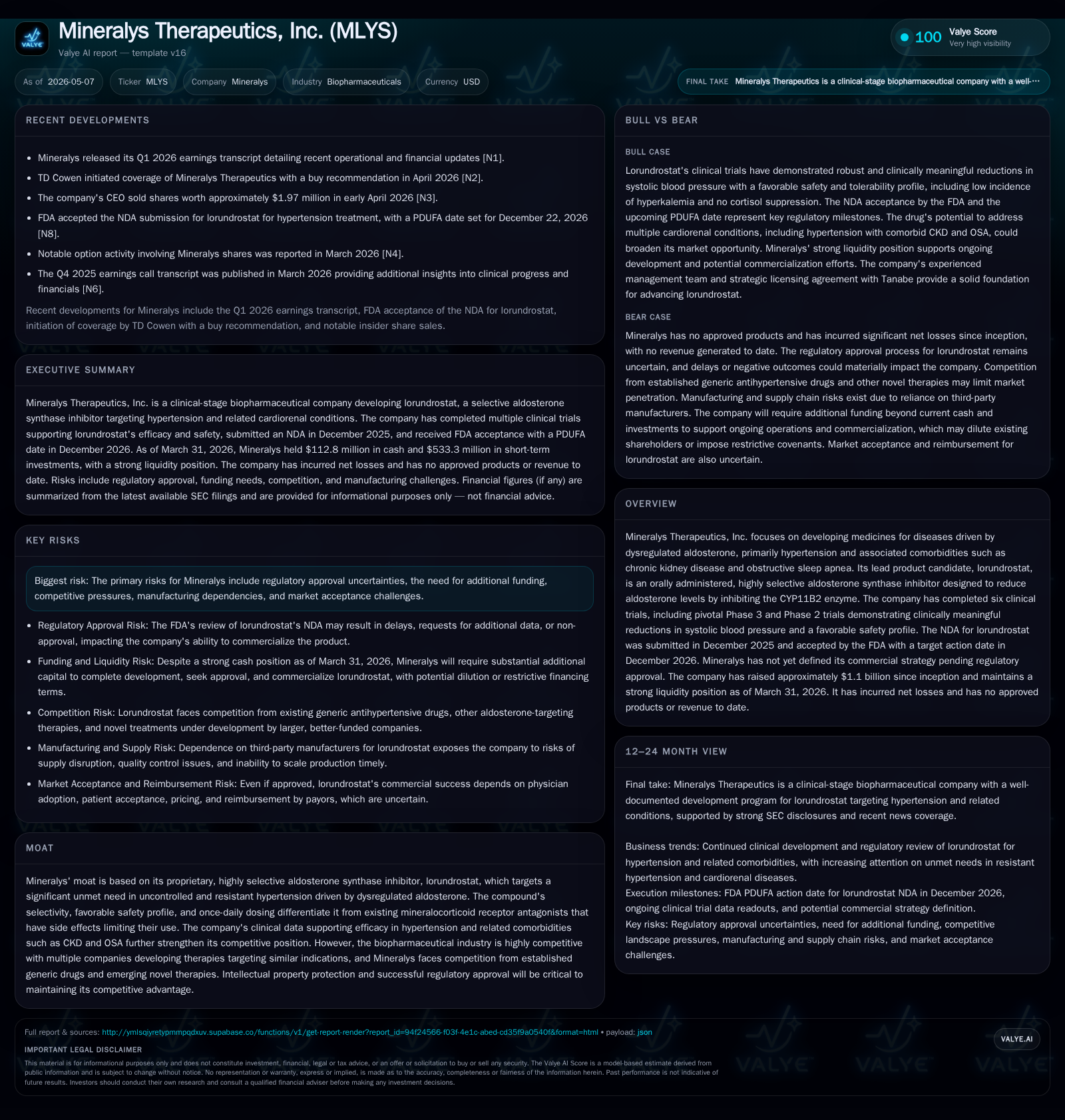
Mineralys Therapeutics reported its Q1 2026 results, emphasizing the FDA’s acceptance of its NDA submission for lorundrostat, a selective aldosterone synthase inhibitor targeting resistant hypertension. The company is awaiting the FDA’s December 2026 decision while continuing long-term clinical studies to bolster safety and efficacy data. Lorundrostat's differentiated profile addresses a critical unmet need in hypertension management, though competitive pressures and commercial strategy execution remain key challenges. Robust cash reserves provide runway into late-stage development and potential commercialization.
Latest Quarter Update and Regulatory Milestones
Mineralys Therapeutics issued its Q1 2026 report on May 6th ([S2], [S3]), confirming the U.S. Food and Drug Administration (FDA) has accepted its New Drug Application (NDA) for lorundrostat. This acceptance formalizes the review process leading to the Prescription Drug User Fee Act (PDUFA) action date scheduled for December 22, 2026. With no material changes reported regarding risk factors since the prior annual filing ([S2], [S7]), this milestone anchors Mineralys in a critical transition phase converging clinical development completion and near-term regulatory decisions. The company continues accrual of longer-term safety and efficacy data through its open-label Transform-HTN extension trial to reinforce confidence post-approval.
Lorundrostat: Business Model and Product Profile
Mineralys' core value proposition centers on lorundrostat, an orally administered aldosterone synthase inhibitor (ASI) targeting CYP11B2 enzyme inhibition to reduce aldosterone levels—the pathogenic driver implicated in roughly 30% of patients with uncontrolled or resistant hypertension ([S1]). Unlike mineralocorticoid receptor antagonists such as spironolactone that block the receptor but present dose-limiting side effects including hyperkalemia and endocrine disturbances, lorundrostat offers once-daily dosing with enhanced selectivity for aldosterone synthesis, potentially translating to improved tolerability and patient adherence ([S1]).
The product candidate's pivotal Phase 3 Launch-HTN and Phase 2 Advance-HTN trials demonstrated robust reductions in systolic blood pressure (sBP) alongside supportive safety metrics that underpin its NDA submission. Clinicians managing resistant hypertension—a subgroup with elevated risk marked by failure to control sBP despite multidrug regimens—constitute a targeted patient base where standard therapies fall short. Additional exploratory studies in chronic kidney disease (CKD) patients have revealed clinically meaningful decreases in urinary albumin creatinine ratio (UACR), which may position lorundrostat favorably within renoprotective indications ([S1]). While Phase 2 Explore-OSA trial results did not meet apnea-hypopnea index (AHI) reduction endpoints distinguishing obstructive sleep apnea (OSA), blood pressure benefits therein suggest utility in complex hypertensive phenotypes overlapping OSA ([S1]).
Currently, Mineralys has not articulated definitive commercial strategies pending regulatory clarity ([S2]). The monetization pathway hinges on successful market access execution upon FDA approval.
Competitive Landscape and Industry Dynamics
The antihypertensive market is crowded with generics primarily comprising mineralocorticoid receptor antagonists (MRAs), angiotensin-converting enzyme inhibitors (ACEi), angiotensin receptor blockers (ARBs), calcium channel blockers, diuretics, beta-blockers, among others. However, resistant hypertension linked to elevated aldosterone remains inadequately addressed by classical MRAs partly due to their unfavorable safety profile limiting prescription doses ([S1]).
Mineralys’ moat stems from lorundrostat’s mechanism—targeting the biosynthesis rather than receptor blockade—and its favorable Phase 2/3 clinical validation conferring differentiation through sustained blood pressure control with fewer off-target effects ([S1]). Maintaining robust intellectual property protection around its proprietary ASI scaffold will be vital given multiple companies exploring similar mechanisms or alternative agents addressing hypertensive subpopulations.
Regulatory approval represents both opportunity and risk; successful NDA clearance could position Mineralys as a pioneer in this niche but will invite competition from generics and emerging novel therapeutics. Pricing power may face constraints given existing affordable generics; thus, demonstrating superior efficacy-safety balance and real-world evidence could be crucial to payer acceptance and formulary positioning.
Key Growth Drivers and Clinical Developments
Several tangible catalysts underpin Mineralys’ projected growth trajectory. Foremost is the impending FDA decision set for December 2026 following the NDA acceptance ([S2]). Positive regulatory outcome would catalyze transition into commercialization.
Ongoing enrollment and data collection from the Transform-HTN open-label extension trial supplies long-term safety and durability insights vital for clinicians and payers, strengthening confidence in sustained benefit-risk profiles beyond initial pivotal data ([S1], [S2]).
Expansion of lorundrostat’s indication profile into CKD represents an important growth avenue, as early Phase 2 trial results showed significant reduction in UACR, a key surrogate marker linked to kidney disease progression. While OSA results were mixed, blood pressure improvements in that subgroup may inform future label claims or therapeutic positioning ([S1]).
Commercial uptake post-approval will depend on formulary negotiations and physician adoption driven by the drug’s once-daily oral convenience, selective mode of action, and manageable safety profile potentially enabling broader use within resistant hypertension cohorts ([S1]). Partnerships or licensing deals could facilitate distribution reach, though no agreements have been disclosed yet ([N3]).
Risks, Challenges, and Market Barriers
Notwithstanding clinical advances, Mineralys confronts a spectrum of execution risks. Regulatory hurdles remain paramount—FDA may require additional data or an advisory committee review, potentially delaying approval or necessitating costly studies ([S7]).
The company’s lack of commercial operating history amplifies uncertainty regarding market penetration capabilities and cost structure management. Manufacturing scale-up for commercial supply introduces complexity and risk given dependency on third-party contract manufacturing organizations (CMOs) with attendant quality consistency demands ([S7]).
Financially, the company has experienced substantial net losses exceeding $154 million annually reflecting ongoing R&D intensity without revenue inflows ([F1]). Continued funding needs persist until commercialization yields revenues; while cash reserves are adequate for at least one year post-March 2026 quarter end ([F1]), future capital raises or partner collaborations may be necessary.
Competitive dynamics expose Mineralys to entrenched generic alternatives and emerging therapies that could erode market share or pricing power. Payer acceptance hinges on cost-effectiveness assessments particularly amid increasing healthcare cost containment efforts ([S1], [S7]). Lastly, successful intellectual property enforcement amidst competitive challenges remains critical.
Upcoming Catalysts and What to Monitor
Stakeholders should watch for the FDA PDUFA action date on December 22, 2026 as the definitive near-term regulatory inflection point ([S2], [S3]). Interim data readouts from Transform-HTN will offer insights into sustained efficacy/safety narratives likely to influence prescriber and payer confidence.
Additional signaling may come from management disclosures detailing commercialization plans, partnerships, marketing infrastructure development, or licensing transactions aiming to broaden geographic or therapeutic reach ([N3]). Monitoring regulatory feedback—such as advisory committee scheduling or requests for supplementary clinical studies—will also be informative.
Any expansion programs targeting CKD or other dysregulated aldosterone-driven indications could emerge as follow-on catalysts enhancing revenue diversification potential.
Financial Snapshot and Capital Position
Latest financial snapshot
| Metric | Value | Period |
|---|---|---|
| Cash & equivalents | $113mm | |
| 2026-03-31 | ||
| Current assets | $652mm | |
| 2026-03-31 | ||
| Current liabilities | $15mm | |
| 2026-03-31 | ||
| Current ratio | 44.33x | |
| 2026-03-31 |
Source: SEC companyfacts cache [F1].
Mineralys exhibits a strong liquidity position with cash and equivalents of approximately $112.8 million as of Q1 2026 quarter-end coupled with minimal current liabilities resulting in a current ratio above 44 — indicative of solid short-term financial flexibility ([F1], [S2]). This buffer supports continued development and pre-commercialization costs in the near term.
Operating losses remain significant with $154.7 million net loss reported for calendar year 2025 reflecting intensive R&D investments primarily related to lorundrostat's clinical progression ([F1], [S9]). The lack of products generating revenue mandates ongoing capital raises or alternative financing mechanisms before reaching profitability.
In sum, Mineralys' financial profile aligns with expectations of a late-stage biotech heavily invested pre-revenue but sufficiently capitalized to bridge towards potential commercialization upon regulatory success.
This analysis is based solely on publicly available information as of the cited filing dates and does not constitute investment advice.
Disclaimer: This is research-only, informational analysis and not investment advice. It may include AI-generated interpretation and general industry context. Always verify important details using primary sources.

Comments