
Kennedy-Wilson’s Strategic Pivot Amid Acquisition Announcement and Q1 2026 Operations
Kennedy-Wilson updates on Q1 results framed by a pending acquisition agreement that reshapes near-term strategic and operational outlooks.
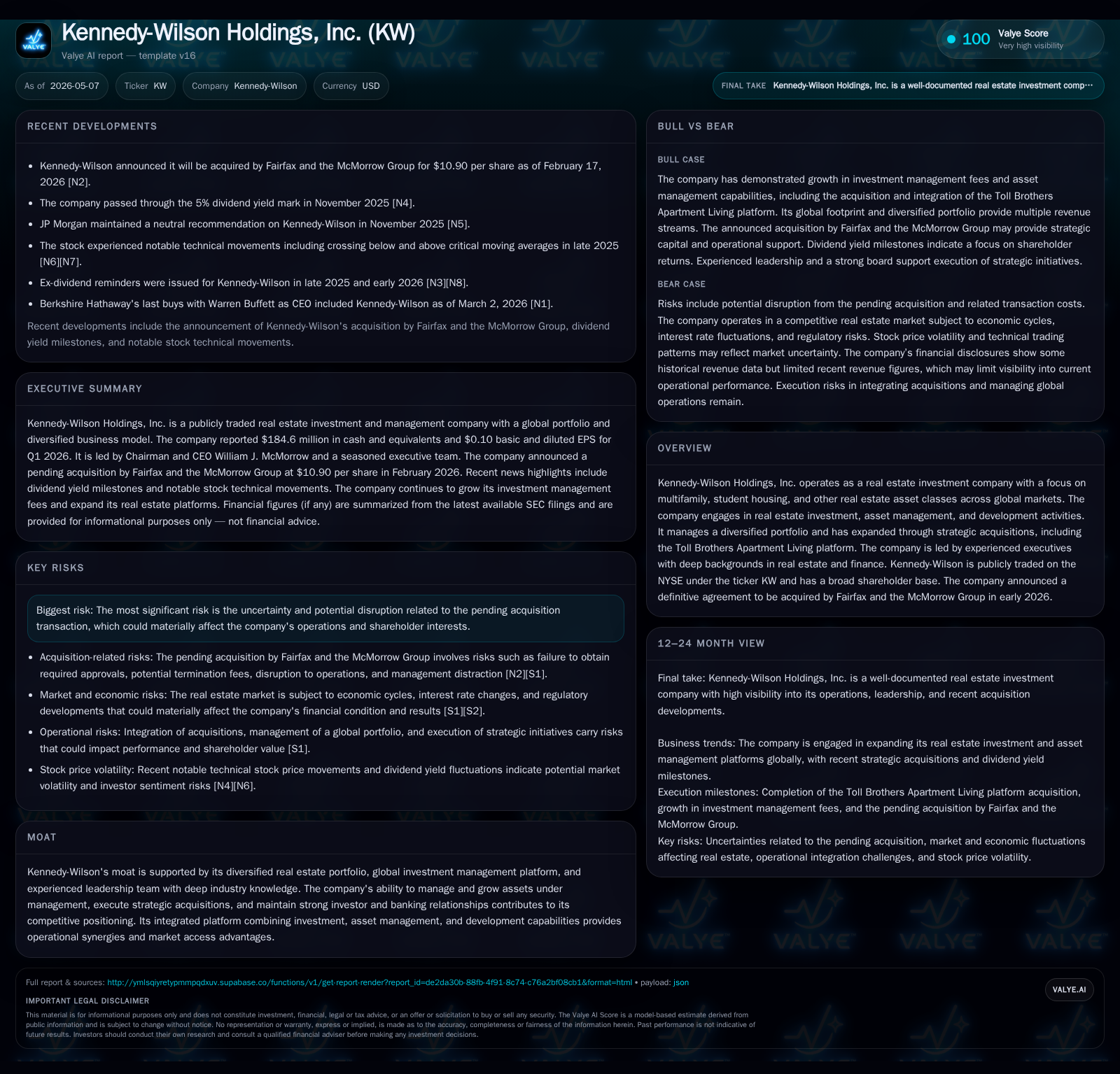
In its latest quarter ended March 31, 2026, Kennedy-Wilson continued operating its diversified real estate platform focused on multifamily and student housing assets globally, maintaining cash reserves near $185 million while facing unchanged risk factor profiles. Concurrently, the company announced a definitive agreement to be acquired by Fairfax Financial Holdings and the McMorrow Group, introducing significant near-term uncertainty and execution risk. Despite this transactional backdrop, Kennedy-Wilson's integrated investment and asset management platform sustains competitive advantages with portfolio diversification and strategic acquisitions like Toll Brothers Apartment Living. The coming quarters will be shaped by the progress of shareholder approvals and regulatory clearances, with operational resilience amid a cyclical multifamily market remaining key.
Latest Quarterly Operating Highlights and Acquisition Update
For the first quarter ending March 31, 2026, Kennedy-Wilson released its financial results highlighting continued operational execution within its diverse real estate portfolio focused mainly on multifamily and student housing assets globally [S2][S28]. Cash and equivalents stood at approximately $184.6 million as of quarter-end per companyfacts data [F1], affirming ample liquidity to support ongoing operations during an uncertain period. Importantly, the company disclosed no material changes to its risk factors compared to the prior annual report [S2], suggesting steady-state risks remain despite external transaction pressures.
The quarter’s disclosures are overshadowed by Kennedy-Wilson's announced definitive agreement to be acquired by Fairfax Financial Holdings Limited along with the McMorrow Group [S3]. This pending acquisition marks a pivotal point in company history with closing expected in Q2 2026 [S18]. The transaction introduces a complex overlay of execution risks including obtaining stockholder approvals, regulatory consents, management focus diversion, potential costs relating to the deal process, and market reaction dynamics [S4]-[S8]. These factors shape substantial near-term uncertainty while also delineating the path forward for shareholders who will cease equity participation post-close.
Despite substantial corporate governance activity related to merger milestones—such as proxy filings for stockholder meetings—the operational slate reported from Q1 indicates business continuity without disruption [S28]. Key performance indicators related to asset-level net operating income (NOI), recurring asset management fees, or investment management revenues did not signal stress or volatility tied to announcement effects within publicly disclosed materials.
Business Model Overview: Integrated Investment, Asset Management, and Development
Kennedy-Wilson operates an integrated real estate investment platform that combines ownership/acquisition of multifamily residences and student housing properties with development initiatives alongside an institutional-grade investment management platform [S1]. The company generates revenue principally through three channels: property-level NOI derived from owned real estate assets; investment management fees earned from managing third-party capital across funds and separate accounts; and ancillary income streams related to development activities that reposition or enhance asset value.
The firm's business model leverages geographical diversification across U.S., European, and some Asian markets alongside diversity in asset types. This mitigates risk concentration while enabling portfolio optimization against regional demand fluctuations [S1]. Additionally, strategic acquisitions such as the Toll Brothers Apartment Living platform have expanded scale significantly—adding both asset base and fee-generating capital under management—which provides synergies across operational platforms.
Leadership depth with extensive experience in real estate finance underpins execution capability as described in annual disclosures [S1]. This expertise facilitates identification of accretive acquisition targets as well as active asset repositioning aligned with shifting tenant preferences prevalent in multifamily living spaces.
Competitive Positioning Within Global Multifamily and Student Housing Sectors
Within highly competitive residential real estate sectors dominated by peers such as UDR Inc., SL Green Realty Corp., REITs specializing in similar property types operate amidst high capital intensity and regulatory constraints influencing supply dynamics [S1]. Kennedy-Wilson differentiates itself through an integrated approach marrying direct property ownership with active investment fund management—a dual strategy that supports multiple revenue pillars.
Its global footprint secures access to institutional capital flows biased toward resilient multifamily housing demand driven by demographic trends favoring rental tenure over homeownership. Moreover, vertical integration encompassing development functions enables swifter response times in optimizing property portfolios compared to more narrowly scoped competitors.
Barriers to entry remain firm due to high capital requirements for sizable portfolio accumulation plus regulatory hurdles placed on new residential developments impacting long-term supply growth. These market characteristics underpin favorable conditions for firms like Kennedy-Wilson possessing scale economies intertwined with fund management expertise.[S1]
Growth Drivers: Portfolio Expansion, Acquisition Synergies, and Asset Management Fees
Identifiable growth drivers for Kennedy-Wilson revolve around expanding Assets Under Management (AUM)—both through acquisitions of new properties/funds—and growing fee income emanating from increased capital commitments by institutional investors targeting resilient real estate sectors [S1]. Recent transactions incorporating platforms like Toll Brothers Apartment Living exemplify accretive consolidation boosting scale metrics along these lines.
Development pipelines focusing on asset repositioning offer opportunities to substantively enhance returns on invested assets (ROIA) by upgrading aging units or improving operational efficiencies—translating into higher property-level NOI.[S1] Strategic development paired with active asset dispositions facilitates dynamic portfolio rotation aligned with evolving market opportunities.
Fee income growth also benefits from rising investor demand for well-managed real estate exposure amidst macroeconomic uncertainties adversely impacting other asset classes. In particular, student housing is positioned structurally well given demographic cohorts entering higher education seeking quality accommodations—demand drivers largely insulated from business cycles.[S1]
Risks and Watchpoints Related to Acquisition Execution and Market Cyclicality
The foremost risk facing Kennedy-Wilson is successful consummation of the pending acquisition by Fairfax Financial Holdings Limited alongside the McMorrow Group—uncertainties here stem from obtaining stockholder approval, receipt of necessary regulatory clearances across jurisdictions involved, integration complexity post-close, possible transaction cost overruns, litigation exposures linked to deal processes, plus market volatility affecting valuation assumptions.[S4]-[S8]
Failure to close would expose share price downside risks while ongoing deal presence may distract senior leadership from routine operating priorities during transition phases.[S2] Interest rate volatility remains an important cyclical factor given sensitivity of property valuations in multifamily segments where capitalization rates fluidly respond to macroeconomic conditions impacting capital costs.[S2]
Moreover, sector-specific cyclicality related to rental demand shifts or regional economic downturns could pressure NOI if tenant retention or occupancy rates decline unexpectedly though portfolio diversification cushions localized shocks.[S2]
Beyond transaction-related event risks, standard REIT operational risks including tenant credit quality variability, local regulatory changes affecting rent controls or property taxes also warrant continuous monitoring.[S2]
What to Monitor Next: Pending Transaction Milestones and Early Financial Indicators
Critical near-term milestones encompass upcoming shareholder votes requisite for approving merger terms outlined in proxy statement filings anticipated imminently post-Q1 disclosures [S15][S17][S21]. Regulatory review processes controlling merger clearance remain active catalysts potentially extending into mid-2026 depending on jurisdictional complexities.[S18]
On the operating front, Q2 earnings release will serve as important evidence regarding business resilience during this transition window especially for stable trends in property-level NOI plus investment management fee recognition patterns.[S28]
Investor attention should also track any amendments in risk factors or unusual costs associated directly with transaction closure or integration preparations which could materially affect operating margins or cash flow statements.[S2]
Lastly, developments surrounding financing arrangements required for merger execution plus any shifts in credit ratings could herald implications for leverage metrics post-closing.[S5][S6]
Concise Financial Profile Supporting Operating Assessment
Kennedy-Wilson ended Q1 2026 with a robust liquidity position featuring approximately $184.6 million in cash & equivalents providing operational flexibility amid transactional uncertainty [F1]. While explicit current total debt figures are not detailed beyond prior disclosures indicating aggregate obligations around $4.4 billion historical data points,[F1] no contrary leverage statements emerged in latest filings suggesting stable refinancing profiles without immediate distress signals [S2].
Operating income commentary reflects steady state activity without significant margin compression attributable directly to deal-related activities as per quarterly disclosures [S2][S28]. This financial footing supports continued execution capability during accelerated corporate governance timelines linked to the acquisition agreement closure.
This analysis is based solely on publicly available SEC filings up through May 6, 2026 (10-Q) and associated event reports without speculative forecasts or non-disclosed internal data. It aims to contextualize Kennedy-Wilson's business strategy amid prevailing market conditions and transaction developments rather than provide investment advice.
Disclaimer: This is research-only, informational analysis and not investment advice. It may include AI-generated interpretation and general industry context. Always verify important details using primary sources.

Comments