
Hope Bancorp’s Loan Portfolio Focus and Regional Growth Set the Stage for Margin Resilience
Hope Bancorp’s Q1 2026 results reveal strengthened profitability and acquisition integration amid concentrated commercial real estate exposure and a robust SBA lending pipeline.
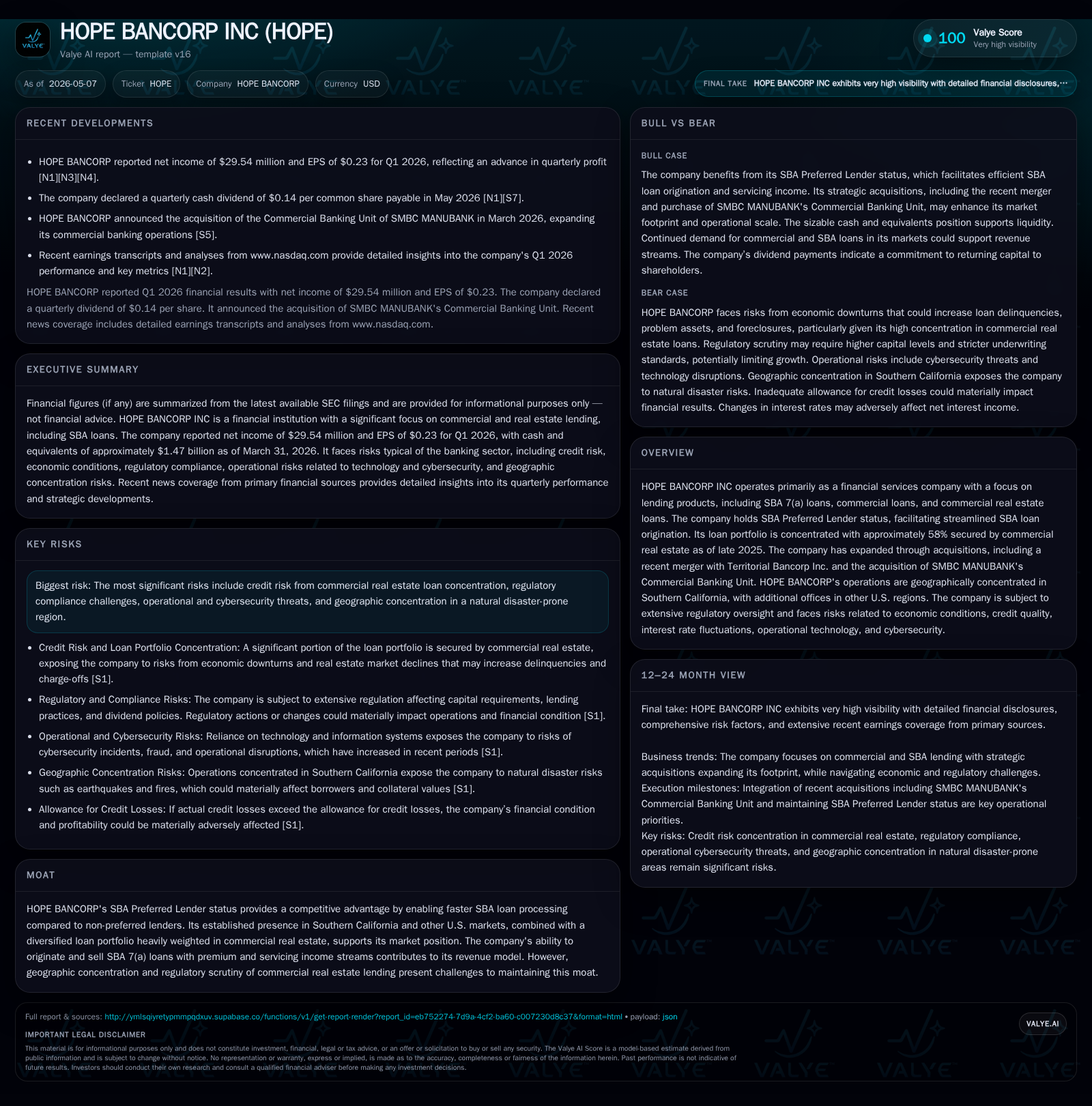
In Q1 2026, Hope Bancorp advanced profitability driven by increased loan origination volumes and successful integration of recent acquisitions, including Territorial Bancorp Inc. and SMBC MANUBANK's Commercial Banking Unit. The company maintains a concentrated portfolio with approximately 58% secured by commercial real estate, presenting regulatory scrutiny and credit risks but also supporting premium fee income streams. Its SBA Preferred Lender status enhances competitive positioning by enabling efficient SBA 7(a) loan processing, crucial for revenue diversification. Geographic regional concentration in Southern California alongside recent expansion amplifies both growth opportunities and risk considerations. Going forward, monitoring credit quality metrics, loan growth, and capital deployment will inform ongoing operational health.
Q1 2026 Operating Update Highlights
Hope Bancorp’s first quarter of 2026 marked a step forward in profitability with operating results surpassing expectations as disclosed in its April earnings release and SEC filings [S2][S3][N1]. The company reported robust origination volumes in its Small Business Administration (SBA) 7(a) loans segment alongside solid commercial loan demand. The integration progress of Territorial Bancorp Inc., merged in April 2025, continues smoothly with contributions now reflected in both loan book expansion and service fee income. Additionally, the acquisition of SMBC MANUBANK’s Commercial Banking Unit announced in March 2026 is expected to further extend their commercial banking footprint regionally.
The firm maintained its quarterly dividend at $0.14 per share reinforcing confidence in stable cash flow generation amidst macroeconomic headwinds [S3]. While the company’s portfolio remains heavily concentrated — roughly 58% secured by commercial real estate collateral — there have been no material changes in credit quality indicators across the first quarter as per management commentary. SBA loans continue to provide diversified income through premiums earned on sales to the secondary market combined with servicing fees on retained portions.
Business Model: Lending Focus, SBA Preferred Status, and Revenue Streams
Hope Bancorp operates primarily as a lending institution specializing in SBA 7(a) loans complemented by commercial loans and commercial real estate financing [S1]. Their SBA Preferred Lender status grants them accelerated application processing authority and preferential treatment versus non-preferred lenders — a strategic advantage that facilitates higher loan origination volumes and better customer retention. This certification acts as both a technical barrier to entry for competitors and a value proposition for business borrowers seeking streamlined access to federally-backed financing.
Revenue from the SBA loan portfolio derives from three main components: interest income on retained loans, premiums from sale of originated loans to investors (primarily SBA pools), and servicing income through ongoing administration of sold loans. The company’s ability to originate substantial volume of these loans allows it to generate recurring revenue streams that are less sensitive to interest rate fluctuations compared to traditional commercial loans alone.
Loans secured by commercial real estate constitute nearly six-tenths of total lending assets; this segment contributes both interest income as well as cross-sell opportunities for deposit products but exposes the bank to cyclical volatility tied to local property market valuations [S1]. Their operating model emphasizes disciplined underwriting reinforced by regulatory compliance requirements, helping mitigate credit risk while supporting steady fee generation.
Industry Context and Competitive Positioning in Regional Commercial Banking
Within the competitive landscape, Hope Bancorp distinguishes itself primarily through its SBA Preferred Lender status combined with its established presence in Southern California — a large market with significant demand for small business funding and diversified commercial activities. This positions the firm favorably against national banks less attuned to local borrower needs or without streamlined SBA capabilities.
The bank also has expanded footprints beyond California into other regional hubs such as New York City, Chicago, Houston, Dallas, Tampa, Seattle, New Jersey, Colorado, Georgia, and Alabama [S1]. This measured geographic diversification enhances resilience but introduces challenges around consistency of operations across decentralized markets.
Regulatory scrutiny continues intensifying with federal agencies focusing on underwriting standards for commercial real estate due to observed market weakness nationally. Institutions like Hope Bancorp face obligations to maintain higher allowances for potential losses along with increased capital buffers affecting leverage capacity [S1]. Pricing power appears durable given the company’s niche lending expertise but may be pressured if credit stress arises or deposit costs escalate.
Growth Drivers: Acquisition Strategy and SBA Loan Origination Dynamics
Strategically, Hope Bancorp is leveraging inorganic growth through carefully selected acquisitions which enlarge its serviceable market area while complementing organic loan growth trajectories. The recent merger with Territorial Bancorp Inc. broadened the deposit base significantly within Southern California enhancing funding flexibility [S2]. Moreover, acquiring SMBC MANUBANK's Commercial Banking Unit aims at capturing specialized commercial banking relationships that can cross-pollinate into broader product adoption.
On the organic front, the company benefits greatly from increased small business borrowing demand facilitated by its preferred lender designation within the SBA program. Such demand is structurally supported by policy emphasis on small business financing post-pandemic recovery efforts. This dual growth vector underpins margin improvement prospects through scale efficiencies in back-office servicing platforms, reduced cost-to-serve ratios, and elevated premium income realization on secondary SBA loan sales.
Risks and Constraints: Commercial Real Estate Concentration and Regulatory Scrutiny
A key risk resides in Hope Bancorp's significant loan concentration secured by commercial real estate (~58%), exposing it materially to cyclical downturns or localized market shocks that could adversely affect collateral values [S1]. Foreclosures in this segment come with longer holding periods due to illiquid assets compared to residential mortgages thereby intensifying credit risk exposure.
Regulators have heightened examination intensity surrounding this portfolio segment demanding rigorous stress testing and increased loss allowances which may constrain balance sheet leverage or require additional capital allocation potentially limiting growth capacity [S1]. Geographic concentration notably involves Southern California—an area prone to natural disasters—which exacerbates potential credit deterioration scenarios.
Operational risks also persist related to technological platform integrations from mergers alongside cybersecurity threats that financial institutions increasingly face under stricter compliance regimes [S2]. Although management reports currently controlled levels of charge-offs and provision adequacy, future economic deterioration could pressure net income performance.
What to Monitor Next: Earnings Guidance, Credit Quality Indicators, and Capital Deployment
Upcoming operational milestones include subsequent quarterly earnings announcements where analysts will closely track updated guidance on loan growth trajectories especially within the SBA portfolio as well as allowance for credit loss provision trends signaling underlying asset quality changes [S2][N1]. Equally important is observing continued dividend declarations which reflect free cash flow generation sustainability.
Execution progress on integrating SMBC MANUBANK’s acquired unit will be critical for realizing anticipated synergies such as expanded client engagement resulting in deposit inflows or fee revenue enhancement. Market participants should also monitor management commentary on regulatory capital compliance amid evolving supervisory expectations affecting future leverage decisions.
Brief Financial Profile: Balance Sheet Strength and Income Trends
Hope Bancorp maintains a robust liquidity position evidenced by total debt approximating $285 million offset against cash balances leading to net negative net debt — a strong cash surplus position conducive for funding organic lending growth or acquisitions without undue refinancing pressure [F1].
Net income measured at approximately $34.5 million per latest available data underscores steady profitability with margins benefiting from diversified revenue composition inclusive of SBA premiums and servicing fees plus interest yield spreads from core lending operations [F1].
This financial posture supports ongoing dividend payments at $0.14 per share level recently declared while maintaining prudent capital buffers required under intensified regulatory oversight ensuring institutional resilience.
This analysis is based exclusively on publicly available SEC filings and company disclosures as of May 2026. It does not constitute investment advice or recommendation.
Disclaimer: This is research-only, informational analysis and not investment advice. It may include AI-generated interpretation and general industry context. Always verify important details using primary sources.

Comments