
DMC Global Reinforces Industry Clout Despite Raw Material Inflation and Market Volatility
DMC Global navigates raw material cost spikes and geopolitical tensions through a diversified manufacturing portfolio and targeted growth initiatives.
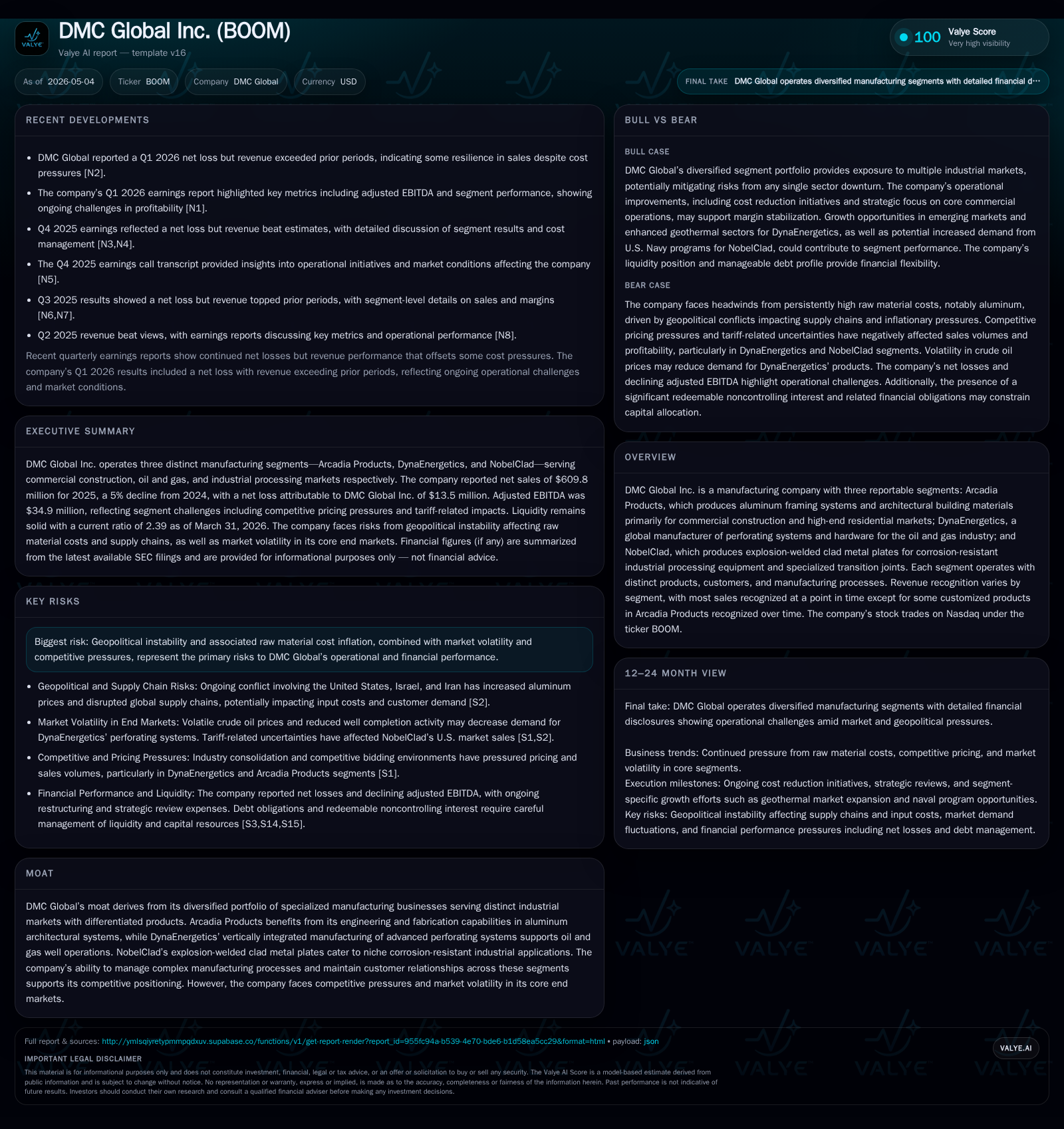
In Q1 2026, DMC Global reported revenue above estimates but posted a loss driven by surging aluminum prices and geopolitical instability affecting its supply chains. The company’s three distinct segments — Arcadia Products, DynaEnergetics, and NobelClad — serve diverse industrial markets with specialized products that underpin resilience amid sector volatility. While raw material inflation and softer end-market demand pose short-term challenges, DMC pursues new geographies and market segments to fuel growth. Maintaining solid liquidity and manageable leverage offers financial flexibility for capital expenditures and strategic investments.
Q1 2026 Operating Update: Inflation and Geopolitical Impacts Surface
DMC Global's latest quarterly filing dated April 30, 2026 ([S2]) revealed a mixed near-term operating picture marked by a revenue beat but an overall loss. The primary headwind was rising aluminum costs which surged to multi-year highs amid the escalating geopolitical tensions between the U.S., Israel, and Iran ([S2]). Although DMC lacks direct Middle East operations, the conflict prompted global energy supply disruptions fueling inflationary pressures on key inputs across all segments.
Specifically noted was Arcadia Products' challenge in passing through these higher raw material costs amidst a weaker construction environment ([S1], [S2]). Management emphasized ongoing efforts to manage supply chain volatility but cautioned that cost inflation will continue negatively affecting margin profiles in 2026.
Meanwhile, DynaEnergetics faces demand softness due to North American well completion uncertainty tied to crude price volatility. Nevertheless, expansion into emerging geothermal projects and non-North American shale regions presents offsetting prospects ([S1]). NobelClad's backlog improved late 2025 due to large international chemical orders despite U.S. market tariff-related challenges ([S1]).
An April 30 event filing ([S3]) corroborated these operational themes alongside additional detail that no materially new risk factors emerged beyond those articulated in the annual report.
Business Model and Product Differentiation Across Three Industrial Segments
DMC Global operates through three core segments with distinct product lines targeting different customers requiring specialized manufacturing processes ([S1], Valye Report):
Arcadia Products manufactures aluminum framing systems primarily for commercial construction and high-end residential architecture. Its products leverage advanced fabrication engineering but are exposed to fluctuations in aluminum prices. Revenue is mostly point-in-time except some custom projects are recognized over time.
DynaEnergetics designs and produces perforating systems critical in oil and gas well completions globally. Vertical integration supports quality control and margin capture. Demand here is cyclically tied to oilfield activity influenced by crude prices.
NobelClad specializes in explosion-welded clad metal plates used in corrosion-resistant industrial processing equipment and transition joints across marine and LNG applications. Its order backlog is an important near-term demand indicator given project-based sales cycles.
Each segment accounts separately for revenues and operating income ([S11]). This diversity provides resilience by diluting exposure to any single end market or commodity cycle.
Competitive Dynamics Within Niche Industrial Manufacturing Markets
DMC's competitive moat stems from its technical manufacturing capabilities customized for demanding industrial niches (Valye Report).[S1] highlights several challenges:
Arcadia Products contends with subdued construction activity shortening bidding pipelines while facing difficulty fully passing through elevated input costs in a competitive aluminum framing space.
DynaEnergetics experiences oilfield cyclicality typical of North America’s shale plays but counters this with strategic push into enhanced geothermal markets—where technologies overlap—and selected emerging shale basins worldwide.
NobelClad encounters tariff uncertainty impacting U.S. bookings but benefits from longstanding relationships supplying highly engineered clad metal solutions often critical in regulated environments such as naval programs.
Barriers include high engineering complexity, customer qualification cycles, and capital intensity of production facilities. However, these also expose margins to external shocks in commodity pricing or project funding cycles.
Growth Opportunities: Emerging Geographies and New End-Market Penetration
Strategic growth avenues identified by management center on geographic expansion and new end markets:
DynaEnergetics has scaled marketing efforts beyond North America targeting shale markets abroad while actively pursuing business within enhanced geothermal projects—a burgeoning clean energy sector leveraging hydraulic fracturing technology similarities ([S1], [S2]).
NobelClad aims to deepen penetration into naval contracts spurred by U.S. military readiness investments that require resistant clad metals for shipbuilding ([S1]). Recent backlog gains from international chemical plants demonstrate capability to secure large-scale project orders despite U.S. market softness.
Arcadia Products anticipates medium-term benefit if commercial construction rebounds or if targeted acquisitions can enhance regional footprint or product mix diversity ([S1]).
These growth drivers hinge on measurable indicators like backlog size (notably NobelClad’s increase to over $62 million late 2025) and bookings momentum in emerging markets.
Risks and Constraints: Commodity Costs, Market Cyclicality, and Geopolitical Tensions
The company's risk landscape is anchored by raw material cost volatility exacerbated recently by Middle East geopolitical upheaval causing unprecedented aluminum price spikes ([S2]). This directly constrains Arcadia’s margin recovery ability given limited pass-through power amid competitive tendering.
Additionally, fluctuating crude oil prices may suppress DynaEnergetics’ core well perforating demand via reduced drilling/completion activity. Moreover, potential tariff reinstatements or continuations weigh on NobelClad’s U.S.-based orders ([S1]).
Cycles in construction spending shrink new business opportunities selectively impacting Arcadia regionally. Financial market tightening globally could impair customers' capital access affecting project funding timelines across all segments ([S2]). These factors exacerbate risks around backlog realization timing or contract award delays.
Investor Focus: Upcoming Catalysts and Performance Watchpoints
Investors should monitor several pivotal metrics to gauge trajectory:
- Backlog updates across segments—especially NobelClad—to assess order pipeline strength amid macro uncertainty.[S1]
- Trends in key input prices like aluminum which heavily influence Arcadia Products' gross margin stability.[S2]
- Progress on announced cost reduction initiatives or tariff mitigation strategies that management indicated would be adapted if business conditions remain challenging.[S1]
- Developments regarding military spending decisions influencing NobelClad’s naval contract opportunities.
- Any escalation or resolution of Middle East conflict affecting global supply chains or energy pricing dynamics.[S2]
- Execution clarity surrounding international sales expansions for DynaEnergetics into emerging shale or geothermal sectors.[S2]
- Monitoring potential acquisition activity related to increased stake ownership interests within Arcadia Products.[S1]
These milestones will be critical signals of operational leverage against external headwinds.
Financial Snapshot: Liquidity Position and Leverage Overview
Latest financial snapshot
| Metric | Value | Period |
|---|---|---|
| Cash & equivalents | $31.5mm | |
| 2026-03-31 | ||
| Total debt | $54.0mm | |
| 2026-03-31 | ||
| Net debt | $22.4mm | |
| 2026-03-31 | ||
| Current assets | $301.6mm | |
| 2026-03-31 | ||
| Current liabilities | $126.0mm | |
| 2026-03-31 | ||
| Current ratio | 2.39x | |
| 2026-03-31 |
Source: SEC companyfacts cache [F1].
As of March 31, 2026 ([F1]), DMC Global reported cash & cash equivalents of approximately $31.5 million with total debt at about $54.0 million yielding net debt near $22.4 million. It does not constitute investment advice or recommendations regarding buying or selling securities of DMC Global Inc.
Disclaimer: This is research-only, informational analysis and not investment advice. It may include AI-generated interpretation and general industry context. Always verify important details using primary sources.

Comments