
JAKKS Pacific’s Q1 2026 Revenue Decline Reflects Challenges in Licensing and Retail Concentration
The company’s sustained licensing model and retailer dependencies continue to shape its operational risks and growth opportunities.
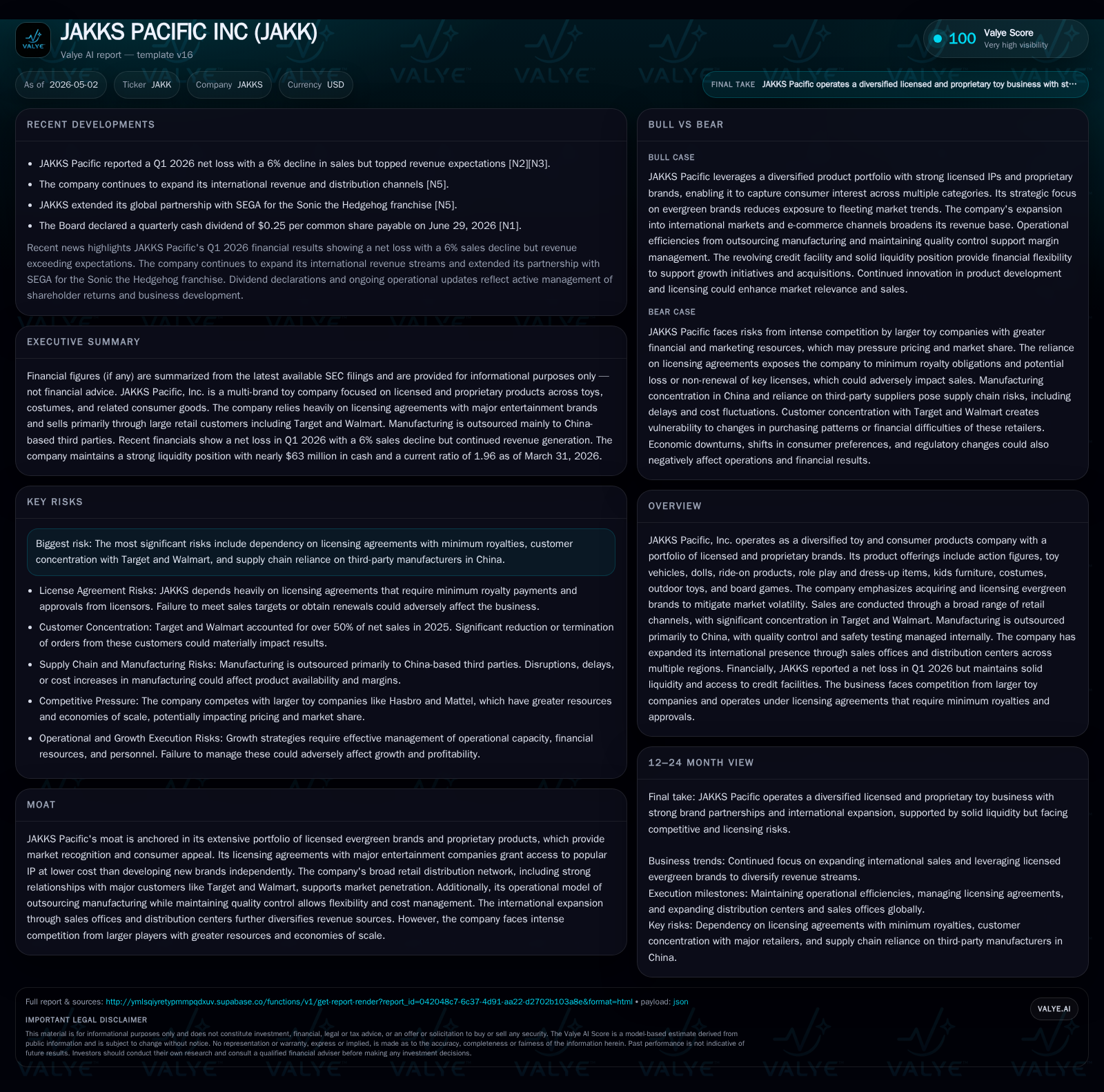
In its latest quarterly filing, JAKKS Pacific reported a net loss amid a 6% sales decline, reflecting ongoing pressures in the consumer products industry. The company’s core business is anchored in licensed evergreen brands distributed primarily through major retailers like Target and Walmart, which creates both competitive advantage and concentration risks. International expansion efforts, product innovation, and operational efficiencies are key growth drivers, but challenges include evolving consumer preferences, supply chain dependencies on Chinese manufacturers, and intense competition. A recent dividend declaration signals confidence despite near-term headwinds.
Recent Operating Update: Q1 2026 Highlights
JAKKS Pacific filed its most recent quarterly report on May 1, 2026 [S2], revealing continued top-line pressure with a reported net loss widening against prior year amid a 6% decline in sales [N2][N4]. While absolute financial metrics from the quarter were not explicitly detailed in the filings reviewed here, public commentary following the release confirmed these trends. Notably, the company declared a quarterly cash dividend of $0.25 per share payable June 29, underscoring management’s commitment to returning capital even during periods of profit contraction [S3].
This early-quarter performance update sets a clear near-term context: JAKKS faces challenges maintaining revenue momentum within an intensely competitive consumer products segment while grappling with evolving retail dynamics.
Business Model Overview
JAKKS Pacific operates as a diversified toy and consumer products company centered on acquiring and licensing well-known intellectual property (IP) that often qualifies as 'evergreen'—brands with enduring appeal beyond transient fads [S1][S7]. This portfolio includes licensed characters from major entertainment companies such as Disney®, Nickelodeon®, Nintendo®, Sega®, WarnerMedia®, among others [S9]. These licensing agreements enable JAKKS to leverage existing brand recognition at relatively lower development costs than building proprietary IP from scratch. However, licenses involve royalty obligations typically ranging from 1% to 22% of net sales with some minimum guarantees [S21]. The licensing strategy helps mitigate volatility by relying on popular franchises with consistent consumer demand but also exposes the company to renewal timing risks and dependence on licensors’ content decisions.
Revenue is generated predominantly through wholesale shipments of finished goods to major mass-market retailers including Target® and Walmart®, which together accounted for over 52% of net sales in 2025 [S4][S15]. Complementing this is distribution via department stores, specialty toy stores, e-commerce platforms such as Amazon.com and retailer websites, as well as international third-party distributors. The sales process involves in-house sales teams supported by independent representatives who actively market products to these clients.
Manufacturing is outsourced almost exclusively to overseas third-party suppliers primarily based in China [S10][S21]. This model grants flexibility to scale production while avoiding fixed manufacturing investments but creates risk exposure related to supplier reliability and geopolitical or logistics disruptions. JAKKS maintains ownership of tooling assets like dies and molds used in production—valued at $16.6 million as of December 31, 2025—which can be transferred among manufacturers if necessary [S10]. Quality control teams conduct ongoing inspections directly at supplier sites to maintain standards.
The product mix spans action figures tied to both licenses (e.g., Sonic the Hedgehog®, The Simpsons®) and proprietary brands (e.g., Creepy Crawlers®), toy vehicles under brands like Xtreme Power Dozer™, dolls including Disney Princess® lines, ride-on toys featuring properties like Bluey® and Fisher-Price®, role-play costumes connected to popular IPs such as Frozen®, kids’ furniture influenced by Disney characters, outdoor toys, board games, and novelty items [S1][S7]. JAKKS also produces certain private label goods exclusive for specific retailers.
Industry Structure and Competitive Position
The global toy industry is fragmented but dominated by giants like Mattel®, Hasbro®, and The LEGO Group that benefit from massive scale advantages in areas ranging from marketing investment pools to data analytics capabilities [S12][S19]. In contrast, JAKKS relies heavily on licensed IP rather than creating entirely original content. Its niche lies in leveraging these licenses cost-efficiently across multiple product categories combined with flexible outsourced manufacturing.
Retailer consolidation has increased buyers’ negotiating power; the two largest customers for JAKKS—Target and Walmart—command significant influence over pricing terms, promotional allowances, inventory management requirements including markdowns or returns [S4][S15]. This concentration increases commercial risk because any reduction or cancellation of orders would materially impact revenue.
JAKKS competes directly with larger companies particularly in major product segments like action figures (Mattel's Hot Wheels), dolls (Barbie), ride-ons (Fisher-Price offerings), and seasonal costumes (Rubies II) [S19]. Smaller importers also compete aggressively on pricing though they typically lack similarly strong licenses or broad retailer relationships.
Moreover, evolving consumer behaviors towards digital entertainment challenge operator relevance—as children adopt interactive technologies earlier they may age out of traditional toys faster [S14].
Growth Drivers
JAKKS' growth approach focuses on several pillars:
- Core Brand Expansion: Incremental product introductions extending existing IP lines with updated features or thematic extensions aim to prolong product life cycles despite shifting consumer tastes [S7][S18].
- New Product Categories: The company is exploring adjacent growth by entering segments like technology-infused classic video game consoles that link retro gaming with modern interfaces and protective gear aligned with skateboards introduced recently at retailer requests [S7][S18].
- Geographic Expansion: International sales represented approximately 27% of total net sales in 2025. Distribution hubs established across Europe (UK, Germany, Italy, Belgium, Spain), Mexico, Canada complement efforts targeting emerging markets especially Latin America and Asia via local representatives and distributors [S6][S9].
- Strategic Acquisitions: Historically effective at acquiring complementary businesses that add new brands or product capability sets bolsters the portfolio breadth without fully relying on internal R&D alone [S9].
- Operating Efficiencies: The infrastructure supports scalable growth without proportionate jumps in operating expenses which could enhance margins if volume rebounds materialize [S9].
Risks and Constraints
Key risks persist:
- License Dependency: Loss or non-renewal of valuable licenses could severely disrupt product availability given royalty commitments tied to high-profile IP [S14][S18].
- Customer Concentration: Over half revenues depend heavily on two retail giants; potential order cancellations or aggressive price demands raise vulnerability concerns [S15][S19].
- Supply Chain Reliance: Outsourcing manufacturing mostly in China exposes the company to geopolitical uncertainty, shipping delays or input cost inflation [S10][S17].
- Consumer Shifts: Accelerating preference for tech-enabled toys shortens traditional play cycles—demanding rapid innovation cycles that strain development resources [S14].
- Competitive Pressure: Larger peers possess more robust brand power enabling them to dominate shelf space while pushing for price reductions may erode margins for smaller competitors like JAKKS [S19].
- Regulatory Environment: Stringent safety standards require ongoing rigorous testing; any failure can lead to costly recalls impacting reputation significantly [S14][S17].
- Economic Sensitivity: As discretionary purchases for toys fluctuate with macroeconomic conditions changes could affect volume sold especially outside peak seasonal periods which compose majority sales volumes historically [S14].
What to Watch Next
Given recent results and disclosures:
- Monitor Q2 earnings for stabilization or further deterioration in revenue trends signaling how durable current demand challenges are given macro factors.
- Licensing renewals announcements will be critical as expiration dates approach impacting future product pipelines.
- Updates about international market penetration success especially after recent expansion investments will indicate if diversification away from US market concentration gains traction.
- Any shifts in retailer ordering patterns or partnership terms especially from Target/Walmart could materially signal shifts in competitive positioning.
- Operational metrics such as inventory turnover rates could indicate effectiveness managing seasonality risks amid evolving consumer interests.
Financial Profile Snapshot (as of March 31, 2026)
Latest financial snapshot
| Metric | Value | Period |
|---|---|---|
| Cash & equivalents | $63mm | |
| 2026-03-31 | ||
| Current assets | $229mm | |
| 2026-03-31 | ||
| Current liabilities | $117mm | |
| 2026-03-31 | ||
| Current ratio | 1.96x | |
| 2026-03-31 |
Source: SEC companyfacts cache [F1].
The nearly $63 million cash balance alongside a current ratio just below two reflects solid near-term liquidity despite recent profitability pressures. Reported total debt was last measured around $34 million at the end of calendar year 2020; no contradictory newer data was disclosed publicly since then in filings considered here ([F1]). The existing revolving credit facility maturing June 2030 provides financial flexibility but comes with covenants that must be carefully managed as emphasized in the risk disclosures about credit agreements ([S5],[S13],[S22]).
Conclusion
JAKKS Pacific continues navigating structural headwinds prevalent across the traditional toy industry segment: evolving kid preferences towards technology-rich entertainment options coupled with concentrated retailer relationships impose both barriers and vulnerabilities. The company's strategy leans heavily on leveraging well-established licensed properties combined with selective geographic expansion attempts abroad paired with incremental new product category adjacencies. Yet execution risks persist primarily around license renewal certainty alongside marketplace competitiveness exacerbated by dominant incumbents.
While near-term operating losses reflect these ongoing adjustment challenges amid modest top-line backslides as indicated by Q1 reporting data,[N2] JAKKS’ maintenance of dividends affirms management confidence addressing current hurdles leveraging its established brand equity base plus scalable infrastructure putatively enabling margin recovery if favorable demand inflections emerge going forward.
This analysis synthesizes publicly available regulatory filings through May 1st/2nd, 2026 without offering investment recommendations or forecasts beyond observed company disclosures.
Disclaimer: This is research-only, informational analysis and not investment advice. It may include AI-generated interpretation and general industry context. Always verify important details using primary sources.

Comments