
Dolby Laboratories Reinforces Market Leadership with Licensing Growth and Innovation
Dolby’s latest quarter reveals continued royalty strength and disciplined revenue recognition amid sustained R&D investment, underscoring its dominant IP licensing model.
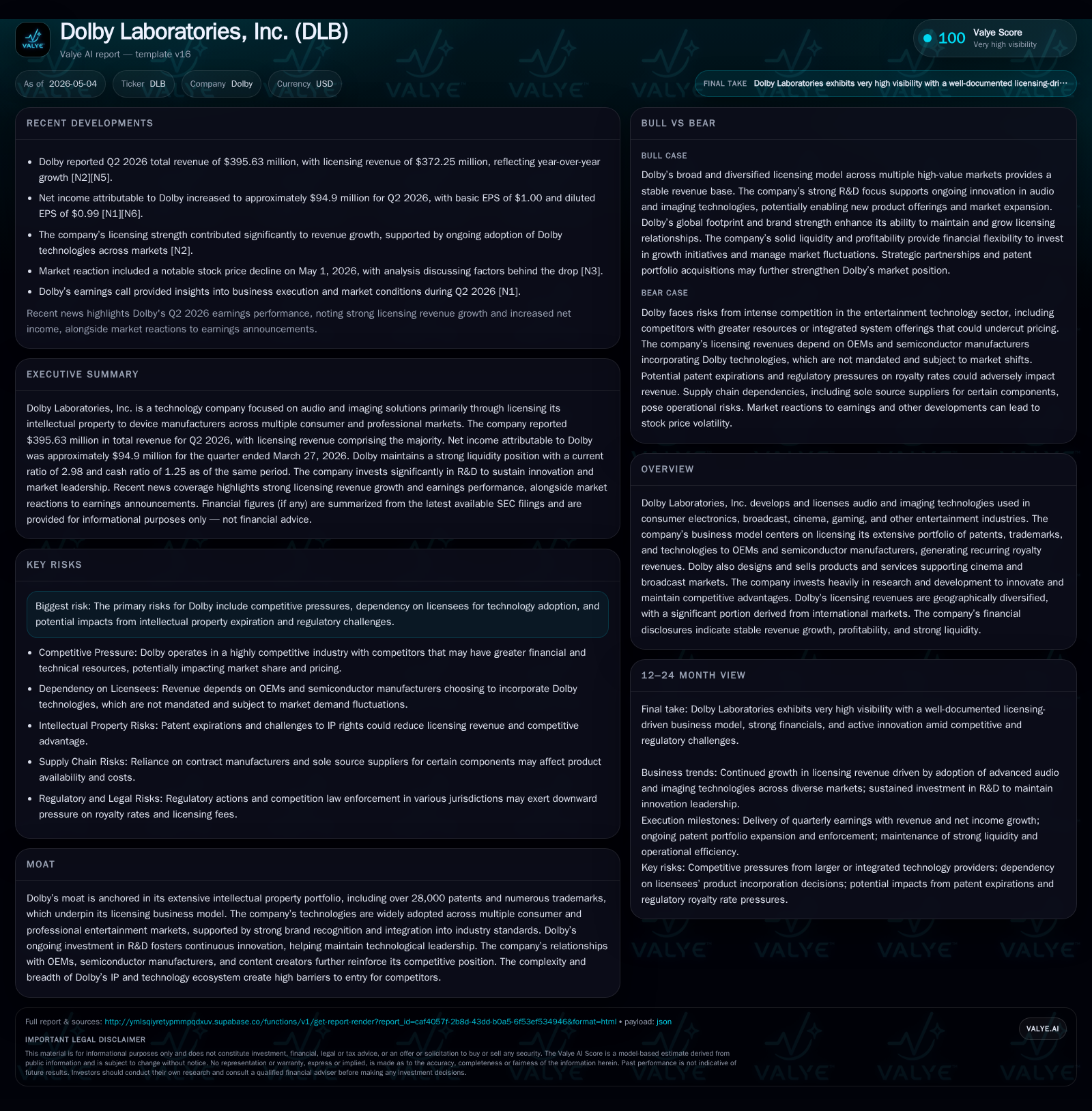
In the quarter ended March 27, 2026, Dolby Laboratories maintained steady license revenue performance with nuanced accounting treatment of variable consideration factors, emphasizing conservative revenue recognition. The company’s core business revolves around leveraging an extensive portfolio of over 28,000 patents to generate recurring royalty streams from OEMs and semiconductor manufacturers worldwide. Sustained heavy investment in R&D fuels innovation in premium audio/visual solutions such as Dolby Atmos and Vision, securing Dolby’s competitive moat amid evolving entertainment industry dynamics. Key risks include dependence on licensees’ market health and patent expiration, while growth is tied to expanding international cinema penetration and adoption of immersive formats. Financially, Dolby stands on a robust liquidity base evidenced by nearly $600 million in cash and a healthy current ratio of 2.98.
Latest Quarterly Operating Update: Licensing Performance and Revenue Recognition Changes
Dolby’s most recent 10-Q filing dated April 30, 2026 [S2] provides critical insight into its revenue recognition policies amid fluctuating industry conditions. The company identifies multiple performance obligations within its licensing contracts and calculates transaction prices incorporating variable considerations such as discounts, rebates, refunds, rights of returns, and incentives. Notably, Dolby updates its estimates regularly for these elements every reporting period to ensure precise revenue reflection.
A key detail from this quarter is the accruing of liabilities for potential returns and adjustments based on past return history—underscoring a conservative approach that mitigates revenue overstatement risks. This accounting rigor highlights inherent unpredictability tied to consumer-driven licenses where end-user purchasing behaviors can affect licensee reporting [S2]. The concomitant event filing on the same date [S3] further confirms Dolby's commitment to transparent communication regarding operational results without major deviation from expectations.
This cautious yet responsive stance in recognizing revenues points to near-term variability in royalty streams but preserves long-term license quality.
Dolby Business Model: IP Licensing Core and Product Solutions
Fundamentally, Dolby operates as an intellectual property powerhouse with a licensing-centric model that monetizes an expansive technology portfolio of over 28,000 patents alongside numerous trademarks [S1][F1]. These patents cover innovations in audio processing, imaging technologies, surround sound formats (notably Dolby Atmos), cinema enhancements (Dolby Cinema), and broadcast delivery systems.
The licensing revenues primarily accrue through royalties paid by consumer electronics original equipment manufacturers (OEMs), semiconductor producers embedding Dolby tech chips, broadcast companies adopting Dolby standards, and film studios producing content using Dolby-enabled technologies. This model yields recurring revenue streams based on unit sales or usage metrics defined per contract.
Complementing this is Dolby's products and services segment oriented towards cinema installations and broadcast support systems. Although smaller than licensing income, it offers diversification by capturing aftermarket upgrade services for theaters deploying immersive sound and image upgrades.
The business deeply invests in research & development to drive continual innovation which is vital to sustain royalties as markets evolve technologically–a critical factor given competitors’ attempts at alternative audio/visual technologies [S1][F1].
Industry Structure: Competitive Moat Through Intellectual Property and Brand Strength
Dolby’s resilience is anchored in its multi-decade accumulation of intellectual property facing few peers with comparable breadth or depth. This portfolio generates high barriers for entrants both due to the sheer number of patented innovations involved plus complex interoperability standards requiring licensed compliance.
Additionally, Dolby benefits from strong brand equity established among consumers (via cinema experiences) and industry players alike. Its name signifies premium audio-visual quality—a valuable intangible contributing to OEMs' willingness to incorporate its technologies despite licensing fees.
Industry dynamics also favor players like Dolby because content creators increasingly adopt immersive formats that depend heavily on proprietary tech integration; regulators indirectly bolster this through standards mandating use of licensed compressions or encodings.
This entrenched position reinforces customer loyalty among OEMs who weigh switching costs heavily due to firmware/hardware integration complexity plus ecosystem lock-in effects.
Growth Drivers: R&D Innovation, Market Penetration, and Emerging Entertainment Formats
Continued growth hinges substantially on Dolby’s ability to innovate aggressively. Its large R&D budgets enable pioneering new audio-visual experiences like the expansion of Dolby Atmos beyond theaters into mobile devices and headphones; similarly, Dolby Vision advances HDR imaging adoption across streaming platforms [N1][N2][S1].
Moreover, international markets remain fertile soil for expansion—particularly Asia-Pacific regions where cinema infrastructure investments are escalating rapidly. Partnerships with exhibitors overseas facilitate scaling of premium Dolby Cinema experiences potentially yielding incremental royalty licenses.
Emerging content formats featuring immersive soundscapes or high dynamic range imaging create new demand corridors upstream for device manufacturers needing licensing agreements for competitive differentiation.
These drivers align with measurable KPIs such as increased number of active license agreements globally and rising unit shipments embedded with Dolby tech.
Risks and Challenges: Competition, Licensee Dependency, and IP Expirations
Despite strengths, several notable risks warrant vigilance. Intense competition from alternative audio brands or open-source codecs could erode pricing power over time.
Licensee dependency remains material; downturns in consumer electronics cycles or delays in product launches can reduce royalty volumes sharply. Additionally, underreporting or non-compliance by licensees poses risk exposure detected only post-facto through audits or incentives adjustments [S1].
Patent expirations present a natural technological limit that may erode parts of the royalty base if not replenished by new IP development. Regulatory scrutiny around licensing practices also constitutes an external uncertainty impacting terms or enforceability.
Effective brand promotion remains imperative; failure here could diminish market preference weakening license uptake.
What to Watch Next: Future Guidance, Milestones, and Execution Risks
Following Q2 results release [N1][N2], attention should focus on updates regarding full-year guidance reflecting macroeconomic factors affecting OEM sales cycles. Monitoring operating margin trends amid shifting mix between stable recurring licenses versus more variable contract revenues provides insight into sustainability.
Key milestones include accelerating rollouts of next-gen formats internationally with footprint expansion in emerging markets poised as potential catalysts. Contract renewal statistics serve as leading indicators for long-term royalty stability.
Competitive positioning will be tested based on ability to maintain R&D lead amid emerging rivals offering commoditized alternatives or integrated system-on-chip solutions with embedded audio capabilities reducing licensing reliance.
Latest Financial Snapshot: Liquidity and Profitability Highlights
Latest financial snapshot
| Metric | Value | Period |
|---|---|---|
| Cash & equivalents | $594mm | |
| 2026-03-27 | ||
| Current assets | $1415mm | |
| 2026-03-27 | ||
| Current liabilities | $475mm | |
| 2026-03-27 | ||
| Current ratio | 2.98x | |
| 2026-03-27 |
Source: SEC companyfacts cache [F1].
As supported by the latest companyfacts data [F1], Dolby's balance sheet remains strong:
| Metric | Value (USD) | Period Ending |
|---|---|---|
| Cash & Equivalents | 594,282,000 | |
| 2026-03-27 | ||
| Current Assets | 1,414,709,000 | |
| 2026-03-27 | ||
| Current Liabilities | 474,606,000 | |
| 2026-03-27 | ||
| Current Ratio | 2.98 | |
| 2026-03-27 |
This healthy liquidity position supports ongoing R&D investments without reliance on external financing while roughly a threefold current ratio indicates solid short-term solvency buffers. While operating income was approximately $265 million reported at fiscal year-end September 2025 [F1], recent quarters maintain profitability reflecting effective cost control alongside revenue generation from licensing deals.
This analysis is prepared solely for informational purposes based on publicly available SEC filings and news sources as of May 2026. It does not constitute investment advice.
Disclaimer: This is research-only, informational analysis and not investment advice. It may include AI-generated interpretation and general industry context. Always verify important details using primary sources.

Comments