
German American Bancorp Expands Regional Footprint with Heartland Integration
Recent quarterly disclosures reveal progress in integrating Heartland Bancorp, underscoring growth in GABC’s regional branch and loan portfolio amidst competitive and regulatory challenges.
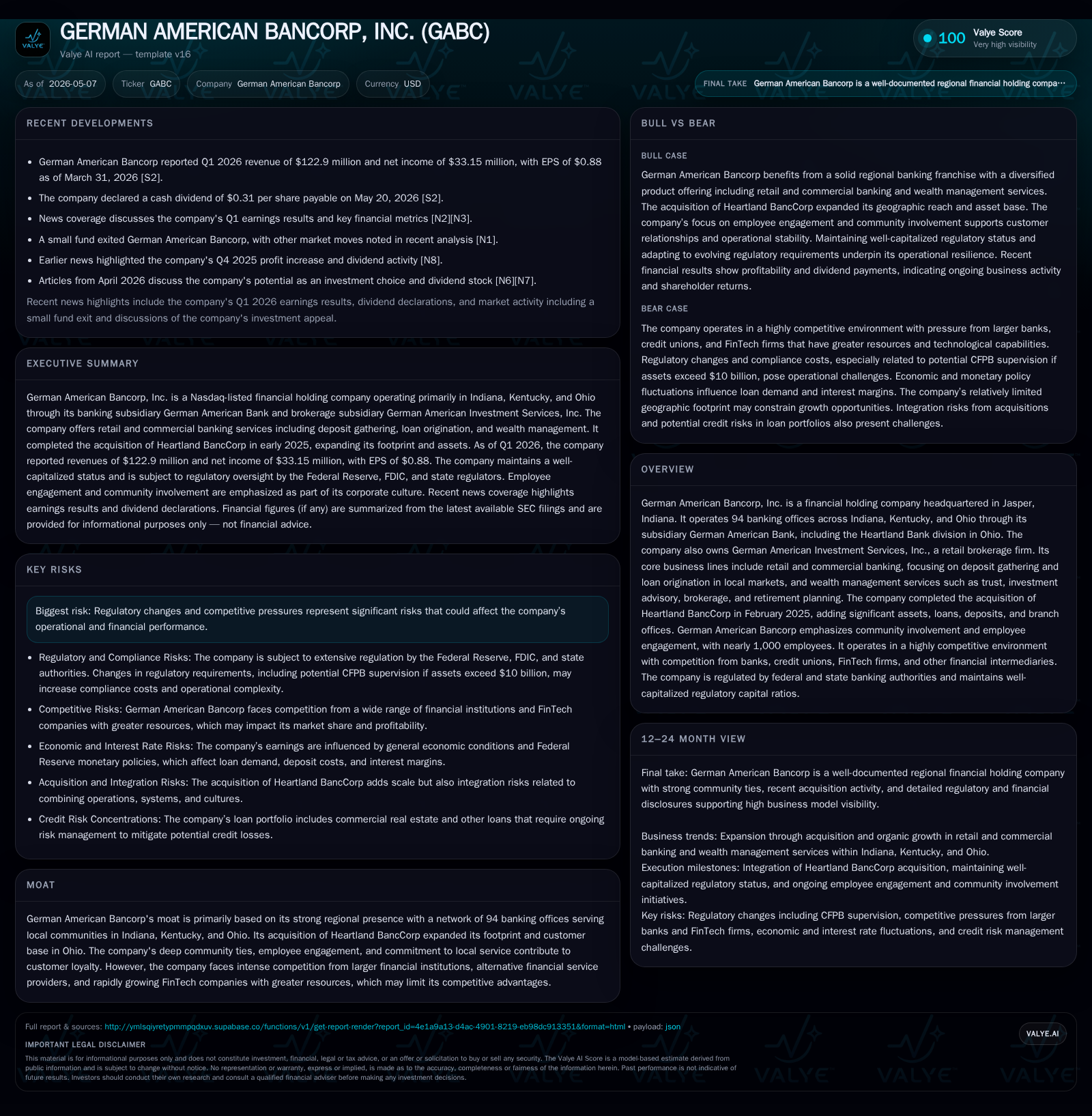
German American Bancorp’s Q1 2026 report highlights ongoing post-acquisition integration of Heartland Bancorp, contributing to expanded assets, deposits, and branch network primarily in Ohio. The company’s core model combines localized commercial and retail banking with wealth management services focused on its tri-state footprint. While intensifying competition from larger banks and FinTechs pressures margins, acquisition synergies, deposit growth, and digital initiatives provide avenues for expansion. Regulatory capital requirements are met comfortably, with the firm proactively preparing for potential CFPB supervision as asset size approaches $10 billion. Key risks include competitive dynamics, regulatory shifts, and credit concentration in commercial real estate. Upcoming milestones will shed light on margin stabilization and digital product adoption.
Q1 2026 Operating Update: Integration and Performance Highlights
The May 6, 2026 Form 10-Q filing ([S2]) anchors recent operational developments at German American Bancorp (GABC). The quarter marked tangible progress in integrating the Heartland Bancorp acquisition completed February 2025 ([S1], [S4]). This strategic move added approximately $1.94 billion in assets, $1.73 billion in deposits, roughly $1.58 billion in loans, and an additional 20 retail branches primarily serving Columbus and Greater Cincinnati markets in Ohio. Although Q1 net income modestly missed estimates ([N2]), management commentary accompanying the simultaneous 8-K filing ([S3]) emphasized the contribution of these newly acquired branches to deposit growth momentum and local market penetration.
The expanded asset base provides scale benefits but has yet to fully translate into margin accretion as integration-related expenses persist. Importantly, no significant credit deterioration or operational disruption was reported amid merging systems and teams.
Chief Executive Officer D. Neil Dauby highlighted ongoing branch consolidation analysis along with customer acquisition efforts aiming to leverage community ties within the combined footprint ([S3]). These operational updates matter now as they reveal the near-term trajectory of the bank’s growth platform post-acquisition while balancing efficiency pressures.
Core Business Model: Regional Commercial and Retail Banking Plus Wealth Management
GABC’s business revolves around localized retail and commercial banking coupled with wealth management services delivered through its wholly owned subsidiaries ([S1]). Revenue is principally generated by:
- Deposit gathering: attracting low-cost core deposits from households and businesses within Indiana, Kentucky, and Ohio.
- Loan origination: extending commercial loans (notably commercial real estate loans comprising over half of the portfolio), residential mortgages frequently sold into secondary markets, and consumer loans.
- Wealth management: through German American Investment Services providing brokerage, trust administration, investment advisory, and retirement planning services.
This combination aims to deepen customer relationships via community banking virtues – personalized service backed by local knowledge – yielding loyal depositors while diversifying fee income through financial advisory offerings ([S1]). Employee engagement is emphasized as a strategic asset supporting high touch customer interaction.
Loan portfolio quality remains sound despite sizable commercial real estate exposure (~53%), maintained under prudent underwriting policies aligned with federal regulatory guidance on CRE concentrations ([S6]). The firm actively manages risk controls including loan monitoring systems.
Regional Banking Market Structure: Competition and Regulation Dynamics
Operating across three neighboring states grants GABC geographic diversification but subjects it to intense competition across its branch network ([S1]). Competitors range widely from large national banks with superior technology budgets to local community banks competing on relationship banking. Additionally, credit unions present alternative deposit avenues with tax advantages.
Emerging FinTech platforms targeting payments, lending niches, or digital-only deposit products further fragment customer attention particularly among younger demographics ([S1], analysis).
Regulatory scrutiny scales with balance sheet size; GABC qualifies as an “Established Small Institution” under FDIC categorizations given assets below $10 billion but expects to cross this threshold potentially as soon as 2027 ([S27]). This transition would trigger direct Consumer Financial Protection Bureau supervision imposing expanded compliance obligations.
Capital requirements under Basel III remain comfortably met with robust CET1 ratios above minimums granting a well-capitalized status ([S5], [S7], [S10]). However incremental regulations like CECL adoption have been fully phased-in impacting capital calculations but manageable within current buffers ([S8]).
The Community Reinvestment Act modernizations present uncertainty due to ongoing litigation delaying effective implementation beyond initial planned dates ([S12]).
Growth Drivers: Acquisition Synergies, Deposits & Loan Origination Expansion
Heartland Bancorp’s absorption completed last year fundamentally reshaped GABC’s growth profile by delivering scale—the addition of roughly one-fifth more branches concentrated in Ohio enhances reach substantially ([S4]). This enlarged physical footprint unlocks cross-selling possibilities between retail-commercial clients and wealth management prospects expanding wallet share per household or business.
Further growth drivers include:
- Deposit base expansion: reinforced by the added branches; increased depositor diversity improves funding stability against rate cycle fluctuations.
- Loan book growth: focus on higher-yield commercial loans within stringent credit limits leverages local market expertise fostering prudent portfolio expansion ([S2]).
- Digital transformation initiatives: spearheaded by a newly appointed Chief Digital & Information Officer since January 2026 — bringing over two decades of fintech experience focused on AI integration and digital banking product innovation ([S1]).
Advances in mobile banking usability paired with backend automation aim to reduce operating costs while enhancing customer acquisition efficacy through modern channels.
Risks and Constraints: Competitive Pressure, Regulatory Environment, Credit Exposure
While the expanded footprint promises scale benefits, competitive hurdles constrain margin expansion:
- Pressures from larger peers wielding broader digital toolkits force pricing compression on deposits and loan products.
- Emerging fintech challengers seeking market share threaten traditional relationship banking relevance especially for younger demographics who prefer mobile-first solutions ([S28], analysis).
- Commercial real estate exposure remains a focal point; though conservative underwriting prevails today, sector downturns could amplify credit risk requiring vigilant monitoring given portfolio concentration (~53%) below regulatory thresholds ([S6]).
- Cybersecurity is an active area of oversight with dedicated governance including an Enterprise Risk Management (ERM) Technology Committee led by the CDIO supported by an Information Security Officer since late 2025—deploying advanced threat monitoring tools like SIEM platforms to counter evolving cyber risks ([S1]).
- Regulatory flux around CFPB supervision due to rapid asset growth imposes compliance cost uncertainty potentially impacting profitability or strategy adjustments in coming years ([S27]).
Forward Watchlist: Upcoming Earnings Milestones, Digital Initiatives, Deposit Trends
Key near-term indicators to monitor include:
- Next quarterly earnings releases: will reveal further progress in merger-related cost synergies translating into margin recovery alongside volume growth validation post-integration.
- Deposit sensitivity: tracking beta to interest rate changes will indicate funding cost flexibility amidst shifting monetary policy environments ( [N1], [N2]).
- Digital product adoption pace: adoption metrics from mobile/online service rollouts under new CDIO leadership will provide clues on future client retention gains or new wallet capture opportunities.
- Non-interest income trends: particularly from wealth management fees aiding revenue diversification beyond net interest margins.
- Management commentary during investor roadshows or shareholder communications will also help clarify potential capital deployment plans including acquisitions or tech investments ([S3], [N5]).
Financial Overview: Capital Adequacy and Profitability Snapshot
As of December 31, 2025 data from companyfacts confirms total debt standing near $100 million reflecting a moderate leverage stance supportive of organic growth initiatives without excessive risk-bearing ([F1]). Net income annualized to ~$113 million underscores profitable operations notwithstanding integration expenses.
The bank subsidiary exceeds all key Basel III common equity Tier 1 (CET1), tier 1 capital ratios and total risk-based capital thresholds permitting classification as "well-capitalized" under applicable Prompt Corrective Action regulations ([S5], [S7], [S10], [F1]). This strong capitalization positions GABC well for absorbing potential regulatory burdens expected upon crossing the $10 billion asset mark anticipated within approximately one year.[S27]
Dividend payouts remain consistent reflecting confidence in cash flow generation capability while retaining sufficient internal capital buffers for strategic flexibility.[N11]
This analysis synthesizes German American Bancorp's recent operational disclosures anchored in their latest quarterly SEC filings supported by supplementary annual context. It seeks to provide a balanced industry-aware perspective focused on tangible business drivers without projecting investment recommendations.
Disclaimer: This is research-only, informational analysis and not investment advice. It may include AI-generated interpretation and general industry context. Always verify important details using primary sources.

Comments