
Array Technologies Advances Utility-Scale Solar with Patented Tracker Expansion
Q1 2026 reveals progress in integrating APA acquisition and scaling patented solar tracker production amid ongoing leverage management.
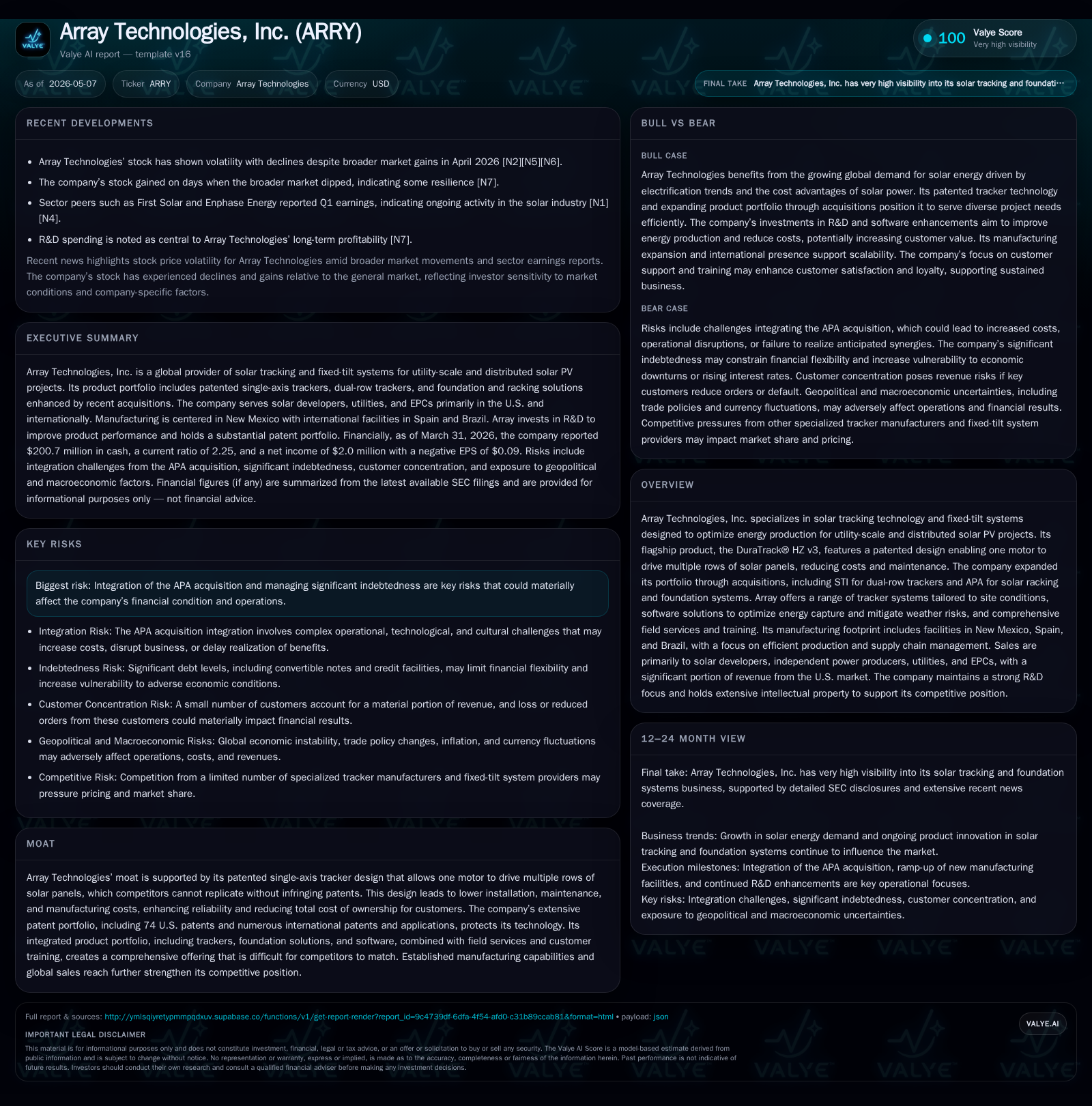
Array Technologies' Q1 2026 filing underscores continued integration of its $185 million APA acquisition, alongside advancing production at a new Bernalillo County manufacturing facility. The company leverages its patented single-axis solar tracker technology, augmented by an expanded product portfolio including dual-row and terrain-flexible trackers, to sustain competitive advantages in utility-scale solar. While growth drivers include market expansion and software optimization, risks from integration costs and substantial net debt remain key considerations. Monitoring operational scale-up and synergy realization will be critical in the near term.
Q1 2026 Operating Update Reflects Integration and Innovation Momentum
Array Technologies’ first quarter 10-Q filed May 6, 2026, highlights steady progress integrating the APA acquisition completed in August 2025 while advancing capacity expansion via a new facility in Bernalillo County, New Mexico [S2][S3]. The company disclosed no material changes to previously reported risk factors this quarter, underlining ongoing transaction costs related to APA's integration but signaling management focus on capturing anticipated synergies. Production at the newly acquired and renovated Bernalillo manufacturing campus began ramping up as planned in early 2026, marking a critical step toward increasing output flexibility for its portfolio of solar tracking solutions [S1][S2]. This operating update frames Array’s near-term positioning as it balances growth investments against operational costs.
Business Model and Product Differentiation in Solar Tracking
Array generates revenue primarily by selling advanced solar tracking hardware complemented by software optimization tools and field services to utility-scale solar developers, independent power producers (IPPs), and utilities [S1]. Its core product is the DuraTrack® HZ v3 single-axis tracker featuring a patented drivetrain allowing one motor to simultaneously drive multiple rows through articulated joints. This linked-row design reduces capital expenditures (CAPEX), lowers maintenance costs (OPEX), and increases reliability compared to competitors that require one motor per row—a more costly and less reliable configuration. The U.S. patent protecting this technology remains active until 2030, solidifying a defensible technological moat [S1].
Strategically broadening its offering, Array incorporated dual-row trackers from its STI acquisition and introduced OmniTrack—an adaptable system designed for uneven terrain requiring minimal grading or civil work. These differentiated solutions allow Array to tailor deployments across diverse site conditions while optimizing Levelized Cost of Energy (LCOE) for customers [S1]. Integrated software platforms further enhance energy capture by adjusting tracker positions dynamically in response to weather patterns and sun trajectory.
Industry Context: Competitive Dynamics and Technological Barriers
Solar energy’s rapid penetration globally is propelled by growing electrification of transportation, heating, industrial processes, and AI-driven data center expansion—dynamics favoring scalable renewables like utility-scale photovoltaics (PV) [S1]. Within this framework, solar tracker demand is buoyed by their proven ability to boost generation efficiency over fixed-tilt systems. Array’s competitive landscape includes firms forced to adopt less efficient mechanical designs due to patent protections on single-motor linked-row drivetrains. This intellectual property barrier constrains direct replication, reinforcing Array’s edge.
Further bolstering competitive positioning is its geographically diversified manufacturing footprint spanning New Mexico, Spain, and Brazil through STI operations—enhancing supply chain resilience amid global material cost inflation and permitting delays typical in distributed energy infrastructure markets [S1]. The combination of domestic manufacturing with international capabilities enables reduced lead times and access to multiple regional markets without exposure to punitive tariffs or geopolitical disruptions.
Unpacking Growth Drivers: Market Expansion and Product Portfolio
Key growth catalysts include:
- Broader Addressable Market: Dual-row STI trackers expand suitability for complex or irregular project layouts; OmniTrack opens installations on uneven terrain often inaccessible to traditional designs [S1].
- Software Adoption: Increasing deployment of control platforms improves yield uplift through enhanced weather response and optimized sun tracking angles, directly impacting megawatt-hours generated per installed megawatt capacity [S1][S2].
- Manufacturing Scale-Up: Commencement of operations at the Bernalillo County facility adds approximately 176,000 sq ft of manufacturing space alongside laboratory support functions—critical for meeting rising project volumes amid accelerating solar builds [S1][S2].
- Customer Base Stability: Predominantly selling into downstream developers/IPP sectors aligned with long-term renewable mandates ensures potentially recurring demand driven by policy incentives.
This combination facilitates penetration into nascent distributed generation projects while retaining leadership in mature utility-scale segments.
Risk Factors: Integration Complexity and Financial Leverage
Notwithstanding growth prospects, several risks must be monitored:
- APA Acquisition Integration: The company faces complex challenges amalgamating APA’s racking/mounting/foundation business systems with existing operations without disrupting customer or supplier relationships. Integration entails significant non-recurring transaction expenses including advisory fees and workforce restructuring costs which are expected to persist near term [S1][S20][S25]. There remains uncertainty whether full anticipated synergies will materialize timely or completely.
- Financial Leverage: As of March 31, 2026, Array reported total debt approximating $679 million against $201 million cash reserves yielding net debt near $479 million—a considerable leverage level that could constrain strategic flexibility especially if operating income generation lags expectations during integration phases [F1][S6].
- Legal Proceedings: Legacy securities class actions filed post-IPO remain in appeals process; management currently views litigation exposures as manageable without material adverse outcomes but this remains a contingent risk factor requiring attention [S4][S5][S8].
Monitoring Forward: Key Milestones and Market Signals
To track Array’s trajectory concretely, stakeholders should monitor:
- Progression of Bernalillo production volumes relative to capacity projections.
- Realization of cost-saving synergies from APA acquisition reflected in operating expense trends.
- Uptake rate of OmniTrack installations across varied geographies versus competitive alternatives.
- Regulatory developments impacting eligibility or structure of tax incentives such as the Section 45X advanced manufacturing credit crucial for domestic component production economics [S9].
- Quarterly updates on order backlog health across core tracker systems indicating sales momentum.
- Any substantive updates from legal proceedings that could affect corporate governance or financial liabilities.
Upcoming earnings presentations will be pivotal venues for management guidance refinement related to these factors.
Current Financial Snapshot Supports Operational Narrative
Liquidity metrics present an adequate short-term coverage picture with current ratio above two; however net leverage remains elevated given operational losses recorded most recently on a trailing basis raising questions around near-term free cash flow sufficiency for deleveraging absent robust operating improvements or external capital measures [F1][S2]. This financial profile reflects typical capital intensity seen within renewable infrastructure hardware manufacturers undergoing transformative acquisitions paired with growth investments.
This analysis synthesizes publicly filed SEC disclosures from May 2026 quarterly reports plus February 2026 annual filings alongside recent regulatory updates relevant to Array Technologies’ evolving business model within utility-scale solar tracking hardware segment. No investment advice is offered here; readers should conduct individual due diligence based on their objectives.
Disclaimer: This is research-only, informational analysis and not investment advice. It may include AI-generated interpretation and general industry context. Always verify important details using primary sources.

Comments