
ADMA BIOLOGICS Pushes Forward with FDA Approvals and Capacity Adjustments in Q1 2026
Recent FDA supplement approval and strategic plasma center divestitures reshape ADMA's operational and supply chain dynamics.
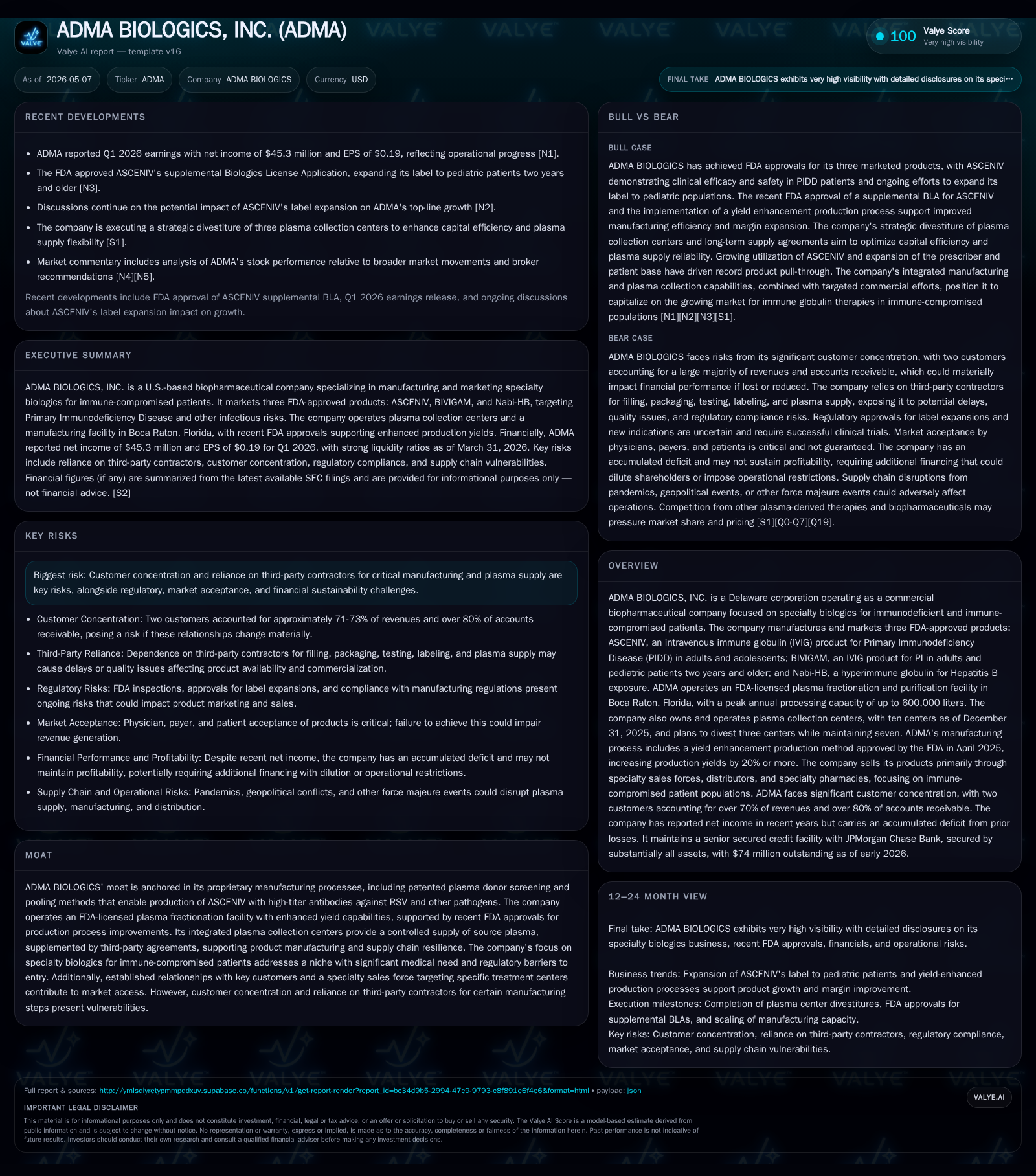
In Q1 2026, ADMA BIOLOGICS secured FDA approval for an expanded label of ASCENIV, signaling important commercial growth potential. The company also continued its strategic divestiture of three plasma collection centers while maintaining seven, aiming to strengthen capital efficiency and plasma supply resilience. These developments come amid ADMA’s ongoing focus on specialty biologics for immunodeficient patients, supported by proprietary manufacturing processes and targeted market positioning. Risks remain related to manufacturing reliance on third parties, plasma supply variability, and customer concentration, highlighting the need to monitor execution and regulatory milestones closely.
Latest Quarterly Operating Update Highlights
ADMA BIOLOGICS' Q1 2026 SEC filing [S2] revealed two pivotal developments defining near-term strategy. First, the U.S. Food and Drug Administration expanded the approved uses of ASCENIV through a supplemental Biologics License Application approval announced in May 2026 [N6]. This regulatory milestone could substantially broaden ASCENIV’s addressable patient population beyond Primary Immunodeficiency Disease (PIDD), bolstering market penetration potential.
Simultaneously, ADMA has pursued a strategic optimization of its plasma collection footprint by divesting three plasma centers out of its ten owned as of year-end 2025. Post-divestiture, operations will consolidate around seven FDA-licensed centers alongside newly established long-term plasma supply contracts with the buyers [S1], reflecting a deliberate shift toward reduced fixed capital intensity while preserving robust raw material availability for downstream biologic production [S6]. The sale closings are expected within early 2026 timelines.
These moves are complemented by continued enhancements at ADMA’s Boca Raton plasma fractionation plant. The company is now fully implementing a production yield enhancement initiative—approved by FDA in late 2025—which increases immunoglobulin yields by approximately 20% per unit of plasma processed [S1]. This capacity upgrade fundamentally strengthens both gross margin profile and production scalability for flagship products including ASCENIV.
Business Model and Product Offering Overview
ADMA BIOLOGICS operates a biopharma model integrating plasma collection with licensed manufacturing to produce specialty immune globulin biologics targeting immune-compromised patients [S1]. Central offerings encompass:
ASCENIV: A high-titer intravenous immune globulin (IVIG) product indicated for PIDD treatment in adults and adolescents - differentiated by proprietary sourcing of RSV-neutralizing antibodies derived from specialized donor screening protocols covered under key U.S. patents [S1].
BIVIGAM: Another IVIG formulation approved for PIDD patients including pediatric use from age two upward.
Nabi-HB: A hyperimmune globulin for post-exposure prophylaxis against Hepatitis B virus.
The company owns the entire value chain from plasma donor centers through disruptive fractionation processes at its Boca Raton FDA-licensed facility capable of processing up to 600,000 liters annually. The patented donor screening method allows selective pooling that supports elevated titers of clinically relevant antibodies [S1].
To supplement owned plasma sources amid divestitures, ADMA has established third-party contracts ensuring resilient supply continuity critical to meet expanding product demand while balancing capital efficiency [S6]. Complementing manufacturing are contract fill-finish and labeling arrangements outsourced to specialized third parties given industry complexities [S2]. Their combined efforts enable ADMA to deliver marketed biologics through direct specialty sales forces targeting immunology clinics alongside partnerships with national distributors for hospital fulfillment [S8].
Competitive Position and Industry Context
ADMA occupies a niche in the fragmented plasma-derived specialty biologics sector characterized by high regulatory barriers and complex manufacturing requirements. Its competitive moat derives mainly from claim-protected advances in high-titer antibody donor selection coupled with proprietary fractionation yield improvements realized at an FDA-inspected plant facility [S1]. These elements help drive clinical differentiation especially for vulnerable immunodeficient populations where safety and efficacy profiles are paramount.
Nevertheless, competition remains intense globally from larger peers like Takeda which boasts broader Ig portfolios coupled with integrated global collection networks ([N9]). Pricing power is moderated by reimbursement policies and the concentrated nature of specialty drug customers; notably ADMA discloses two customers accounted for roughly 73% total revenue pre-divestiture reflecting customer concentration risks [S8].
Supply chain complexity is amplified by reliance on external fill-finish providers subject to regulatory inspections impacting product release timing risk [S2]. Regulatory scrutiny is heightened given the severe health implications tied to product quality failures within immune globulin therapies [S12].
Growth Drivers: Expansion Opportunities and Pipeline Progress
Key growth vectors pivot around:
Label Expansion Impact: The recent FDA supplemental approval for ASCENIV widens clinical indications beyond PIDD potentially unlocking new prescribing contexts among immunologists that may accelerate penetration rates in fiscal 2026 and beyond ([N5]). Expanded label utilization benefits from accumulated real-world data demonstrating reduced infection incidence amongst treated patients driving payer support.
Manufacturing Scale Efficiencies: Full deployment of the yield enhancement process initiated in late 2025 raises output without proportional increases in raw plasma procurement or fixed costs - supporting margin expansion while accommodating higher sales volumes without incremental capex requirements ([S1]).
Pipeline Development: Progression of SG-001, an investigational pneumococcal hyperimmune globulin leveraging standardized antibodies against multiple S. pneumonia serotypes represents a promising future revenue opportunity. Animal studies are underway with a planned pre-IND submission anticipated within fiscal 2026 potentially enabling registrational Phase III trials facilitated by a Commissioner’s National Priority Voucher application submitted last September accelerating potential approvals ([S1]).
Optimized Plasma Supply Strategy: Divesting owned centers while contractually securing diversified third-party source plasma mitigates operational capital strain yet preserves raw material sufficiency underpinning expanded product volume forecasts ([S6]).
Risks and Constraints on Growth
Despite positive momentum, persistent risk factors demand attention:
Third-Party Reliance: Outsourcing critical activities like fill-finish manufacturing introduces vulnerabilities if partners fail to meet quality or timing standards causing potential commercial supply disruptions ([S2]).
Regulatory Risk: FDA inspections across internal facilities plus external contractors carry threat of observations or enforcement actions that could delay batch releases or require costly remediation ([S12]). The evolving regulatory landscape mandates continuous compliance vigilance.
Customer Concentration: Dependence on two major customers contributing over seventy percent of revenue amplifies business volatility from any contract or pricing shifts ([S8]).
Financial Sustainability: Although recent GAAP profitability was reported through 2025 ([F1]), maintaining positive operating cash flows remains challenging due to the capital-intensive nature of biologics manufacturing. Large debt obligations coexist alongside growth investments creating leverage concerns ([S2], [F1]).
Market Penetration Uncertainties: Growth projections tied to label expansions assume successful physician adoption and payer acceptance which may not scale as forecasted due to competitive dynamics or reimbursement hurdles ([S2]).
Upcoming Catalysts and Key Milestones
Monitoring these developments is crucial for understanding growth trajectory:
Regulatory review outcomes concerning clinical trial designs or approvals related to SG-001 pneumococcal program will indicate pipeline viability ([N5], [S1]).
Renewal negotiations or expansions on third-party plasma supply contracts will confirm raw material access stability post-plasma center divestitures ([S6]).
Market uptake metrics post-label expansion including physician prescribing patterns coupled with payer coverage decisions will drive near-term revenue visibility.
Operational integration progress following capacity reallocation linked to production yield enhancements at Boca Facility provides margin improvement cues.
Financial Profile and Liquidity Snapshot
Latest financial snapshot
| Metric | Value | Period |
|---|---|---|
| Cash & equivalents | $138mm | |
| 2026-03-31 | ||
| Total debt | $199mm | |
| 2026-03-31 | ||
| Net debt | $60mm | |
| 2026-03-31 | ||
| Current assets | $511mm | |
| 2026-03-31 | ||
| Current liabilities | $74mm | |
| 2026-03-31 | ||
| Current ratio | 6.95x | |
| 2026-03-31 |
Source: SEC companyfacts cache [F1].
At quarter end March 31, 2026, ADMA BIOLOGICS held approximately $138 million in cash plus equivalents against total debt approximating $199 million yielding net debt near $60 million — indicative of moderate financial leverage amid ongoing growth investments [F1]. Current assets stood robustly at $511 million compared to current liabilities at $74 million generating a strong current ratio close to 7.0 suggesting comfortable short-term liquidity buffers [F1].
This financial position supports continued operational investment especially in production upgrades and pipeline advancement; nevertheless balancing debt servicing obligations alongside sustaining positive cash flow remains a critical execution focal point highlighted repeatedly in SEC disclosures [S2], [S7], [S9].
This analysis is based solely on company filings as cited; it does not constitute investment advice.
Disclaimer: This is research-only, informational analysis and not investment advice. It may include AI-generated interpretation and general industry context. Always verify important details using primary sources.

Comments