
Dutch Bros Expands Footprint with Solid Q1 Growth and Brand Resilience
Dutch Bros reported robust Q1 2026 operational progress driven by new shop openings, strong proprietary product sales, and steady brand loyalty despite rising competitive and supply chain pressures.
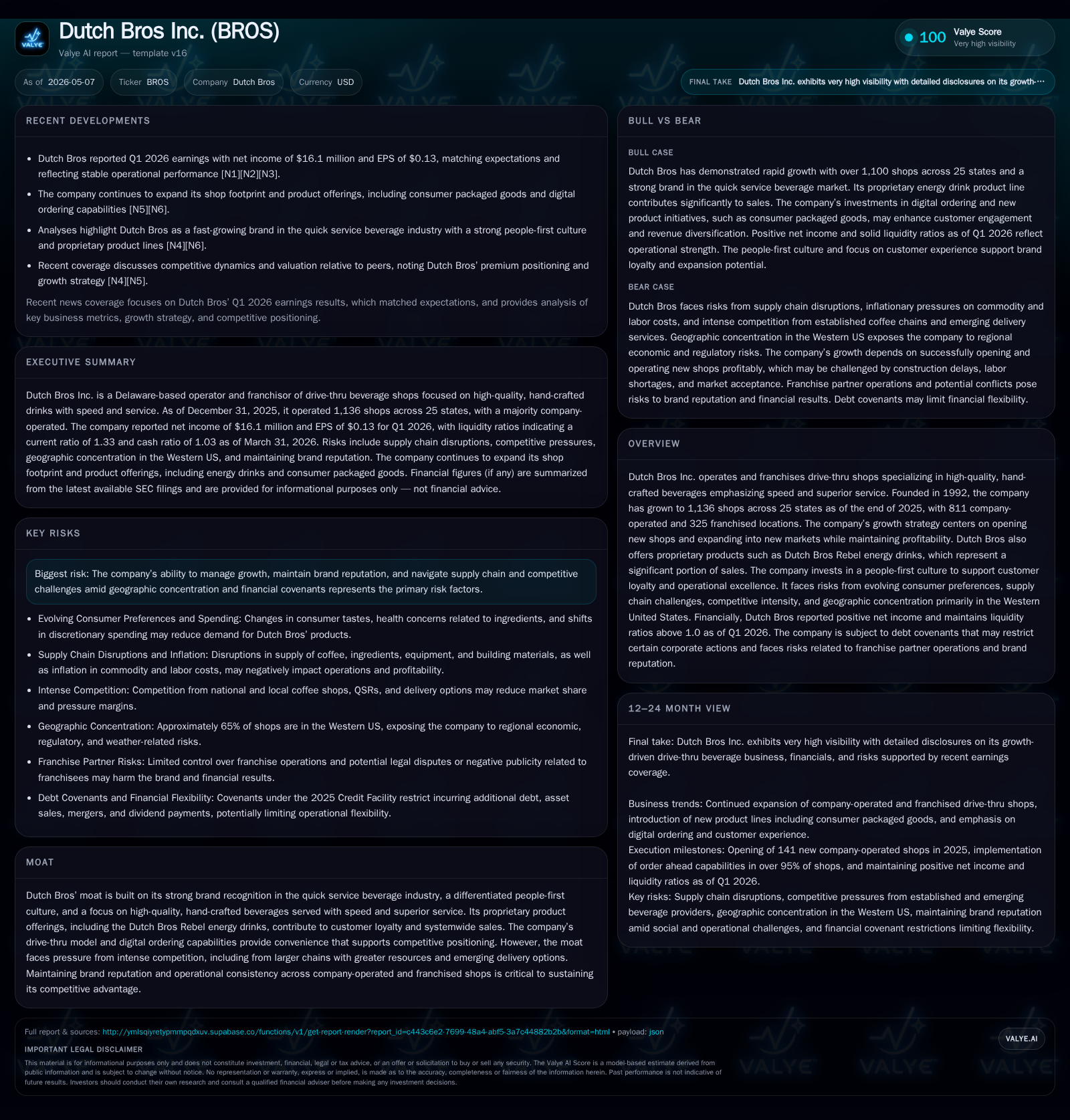
In the first quarter ended March 31, 2026, Dutch Bros continued to advance its growth strategy by increasing its store footprint across 25 states with an emphasis on both company-operated and franchised locations. The company maintained solid same-store sales growth supported by its flagship Rebel energy drinks and high-speed service model. While market competition intensifies and supply chain issues linger, Dutch Bros’ people-first culture and digital capabilities provide a durable competitive edge. Risks remain from geographic concentration in the Western US and restrictive debt covenants, but financial liquidity appears healthy as of Q1-end. Key upcoming indicators include further expansion pace and same-store sales updates.
First Quarter 2026 Operating Highlights
Dutch Bros’ latest quarterly filing dated May 6, 2026 ([S2]) discloses key operating metrics that underscore continuation of its strategic growth trajectory into Q1. The company operated a total of 1,136 shops across 25 states by the quarter’s close, consisting of 811 company-operated locations complemented by 325 franchised outlets ([S2],[S3],[S1]). This balanced mix reflects Dutch Bros' dual revenue model generating income from direct retail sales in COCO (company-operated) stores alongside royalty streams from franchised operations.
Same-store sales (SSS) remained positive with sustained customer demand for the brand’s core hand-crafted beverages and notably its proprietary Dutch Bros Rebel energy drinks. The Rebel product line contributed approximately 22% of systemwide net sales for the trailing twelve months ended December 31, 2025 ([S1],[F1]). This proprietary offering differentiates Dutch Bros within the competitive quick-service beverage (QSR) sector by capitalizing on consumer preference shifts towards energy beverages amid coffee-centric peers.
Operationally, the company's hallmark drive-thru model delivered speed alongside superior service quality fostering customer loyalty. Digital ordering channels further enhanced convenience and order throughput efficiency—vital in retaining urban and suburban demographic segments increasingly favoring contactless purchase options ([N1],[N2]).
Dutch Bros' Business Model and Service Excellence
Founded in 1992 as a regional pushcart operation in Oregon ([S1]), Dutch Bros has evolved into a high-growth operator-franchisor hybrid specializing in quick-service handcrafted beverages distinguished by quality ingredients paired with rapid order execution. Revenue is principally realized through beverage sales at company-operated stores supplemented by royalties from franchised locations who pay for rights to operate under the brand.
The business model is reinforced by proprietary offerings such as Rebel energy drinks which command higher margins relative to traditional coffee products due to unique co-packing partnerships (with Portland Bottling Co. and Lieb Foods LLC) ensuring control over quality and supply reliability ([S1]). This vertical integration aspect supports both margin protection and customer retention through consistent availability.
A critical component sustaining Dutch Bros’ competitive moat is its people-first internal culture emphasizing employee engagement—important for frontline baristas who directly influence customer experience. Maintaining this culture while scaling presents challenges but also creates switching costs not easily replicated by larger players lacking localized community ties ([S1]). Further differentiation arises from the brand’s commitment to speed without sacrificing hand-crafted preparation standards vital in premium QSR categories.
Competitive Dynamics in Quick Service Beverages
Dutch Bros faces an intensely competitive landscape including national chains like Starbucks and Dunkin’, regional QSR coffee operators, convenience store chains expanding coffee offerings, plus increasingly prevalent third-party delivery platforms ([S1],[N10],[N14]). This environment compresses pricing leverage forcing strategic focus on value perception via unique product innovation (e.g., Rebel line) and operational excellence.
Moreover, supply chain volatility remains a persistent headwind affecting key inputs such as arabica coffee beans whose inflationary cost trends coupled with dairy price fluctuations elevate input cost risk ([S1],[S26]). Equipment parts shortages have occasionally delayed shop expansions or maintenance impacting unit-level economics.
The company's geographic concentration—about 65% of shops reside in the Western US— exposes it to region-specific economic cycles or weather-related disruptions more acutely than broadly diversified competitors ([S15],[S29]). Regulatory complexity surrounding franchising laws heightens operational vigilance to avoid disputes that could tarnish reputational capital or impede franchisee cohesion ([S17],[S27]).
Expansion Catalysts Driving Growth Trajectory
Growth accelerators for Dutch Bros anchor on a disciplined rollout strategy focused on opening new units both company-operated and franchised while expanding physical presence into untapped states ([S2],[S3],[S1]). The franchise model offers scalable capital-light expansion potential but introduces variability tied to partner execution capability.
Digital transformation initiatives such as mobile ordering enhancements streamline purchase funnels increasing average ticket sizes and frequency among tech-savvy consumers ([N1]). Product innovation pipeline beyond core coffee offerings including seasonal/specialty drinks can further broaden customer appeal if executed consistently.
Capital allocation is hedged by the company’s debt covenants under its 2025 Credit Facility which impose limits on additional indebtedness, asset sales, acquisitions or distributions thus constraining flexibility but also enforcing financial discipline required for sustainable growth ([S5]). Managing these covenants while funding new openings demands careful balance between growth investments versus profitability preservation.
Risks and Operational Constraints to Monitor
Dutch Bros enumerates several core risks including evolving consumer preferences which may shift away from premium handcrafted beverages or towards cheaper commoditized alternatives affecting traffic patterns ([S1],[S7]). Supply chain interruptions continue posing risks not just for raw materials but also for cups, lids, espresso machines or construction supplies critical to expansion timing ([S26]).
Inflationary pressures on labor costs are particularly relevant given the people-intensive service lens; emergence of unionization or regulatory changes could elevate wage bills restricting margin expansion potential ([S18],[S21]). Franchise partner relationship risks stem from potential conflicts of interest or divergence in operational standards which could undermine cohesive brand representation adversely impacting revenue streams ([S17],[S21]).
Geographic concentration chiefly in Western markets makes Dutch Bros vulnerable to localized economic downturns or adverse weather events disproportionately compared to more geographically diverse rivals ([S15],[S29]). Lastly, financial restrictions via debt agreements create execution risk; failure to maintain required leverage ratios or fixed charge coverage thresholds could trigger defaults complicating capital structure management ([F1]).
Upcoming Milestones and Market Indicators
Key near-term indicators include quarterly releases reflecting same-store sales trajectory which elucidate organic demand amidst macroeconomic conditions; any inflection points would signal changes in customer engagement metrics ([N4],[N5],[S2]). Monitoring pace of new shop openings both COCO and franchised will reveal operational scalability success versus prior cadence.
Franchise partner onboarding quality signals sustainability of dispersed operating model with attendant royalty contributions critical for non-company operated revenue growth. Debt covenant compliance disclosed metrics will provide insight into financial flexibility available for opportunistic investments or mitigating inflationary threats.
Financial Position and Liquidity Snapshot
Latest financial snapshot
| Metric | Value | Period |
|---|---|---|
| Cash & equivalents | $264mm | |
| 2026-03-31 | ||
| Total debt | $201mm | |
| 2026-03-31 | ||
| Net debt | $-62mm | |
| 2026-03-31 | ||
| Current assets | $340mm | |
| 2026-03-31 | ||
| Current liabilities | $255mm | |
| 2026-03-31 | ||
| Current ratio | 1.33x | |
| 2026-03-31 |
Source: SEC companyfacts cache [F1].
Per the latest quarter ended March 31, 2026 balance sheet data sourced from [F1] via latest filings [S2]:
| Metric | Value (USD million) | Date |
|---|---|---|
| Cash & Equivalents | 263.5 | |
| 2026-03-31 | ||
| Total Debt | 201.5 | |
| 2026-03-31 | ||
| Net Debt | -62.0 | |
| 2026-03-31 | ||
| Current Assets | 340.5 | |
| 2026-03-31 | ||
| Current Liabilities | 255.2 | |
| 2026-03-31 | ||
| Current Ratio | 1.33 | |
| 2026-03-31 |
Dutch Bros holds a net cash position of approximately $62 million indicating liquidity adequacy amid expansion capex requirements. The current ratio above one signals sufficiency in near-term obligations coverage albeit total liabilities remain material reflecting funded growth activities under credit facility drawn down balances ([F1]).
This analysis synthesizes publicly filed SEC disclosures as of early May 2026 alongside recent earnings-related news commentary representing factual insights without investment recommendations or price forecasts.
Disclaimer: This is research-only, informational analysis and not investment advice. It may include AI-generated interpretation and general industry context. Always verify important details using primary sources.

Comments