
Aviat Networks, Inc. (AVNW) Deep Dive: Navigating Technological Transitions Amid Sales Cycle Complexity
Aviat Networks operates in the niche wireless transport sector with microwave and millimeter-wave solutions, facing long sales cycles and rapid tech evolution. Its competitive position hinges on innovation and partner networks amid operational and market volatility.
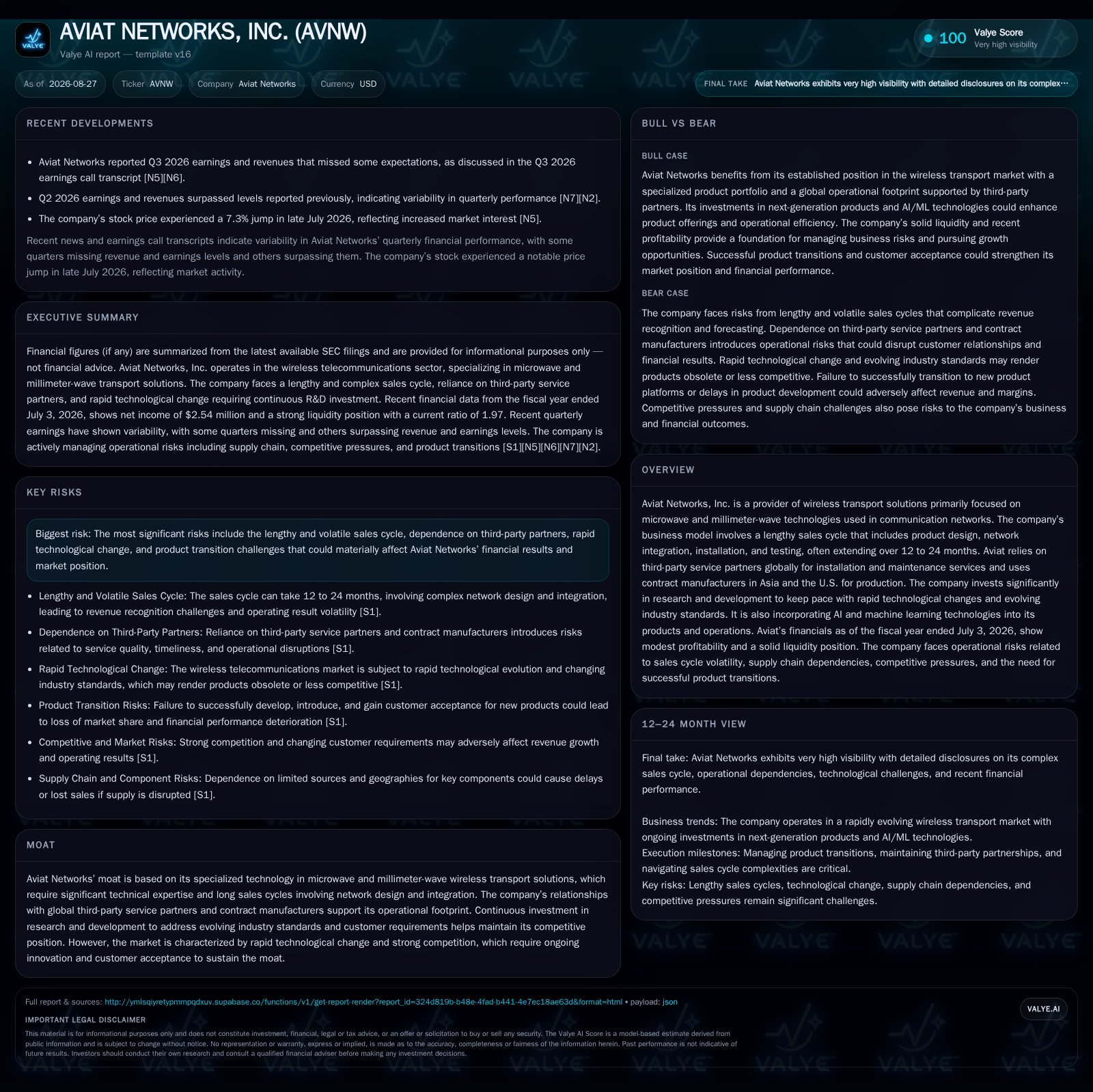
Aviat Networks delivers specialized wireless transport products through complex, extended sales and integration cycles supported by third-party partners and outsourced manufacturing. While recent profitability and liquidity provide operational footing, the company must successfully navigate rapid technological shifts, product transitions, and supply chain risks to sustain growth. Its moat derives from technical expertise and integration capabilities but is vulnerable to disruptive innovation and competitive pressures. Key near-term factors include product acceptance, partner execution, and sales cycle management.
Aviat Networks, Inc., a specialist in microwave and millimeter-wave wireless transport solutions, operates within a technically demanding and rapidly evolving segment of the telecommunications infrastructure market. The company’s business model is defined by lengthy and complex sales cycles often stretching 12 to 24 months, during which network design, installation, and integration require substantial coordination with global third-party service partners. Aviat’s reliance on outsourced manufacturing and its continuous investment in research and development, including AI and machine learning integration, position the firm at the intersection of technological innovation and operational complexity. While recent fiscal results show modest profitability and reported liquidity position, the company’s future trajectory depends critically on successful product transitions, managing supply chain dynamics, and sustaining its competitive moat in a volatile market landscape.
Latest Operating Snapshot
Aviat Networks reported net income of $2.54 million for the fiscal year ended July 3, 2026, with basic earnings per share of $0.20 and diluted EPS of $0.19, supported by a solid liquidity position evidenced by cash and cash equivalents of approximately $72.8 million and a current ratio of 1.97 [S1]. This financial footing provides operational flexibility despite market and technological challenges. However, the company’s quarterly financial performance demonstrates variability: Q2 2026 revenues and earnings surpassed previous quarters, while Q3 2026 results fell short of some expectations, reflecting the inherently volatile and unpredictable nature of its sales cycles [N5][N6][N7][N2].
Operationally, Aviat’s sales cycles remain lengthy, often spanning 12 to 24 months due to the technical complexity of network design, installation, and integration processes, which introduce delays in revenue recognition and earnings visibility [S1]. The firm depends heavily on third-party service partners worldwide for installation, maintenance, and customer support, alongside outsourced manufacturing through contract manufacturers in Asia and the U.S., which collectively form a critical backbone for execution [S1]. Recent stock price movements, including a 7.3% jump in late July 2026, suggest increased market attention possibly linked to these operational dynamics and product transition efforts [N5].
Business Model and Unit Economics
Aviat Networks generates revenue primarily by selling microwave and millimeter-wave wireless transport equipment integrated into customer communication networks. The company’s pricing reflects the technical complexity of its products and the customization required for network integration, often negotiated through lengthy sales cycles involving extensive technical evaluations and design collaboration [S1]. This extended sales horizon creates delayed revenue realization but can yield higher-margin contracts once products are successfully integrated and accepted by the customer’s network.
On the cost side, Aviat operates an asset-light manufacturing model outsourcing production to contract manufacturers in Asia and the United States, which reduces fixed capital investment and manufacturing risk but increases exposure to supply chain disruptions and variable costs [S1]. The reliance on third-party service partners for installation and maintenance means operating leverage is constrained by partners’ capacity and performance, limiting tight cost control but enabling scalability without commensurate fixed cost increases. Research and development expenses are significant and ongoing, driven by the need to keep pace with rapid technological changes and evolving standards, which adds to fixed costs but is necessary to maintain competitiveness and support future revenue growth through next-generation product launches incorporating AI and machine learning [S1].
Moat, Competition and Counterforces
Aviat Networks’ moat is grounded in its specialized expertise in microwave and millimeter-wave wireless transport solutions, which require deep technological know-how and the ability to manage complex, long-duration sales cycles involving design, integration, and testing. Its global network of third-party service partners enhances its ability to deliver installation and maintenance services critical to customer satisfaction and retention. This integrated service model, combined with continuous R&D investment to meet evolving industry standards, helps sustain a competitive position, particularly against less specialized providers [S1].
Nevertheless, this moat faces significant counterforces. The wireless telecommunications industry is characterized by rapid technological advancement and intense competition from larger infrastructure vendors and niche innovators alike, who may develop disruptive technologies or more cost-effective solutions. Aviat’s dependence on third-party manufacturers and service partners introduces execution and quality risks that competitors with more vertically integrated operations may mitigate. Additionally, the lengthy sales cycle exposes the company to changing customer preferences and technology shifts during contract negotiations, increasing the risk of product obsolescence or replacement by alternative technologies [S1].
Bull Case
In a favorable scenario, Aviat Networks capitalizes on its technical specialization and global partner ecosystem to strengthen its position in the wireless transport market. Successful commercialization of next-generation microwave and millimeter-wave products, enhanced by AI and machine learning capabilities, could differentiate Aviat’s offerings through superior performance, operational efficiency, and predictive maintenance features. This innovation-driven competitive edge could shorten sales cycles over time by increasing customer confidence and reducing integration complexity, leading to improved revenue visibility and margin expansion.
Supporting evidence for this scenario would include consistent revenue growth attributable to new product adoption, improving sales cycle metrics such as reduced lead times, and expanding relationships with key customers. Additionally, increased profitability driven by operational efficiencies and higher-margin product mix would confirm the successful transition. Conversely, failure to achieve these outcomes or persistent sales cycle elongation would falsify this bullish view, highlighting the difficulty of overcoming industry inertia and competitive pressures [S1][N5].
Base Case
The base case envisions Aviat Networks maintaining its current market niche by managing its product portfolio through incremental innovation and steady operational execution. The company continues to invest in R&D to keep pace with industry standards but without radical breakthroughs that dramatically alter its competitive positioning. Sales cycles remain long and somewhat volatile, reflecting the complexity of customer network integration, but stable enough to generate modest profitability and cash flow, supported by disciplined cost management and reported liquidity position.
In this scenario, Aviat leverages its third-party service partners and contract manufacturers effectively, mitigating supply chain disruptions through ongoing evaluation of manufacturing mixes and maintaining robust customer relationships. Competitive pressures persist but do not erode the company’s core market share significantly. Quarterly earnings and revenue fluctuate within expected ranges due to the inherent timing of large orders and project phases. Confirmation of this case would come from steady financial performance, consistent R&D outputs, and controlled operating costs, while major deviation in earnings volatility or market share loss would signal a need to reassess [S1][N6][N7].
Bear Case
The downside scenario revolves around Aviat Networks’ inability to adapt effectively to rapid technological changes and evolving customer demands, resulting in product obsolescence and loss of market relevance. Extended sales cycles could lengthen further due to increased technical complexity or customer hesitation, severely impacting revenue recognition and financial predictability. Reliance on third-party service partners and contract manufacturers might lead to operational disruptions, quality issues, or increased costs, eroding customer satisfaction and margins.
Failure to successfully launch and gain customer acceptance for next-generation products incorporating AI/ML could compound these challenges, leaving Aviat vulnerable to competitors with superior technology or more integrated service capabilities. Confirmation of this bear case would include sustained declines in revenue and margins, loss of key customers, deteriorating partner relationships, and escalating supply chain issues. Conversely, stabilization or improvement in sales cycle times, product acceptance, and operational execution would counter this negative outlook [S1][N5].
What Matters Next
Key performance indicators and milestones critical for assessing Aviat Networks’ trajectory include: (1) sales cycle length and variability metrics to gauge revenue visibility; (2) adoption rates and revenue contribution from next-generation microwave and millimeter-wave products, indicating successful product transitions; (3) R&D investment levels and their translation into tangible product innovations; (4) operational performance of third-party service partners measured by installation success rates and customer satisfaction scores; (5) supply chain stability indicators such as lead times and component availability; (6) quarterly revenue and margin trends reflecting market acceptance and cost control; (7) customer retention and new contract wins signaling competitive positioning; and (8) progress integrating AI and machine learning features into product offerings, which may drive differentiation and efficiency.
Tracking these metrics, whether currently disclosed or identified as useful for future reporting, will provide investors with insight into Aviat’s ability to manage its complex sales cycle, operational dependencies, and technological evolution amid a competitive and fast-changing wireless telecommunications landscape.
Disclaimer: This is research-only, informational analysis and not investment advice. It may include AI-generated interpretation and general industry context. Always verify important details using primary sources.

Comments