
Mission Produce’s Vertically Integrated Avocado Model: Pricing Volatility, Operational Leverage, and the Next Phase of Global Expansion
Recent improvements in segment profitability and pricing gains have not fully offset persistent market and supply-side pressures. As Mission Produce pursues further vertical integration and geographic diversification, the company's ability to manage avocado concentration risk and margin volatility will define its long-term value creation.
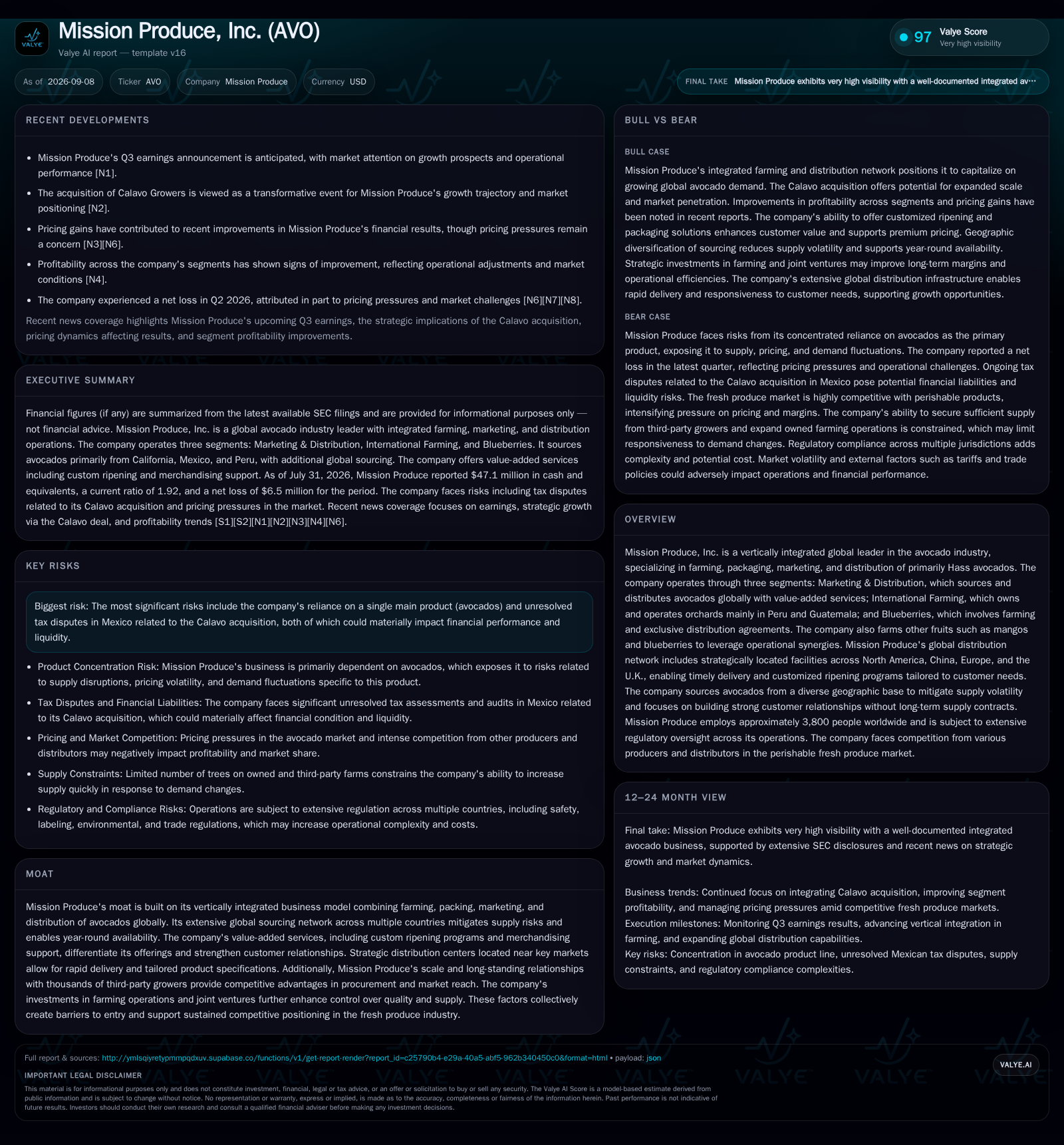
Mission Produce reported a net loss of $6.5 million as of July 31, 2026, despite segment profitability improvements and pricing gains earlier in the year. The company’s vertically integrated model and broad sourcing network provide resilience against supply shocks, but concentrated reliance on avocados, intense competition, and ongoing pricing pressures continue to challenge sustained profitability. The near-term outlook hinges on the effectiveness of operational adjustments, the realization of value from recent investments, and Mission Produce's ability to navigate regulatory complexity and supply constraints. [S2] [N3] [N4] [N6]
Mission Produce, Inc. stands as a global leader in the avocado supply chain, leveraging vertical integration to manage farming, packaging, marketing, and distribution primarily of the Hass variety. As of July 2026, the company’s financials reflect the difficulty of sustaining profitability in a sector marked by perishable inventory, volatile pricing, and intense competition. While Mission Produce’s operational model—combining value-added services, global sourcing, and customized ripening—gives it resilience against supply shocks, persistent pricing pressures, supply constraints, and a heavy reliance on avocados challenge the durability of its moat. The company’s next phase will test whether operational improvements and strategic investments can translate into sustained value for shareholders.
Recent Results Highlight Margin Pressures Amid Modest Operational Gains
Mission Produce reported a net loss of $6.5 million for the period ending July 31, 2026, with basic and diluted EPS of -$0.08 per share. This loss follows a period in which segment-level profitability showed improvement, attributed in part to operational adjustments and selective pricing gains. However, these gains have not been sufficient to overcome persistent pricing pressures in the core avocado market. The company ended the period with $47.1 million in cash and equivalents, a current ratio of 1.92, and a cash ratio of 0.22, providing it with operational liquidity but little margin for error if further shocks occur. [S2] [N3] [N4] [N6]
Market attention is currently focused on Mission Produce's upcoming Q3 earnings and the potential impact of the Calavo deal, as investors look for evidence that operational improvements and strategic expansion can reverse the recent trend of net losses. [N1] [N2]
How Mission Produce’s Model Translates Volume, Pricing, and Integration into Profit Potential
Mission Produce’s business model centers on vertical integration across farming, packing, marketing, and distribution—primarily of Hass avocados—aiming to capture value at every stage of the supply chain. The company sources fruit from both owned orchards (primarily in Peru and Guatemala) and a broad network of third-party growers, distributing through a global network of strategically located centers. This structure is designed to mitigate supply volatility and capture margin through value-added services such as custom ripening, packaging, and logistics.
Revenue is driven by a combination of volume throughput and the ability to command premium pricing for differentiated services. However, the company’s cost structure is highly sensitive to input costs (farm labor, land, logistics, packaging) and is exposed to fixed costs in owned farming operations. Operating leverage can be positive in periods of high volume and favorable pricing, but swings rapidly negative if input costs spike or pricing deteriorates, as seen in the latest quarter. The perishable nature of inventory compounds risk, requiring tight working capital management and rapid inventory turns.
Capital requirements remain substantial, given the need to invest in orchards, distribution infrastructure, and joint ventures. While the current balance sheet provides a liquidity buffer, persistent net losses could eventually constrain investment capacity if not reversed. There is also a single-customer concentration risk in the Blueberries segment, which, while a source of operational synergy, does not diversify the core avocado exposure meaningfully.
Competitive Dynamics: Scale, Service Differentiation, and the Limits of Vertical Integration
Mission Produce’s competitive positioning rests on its global scale, extensive sourcing network, and ability to provide value-added services such as custom ripening and merchandising support. These capabilities help build sticky relationships with retailers and foodservice customers who require consistent quality, year-round supply, and tailored product specifications.
However, the fresh produce market is structurally low-margin and intensely competitive. Large, vertically integrated peers and specialized distributors compete on price, reliability, and service. The absence of long-term supply contracts with customers limits revenue visibility and weakens pricing power during periods of oversupply or weak demand. Furthermore, the market is exposed to substitution risk from other produce categories and plant-based alternatives, especially if avocado prices rise or consumer preferences shift.
Mission Produce’s geographic sourcing diversity mitigates some supply shocks (weather, pests, geopolitical events), but also increases regulatory and logistical complexity. The company’s scale and network are meaningful barriers to entry, but do not fully insulate it from the cyclical and perishable nature of the category.
When Vertical Integration and Global Reach Translate to Margin Expansion
A favorable outcome for Mission Produce would involve the company leveraging its integrated model and geographic sourcing to capture higher margins as global avocado demand grows. This scenario could unfold if recent operational improvements—such as cost discipline, yield improvements in owned orchards, and better working capital management—translate to sustained segment profitability. The successful integration of acquisitions or joint ventures (e.g., the Calavo deal) could further enhance scale, procurement power, and customer reach.
Key confirming evidence would include consecutive quarters of positive net income, margin expansion across all segments, increased utilization of value-added services by customers, and evidence of pricing power (e.g., ability to pass through higher costs without volume loss). A meaningful reduction in supply chain disruptions, regulatory headwinds, or customer concentration would also support this scenario.
Falsification would come from persistent net losses despite operational improvements, inability to realize synergies from expansion, or continued margin compression due to competitive or supply-side pressures.
Sustained Margin Volatility as Mission Produce Adjusts to Market Realities
The most plausible scenario for Mission Produce is a continued cycle of margin volatility, reflecting the interplay of supply-side shocks, competitive pricing, and operational adjustments. While the company’s integrated model and diversified sourcing provide resilience, its concentrated exposure to avocados and lack of long-term customer contracts limit its ability to fully control margins.
Periodic improvements in profitability may be achieved through cost discipline, incremental gains in value-added services, and supply chain optimization. However, these are likely to be offset by ongoing pricing pressures, regulatory costs, and supply constraints. The base case assumes that Mission Produce remains a key player in the global avocado market, but with net income fluctuating around break-even and a need for ongoing investment to maintain infrastructure and market position.
This scenario would be confirmed by continued modest improvements in segment profitability but inconsistent net income, persistent sensitivity to external shocks, and a balance sheet that remains stable but does not allow for aggressive expansion without external financing.
Adverse Supply Shocks and Intensifying Competition Drive Prolonged Losses
A negative scenario would be triggered by a combination of adverse supply shocks (weather events, disease, trade disruptions), sustained pricing declines, and/or an inability to secure adequate fruit supply from third-party growers. In this case, fixed costs from owned orchards and infrastructure would become a drag on profitability, while inventory perishability would exacerbate working capital strains.
Prolonged net losses could force Mission Produce to curtail investment, reduce headcount, or divest non-core assets. Customer relationships could weaken if service levels or quality decline, and regulatory penalties or compliance costs could further pressure margins. The company’s liquidity buffer, while adequate in the near term, would erode under persistent losses, increasing the risk of covenant breaches or the need for dilutive financing.
Confirmation of this scenario would include multiple consecutive quarters of widening net losses, deteriorating balance sheet metrics (declining current ratio, cash burn), loss of key customers, or significant operational disruptions.
Testing the Thesis: Operational, Financial, and Market Catalysts to Monitor
Segment-level margin trends, especially in Marketing & Distribution and International Farming, as these reflect both operational execution and pricing power.
Quarterly net income and free cash flow generation, to track whether operational improvements are translating into sustainable profitability.
Utilization rates and volume growth for value-added services such as custom ripening and packaging—if disclosed, these would help test differentiation and customer stickiness.
Updates on the integration and performance impact of recent deals, such as the Calavo transaction, including realized synergies and expansion of customer relationships.
Geographic sourcing mix and yield improvements in owned orchards, as evidence of supply chain resilience and capital efficiency.
Customer concentration and contract structure, particularly in the Blueberries segment and among top avocado buyers—a useful metric would be renewal rates or share of revenue.
Regulatory developments or compliance costs in key sourcing and distribution markets, as these can materially impact cost structure and operational flexibility.
Changes in working capital and inventory turnover, given the high perishability of inventory and sensitivity to supply/demand swings.
Disclaimer: This is research-only, informational analysis and not investment advice. It may include AI-generated interpretation and general industry context. Always verify important details using primary sources.

Comments