
Anteris Technologies Faces Capital and Regulatory Challenges in Advancing Structural Heart Devices
The clinical-stage medical device developer focuses on minimally invasive heart valve therapies, backed by significant capital raises but operating losses.
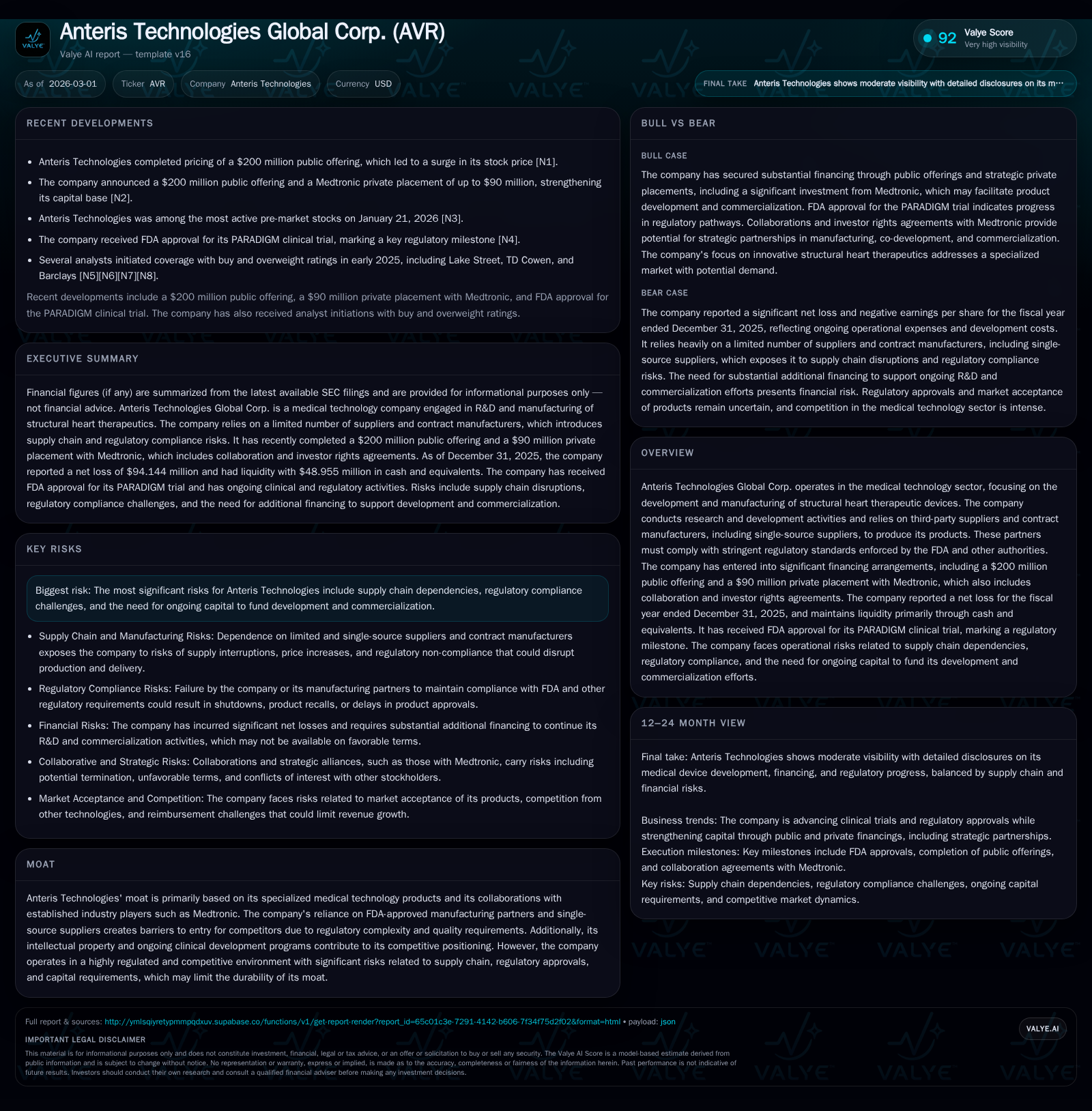
Anteris Technologies Global Corp. is advancing development and future commercialization of its DurAVR® THV System within a challenging regulatory and competitive environment. Despite strategic capital raises, including a $200 million public offering and a $90 million private placement from Medtronic, the company remains unprofitable with substantial operating losses and negative free cash flow reflecting ongoing R&D and preparatory commercialization costs. Future growth depends on clinical trial success, regulatory approvals, manufacturing scale-up with FDA-qualified suppliers, and navigating complex healthcare reimbursement dynamics.
Company Overview and Sector Context
Anteris Technologies Global Corp. operates in the highly regulated medical technology sector specializing in minimally invasive structural heart devices. The company's lead product candidate is the DurAVR® Transcatheter Heart Valve (THV) System designed to treat heart valve disease using less invasive approaches. Successful commercialization requires extensive research and development (R&D), clinical testing, and navigating complex regulatory pathways primarily overseen by the U.S. Food and Drug Administration (FDA) alongside international agencies.
Manufacturing is outsourced to third-party suppliers who must comply with FDA regulations. This creates operational dependencies that can introduce supply chain vulnerabilities if capacity constraints or compliance issues arise.
Historical Financial Performance
Since inception, Anteris has consistently operated at a loss as it invests heavily in product innovation and clinical development. For fiscal year 2025, the company reported a net loss of approximately $94.1 million, an increase from $76 million in 2024, driven by accelerated R&D spending and preparatory commercialization activities [F1][S1]. Operating losses closely mirror net results with nearly $93.9 million recorded for 2025 [F1].
Liquidity analysis shows current assets of $15.7 million against current liabilities of $21.3 million at year-end 2025, resulting in a current ratio of approximately 0.73—a typical profile for clinical-stage medtech companies reliant on external financing [F1]. Cash and equivalents were reported at $48.9 million as of Q1 2025.
Historical performance (annual)
| FY |
|---|
| 2025 |
Source: SEC companyfacts cache [F1].
Future Growth Prospects
Anteris’s growth trajectory depends on successful progression through clinical trials—such as the FDA-approved PARADIGM study—and subsequent regulatory clearances for its DurAVR® THV System [S1][S3]. Revenue generation hinges on achieving these approvals followed by market adoption among healthcare providers treating structural heart conditions.
Key constraints include:
- Potential delays or additional clinical trial requirements imposed by regulators impacting timelines and costs [S4][S20].
- Dependence on single-source FDA-qualified suppliers introduces risk to manufacturing continuity and cost efficiency during scale-up phases [S25].
- Competitive pressures from established medtech firms necessitate continued innovation and demonstration of clinical efficacy.
Milestones and Expectations
Near-term milestones critical to value realization include:
- Completion and positive outcomes from pivotal clinical trials such as PARADIGM.
- Securing full regulatory clearances enabling commercial sales.
- Establishing reliable manufacturing partnerships capable of supporting commercial volumes.
- Developing distribution channels or sales infrastructure to facilitate market entry.
Failure to achieve these milestones could delay or impair transition to revenue-generating operations [S1][S24].
Returns and Capital Allocation
Given its pre-commercial status, Anteris does not generate positive returns but incurs substantial negative free cash flow estimated around -$79.8 million for fiscal 2025, indicating heavy investment exceeding operating cash inflows [F1]. Capital allocation prioritizes R&D expenditure and corporate infrastructure support funded through equity issuances:
- A $200 million public offering completed in early 2026 provided significant liquidity for ongoing development efforts [N2][N3].
- Concurrently, Medtronic invested $90 million via private placement reinforcing strategic collaboration yet introducing considerations around investor alignment due to Medtronic's competitive role [N3][S21].
No dividends or share repurchases have been reported given reinvestment focus.
Strategic Collaborations and Competitive Positioning
Partnerships with industry leaders like Medtronic offer technological collaboration potential alongside financial backing; however, Medtronic’s competitor status presents complex stakeholder dynamics [S21].
Competitive advantage stems from proprietary technology protected by intellectual property rights combined with stringent quality standards required by FDA-regulated manufacturing processes—a barrier limiting supplier substitution options but also increasing supply risk exposure [S6][S25]. Nonetheless, competition from larger medtech companies remains intense.
Risks Summary
Form 10-K filings underscore several operational risks:
- Dependency on single-source suppliers susceptible to disruptions impacting product availability.
- Regulatory scrutiny imposing costly compliance burdens including risks of recalls affecting reputation and sales ability [S4][S7][S8].
- Lengthy approval processes create uncertainty around market entry timing.
- Intellectual property litigation risks common in medtech innovation cycles adding expense volatility [S18].
- Potential failure of products under development to achieve market acceptance or reimbursement hurdles limiting growth opportunities.
- Necessity for ongoing capital raises due to persistent operating losses raising dilution concerns.
- Increasing investor focus on ESG factors influencing reputation and access to capital on favorable terms [S5].
Conclusion
Anteris Technologies operates at the intersection of innovative transcatheter heart valve development amid significant financial commitments characteristic of early-stage medical device companies. Recent capital infusions improve near-term liquidity while strategic collaborations may facilitate execution advantages.
Long-term sustainability depends on successful navigation of protracted clinical trials coupled with obtaining robust regulatory approvals under complex global compliance frameworks. Supply chain dependencies further compound operational uncertainties ahead of commercial scale-up which will ultimately determine whether scientific promise translates into viable market offerings.
This report is prepared exclusively for informational purposes without providing investment advice or recommendations.
Disclaimer: This is research-only, informational analysis and not investment advice. It may include AI-generated interpretation and general industry context. Always verify important details using primary sources.

Comments