
Bone Biologics’ Quest to Pioneer Targeted Spinal Fusion Solutions
Bone Biologics advances its proprietary NELL-1 protein for osteopromotive spinal fusion amid regulatory and financial hurdles.
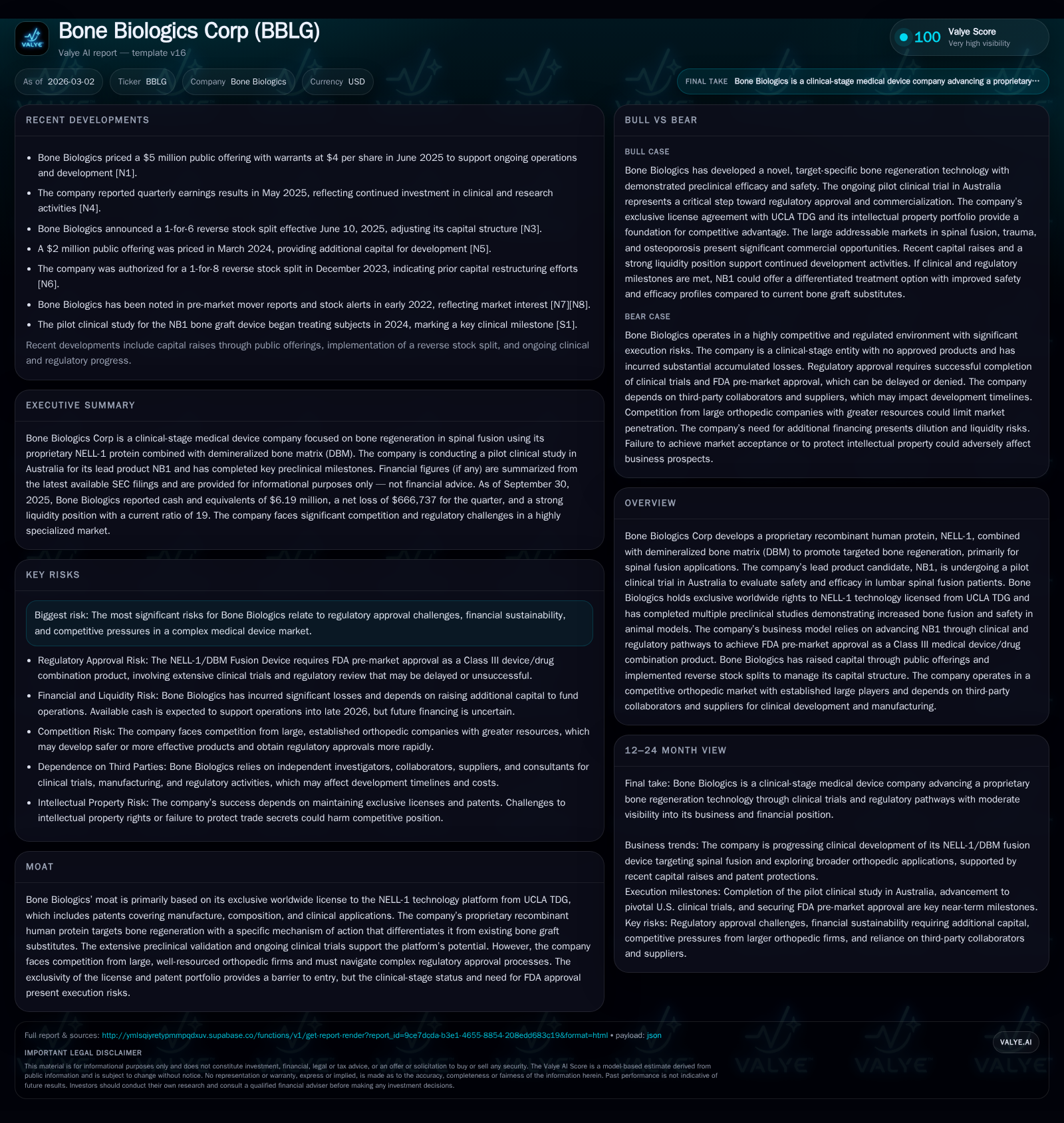
Bone Biologics Corp focuses on developing a recombinant human protein, NELL-1, combined with demineralized bone matrix (DBM) to drive targeted bone regeneration in spinal fusion surgery. Its lead candidate, NB1, is currently under pilot clinical trial in Australia targeting lumbar spinal fusion efficacy and safety. The company faces typical early-stage developmental challenges including persistent operating losses partially mitigated by improved cost management, regulatory complexities due to the product’s combination device/drug classification, and a capital structure maintained through public offerings and reverse splits. Key risks include uncertain FDA approval timelines, competitive pressures from well-established orthopedics firms, and cash flow constraints that require continued external financing.
Evolution of Bone Biologics: Platform, Preclinical Validation, and Early Development
Bone Biologics Corp’s foundation rests on its proprietary recombinant human protein NELL-1 combined with demineralized bone matrix (DBM), forming an osteopromotive agent designed explicitly to promote targeted bone regeneration. Licensed exclusively worldwide from UCLA Technology Development Group, this platform distinguishes itself mechanistically by providing site-specific control over bone growth. Preclinical studies including validation in sheep and non-human primate models demonstrate enhanced bone fusion rates and safety profiles crucial for translating into human spinal fusion surgery contexts [S1].
The focus has concentrated on the surgical specialty of spinal fusion—particularly the lumbar segment—due to its substantial market opportunity among orthopedics procedures complicated by autograft limitations such as donor site morbidity. The product candidate NB1 encapsulates this platform into a bone graft device combining NELL-1 protein with DBM for translational application.
Financial Footprint and Historical Performance: Operating Losses Amid R&D Investment
From a financial perspective, Bone Biologics maintains reported revenues at $1.07 billion historically through FY2020 from legacy business segments; however, these figures do not reflect current core clinical-stage operations emphasizing the NB1 development program [F1]. Revenue has remained flat since then.
Operating income shows persistent losses narrowing steadily—from approximately -$9.43 million in FY2023 to -$3.23 million in FY2025—pointing to improved operating leverage as R&D spending rationalizes following intensive preclinical phases. Net income follows a similar pattern with incremental improvements but remains negative [F1]. Operating cash flow (CFO) trends show reduced cash burn from -$9.56 million (FY2023) to about -$2.69 million (FY2025), indicative of controlled cash consumption but ongoing reliance on external capital [F1]. Capital expenditures remain nominal.
Historical performance (annual)
| FY | Net ($mm) | CFO ($mm) | OpInc ($mm) | Net YoY |
|---|---|---|---|---|
| 2025 | -3 | -3 | -3 | +24.4% |
| 2024 | -4 | -4 | -4 | +54.0% |
| 2023 | -9 | -10 | -9 | -502.8% |
| 2022 | -1 | -4 | -4 |
Source: SEC companyfacts cache [F1].
Capital returns and efficiency (annual)
| FY | ROE% |
|---|---|
| 2025 | -57.8 |
| 2024 | -118.0 |
| 2023 | -307.9 |
| 2022 | -25.0 |
Source: SEC companyfacts cache [F1].
Current ratio above 13x underscores liquidity adequacy against short-term obligations though operational cash generation remains insufficient to cover burn without capital injections [F1][S15].
Advancing NB1 Clinical Trials: Design and Objectives
The company initiated a multicenter prospective randomized pilot clinical trial of NB1 targeting transforaminal lumbar interbody fusion (TLIF) procedures addressing degenerative disc disease (DDD) in adults [S1]. Enrolling up to 30 subjects across Australian sites since the first treatments began during 2024 marks an important execution milestone.
Key endpoints encompass safety assessment alongside efficacy metrics such as radiographic fusion success rates and patient-reported outcomes measuring pain relief and functional improvement. These data aim not only to demonstrate proof-of-concept but also to underpin pivotal FDA submissions required under stringent combination product pathways.
Regulatory Environment: FDA Approval Pathway for NELL-1/DBM Combination Product
The FDA categorizes NB1 as a Class III device/drug combination product necessitating a full pre-market approval (PMA) application before commercialization within the U.S., imposing rigorous requirements including phased clinical trials under Investigational Device Exemptions (IDEs), comprehensive manufacturing controls under current Good Manufacturing Practices (cGMPs), followed by post-market surveillance obligations [S1][S22][S23].
This pathway introduces significant timeline uncertainties and elevated costs relative to standalone medical devices or biologics approval paths. Potential regulatory delays or issues during review or clinical phases could materially postpone commercialization plans while escalating expenditure burdens [S4][S5].
International regulatory approvals will require navigating disparate country-specific frameworks beyond U.S. FDA oversight adding another layer of operational challenge [S5].
Intellectual Property Portfolio: Strategic Moat Amid Competition
Bone Biologics holds exclusive global licensing rights from UCLA Technology Development Group covering the proprietary NELL-1 protein composition, manufacturing methods and multiple application patents related to bone regeneration treatments [S1][S6][S13]. This portfolio creates barriers limiting competitors' ability to replicate or circumvent the technology.
However patent protection is subject to potential invalidation or design-arounds common in med-tech sectors—and legal defenses impose significant cost risks [S6][S11]. Active management of intellectual property enforcement is required alongside compliance with licensing obligations.
Competitors include established orthopedic companies with significantly greater R&D resources compressing market share prospects upon successful launch [S26][S19]. Academic research entities also pose innovation risks.
Capital Strategy: Funding Operating Losses Through Public Markets
Funding ongoing R&D activities including clinical trials depends primarily on periodic public equity offerings augmented by reverse stock splits used strategically to sustain Nasdaq listing compliance amid low stock prices [S15]. Despite recurring losses recently exceeding $3 million annually the company maintains healthy current assets versus liabilities resulting in strong short-term liquidity metrics (current ratio ~13.85x) [F1][S15].
No dividends or share repurchases occur due to negative earnings trajectory and reinvestment needs.
Dependence on external financing introduces dilution risk while access depends heavily on market conditions given limited revenues outside legacy segments [S15]. Equity rose modestly from about $2.9 million (FY2023) to $5.38 million (FY2025), reflecting capital raises offsetting accumulated deficits [F1].
Risks: Regulatory Delays, Competition & Cash Flow Pressures
Bone Biologics faces critical risks detailed in SEC filings:
- Regulatory uncertainty: Prolonged FDA review cycles or rejection scenarios delay revenue generation timelines materially impacting commercialization prospects [S4][S5].
- Competitive pressure: Large orthopedics manufacturers with extensive resources create adoption hurdles even post approval [S26][S19].
- Financial sustainability: Ongoing operating deficits coupled with negative cash flows require continuous fundraising exposing dilution risk or potential research curtailment if capital access diminishes [S15][F1].
- Clinical development: Patient recruitment difficulties or adverse events could impede trial completion jeopardizing regulatory submissions [S12][S17].
- Intellectual property litigation: Potential infringement claims or defense actions could drain resources undermining competitive positioning [S6][S11][S20].
- Personnel retention: Dependency on key executives increases vulnerability during critical development phases [S25][S19].
Future Milestones: Indicators for Investor Confidence
Key upcoming benchmarks include:
- Completion of NB1 TLIF pilot study enrollment across Australian sites.
- Interim clinical data releases focusing on safety outcomes supporting readiness for pivotal trials.
- Submission timeline targets for the FDA PMA application following pilot study results.
- Updates on international regulatory strategies beyond the U.S.
- Timely capital raises before liquidity tightens while managing shareholder dilution.
- Patent prosecution progress or any emerging IP litigation developments indicating portfolio strength or vulnerabilities.
- Operational updates regarding manufacturing scale-up ahead of planned commercialization.
These factors will shape Bone Biologics’ path toward translating scientific promise into commercial returns within a challenging orthopedic sector marked by entrenched incumbents and complex combination product regulations.
This analysis synthesizes information from SEC filings disclosed through March 2nd, 2026 ([S#]) alongside validated financial statements ([F1]). It aims solely at providing an informed corporate overview without constituting investment advice or forecasts beyond available data points.
Disclaimer: This is research-only, informational analysis and not investment advice. It may include AI-generated interpretation and general industry context. Always verify important details using primary sources.

Comments