
TopBuild Corp's Growth Moderates as Supply Chain and Labor Challenges Persist
BLD's recent acquisitions expand its footprint, but operational headwinds and competitive pressures temper profit margins.
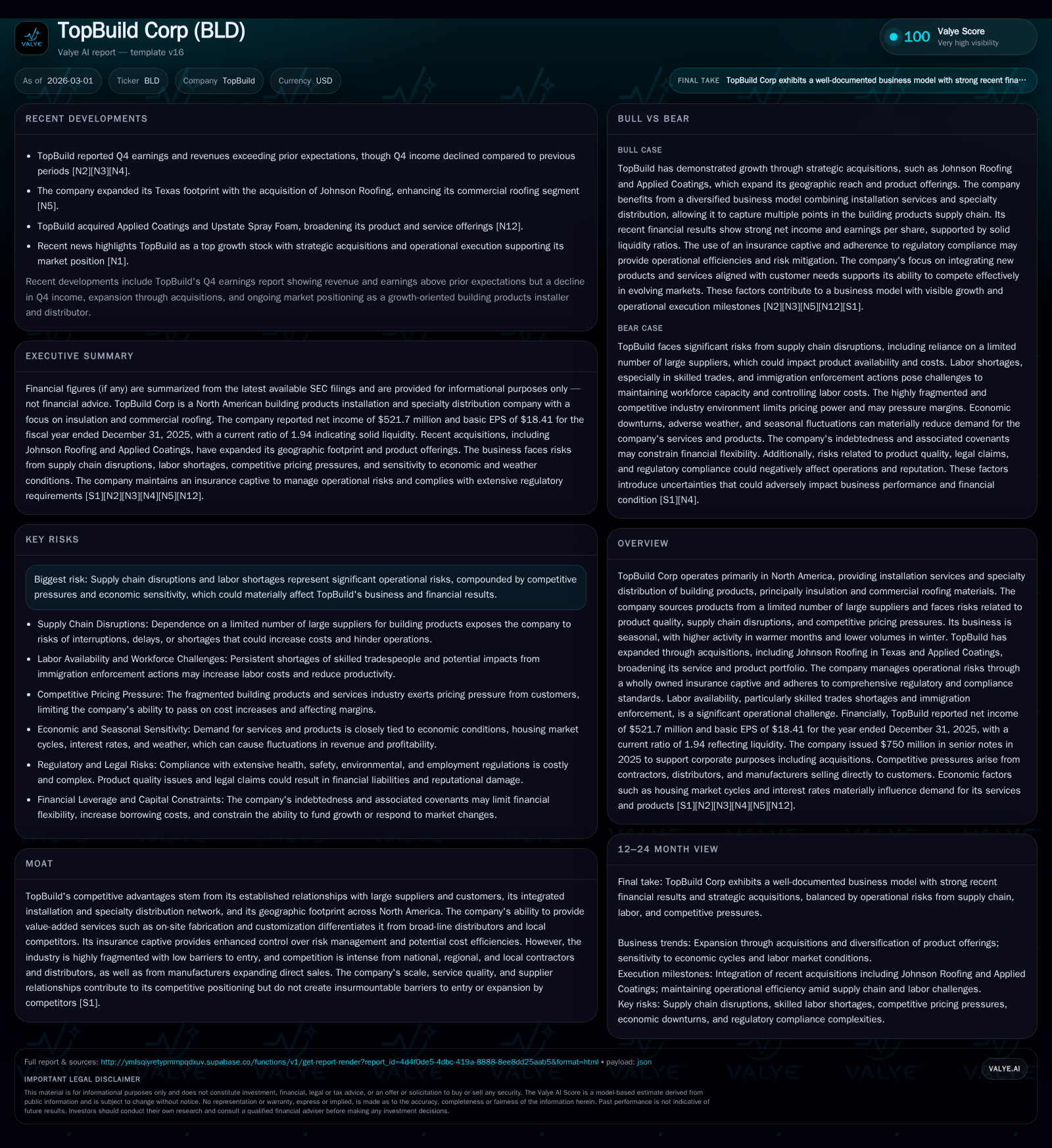
TopBuild Corp (BLD) operates a North American specialty distribution and installation business primarily focused on insulation and commercial roofing. While the company has grown through strategic acquisitions like Johnson Roofing and Applied Coatings, it continues to face risks from supply chain disruptions, labor shortages, and intense pricing competition in a fragmented industry. Financially, operating income and net income declined year-over-year in 2025 despite strong cash flow generation. TopBuild maintains capital discipline, returning substantial capital to shareholders through buybacks. Moving forward, growth depends on navigating ongoing supply constraints, labor market tightness, and integrating recent acquisitions effectively.
Company Overview
TopBuild Corp (BLD) is a leading provider of installation services alongside specialty distribution of building products—primarily insulation and commercial roofing materials—across North America. The company integrates product distribution from a limited number of major suppliers with value-added installation capabilities delivered through an extensive branch network. This vertical integration supports residential new construction, commercial projects, industrial facilities, and repair/remodel markets with broad offerings including on-site fabrication.
Recent strategic expansions include acquisitions such as Johnson Roofing in Texas and Applied Coatings in the Northeast, aimed at enhancing geographic coverage and diversifying product lines beyond insulation into commercial roofing [N7][N13]. These moves add operational complexity amid persistent supplier concentration and labor challenges.
Historical Performance
From fiscal years 2022 through 2025, TopBuild exhibited solid top-line strength alongside variable profitability influenced by external cost factors and acquisition-related expenses. Operating income peaked near $886 million in 2024 before declining roughly 10.7% to $792 million in 2025. Net income similarly decreased by approximately 16%, falling to $522 million in 2025 from prior-year levels above $620 million. Despite profit pressures, operating cash flow remained strong at $756 million in 2025 [F1].
Capital expenditures have moderated since a peak of about $76 million in 2022 to approximately $59 million in 2025 as the company optimizes post-acquisition spending. Free cash flow remains robust at nearly $697 million (operating cash flow minus capex) [F1].
Share repurchases have been a key capital deployment focus with $434 million spent on buybacks in fiscal year 2025 following an even larger program of nearly $966 million the prior year—demonstrating commitment to shareholder returns despite earnings pressure [F1].
Historical performance (annual)
| FY | Net ($mm) | CFO ($mm) | OpInc ($mm) | Capex ($mm) | Net YoY |
|---|---|---|---|---|---|
| 2025 | 522 | 756 | 792 | 59 | -16.2% |
| 2024 | 623 | 776 | 886 | 69 | +1.4% |
| 2023 | 614 | 849 | 879 | 64 | +10.5% |
| 2022 | 556 | 496 | 797 | 76 |
Source: SEC companyfacts cache [F1].
Capital returns and efficiency (annual)
| FY | Buybacks ($mm) | FCF ($mm) | ROE% |
|---|---|---|---|
| 2025 | 434 | 697 | 22.5 |
| 2024 | 966 | 707 | 28.2 |
| 2023 | 250 | 785 | 24.0 |
| 2022 | 250 | 419 | 28.8 |
Source: SEC companyfacts cache [F1].
Note: Revenue figures for recent years are not disclosed; operating income declines reflect margin pressures.
Industry Context and Competitive Positioning
The building products installation and distribution market is highly fragmented with low entry barriers, fostering intense competition from national, regional, local contractors as well as manufacturers increasingly selling directly to customers [S7][S12]. Within specialty distribution focused on insulation products, TopBuild depends heavily on a limited set of large suppliers controlling fiberglass insulation and roofing materials availability.
Fiberglass insulation experiences cyclical supply fluctuations with extended periods of shortage or oversupply that disrupt cost structures across housing cycles [S1][S12][S16]. Commercial roofing services also face significant pricing pressure amid crowded contractor markets competing aggressively for projects.
TopBuild's competitive advantage lies in integrated service delivery combining specialty distribution with customized installation solutions—including local fabrication—to enhance customer value across its broad North American footprint [S6][S11]. Its use of a wholly owned insurance captive further supports risk management uncommon among peers.
Nevertheless, competitive intensity combined with cyclical demand sensitivity limits sustainable pricing power or significant barrier creation against rivals targeting similar customers.
Operational Challenges: Supply Chain & Labor
Supply chain reliability remains a critical vulnerability due to dependence on timely delivery of high-quality products from third-party manufacturers primarily supplying fiberglass insulation and commercial roofing materials [S1][S12]. Recent acquisitions have expanded product breadth but also increased exposure to potential disruptions.
Labor availability poses significant risk amid skilled trades shortages compounded by stringent immigration enforcement which may reduce eligible workforce pools and elevate compliance burdens [S26]. These dynamics exert upward pressure on labor costs while challenging project throughput during seasonal peaks concentrated between spring and early fall.
Adverse weather events such as hurricanes or snowstorms can delay or suspend projects regionally within TopBuild’s operating areas impacting efficiency and costs [S7][S19].
Risk Management & Regulatory Compliance
Installation operations expose TopBuild to various liabilities including personal injury claims, warranty disputes, environmental exposures alongside complex multi-jurisdictional regulatory compliance—covering OSHA safety standards, employment laws including wage/hour rules, immigration policies, environmental permits among others [S8][S10][S15][S18].
The company mitigates these risks via comprehensive strategies highlighted by its wholly owned insurance captive providing enhanced claims management control though rising insurance costs or regulatory tightening could impact future financial results.
Financial Health & Capital Allocation
As of December 31, 2025, TopBuild reported a healthy current ratio near 1.94 supported by cash plus equivalents exceeding $184 million against current liabilities of approximately $845 million [F1]. Equity stands robust above $2.3 billion indicating substantial shareholder investment.
Strong free cash flow generation estimated near $697 million (operating cash flow minus capex) underpins internal funding capacity enabling active share repurchase programs—$434 million deployed in fiscal year 2025 alone following an aggressive prior-year pace [F1].
No dividend payments are prominently noted; capital return currently favors buybacks.
Leverage is managed within covenants embedded in credit agreements limiting additional debt or distributions while preserving balance sheet flexibility but constraining expansive M&A absent accretive financing alternatives [S4][S23].
Forward-Looking Considerations & Catalysts
No explicit public guidance was available as of early-2026 filings; key metrics to watch include margin recovery post recent profit declines and integration success from Johnson Roofing acquisition expanding commercial roofing presence in Texas along with Applied Coatings enhancing Northeast penetration [N7][N13].[N8]
Macro factors influencing residential construction activity—especially mortgage rates—bear heavily on housing starts driving insulation demand cycles [S11][S14].
Efforts to diversify suppliers or secure more favorable purchasing terms could reduce product cost volatility over time [S12].
Addressing skilled labor shortages through training investments or refined immigration compliance may mitigate labor cost pressures constraining project viability [S26].
Failure to timely adopt new product innovations risks market share erosion given evolving customer preferences [S17]. Weather disruptions remain unpredictable short-term headwinds [S19].
These variables shape operational performance amid competitive forces; earnings trajectory recovery alongside disciplined capital deployment will be central for assessing long-term growth sustainability.
DISCLAIMER: This report is intended solely for informational purposes based on available data up to March 2026 without providing investment advice or recommendations regarding TopBuild Corp securities or related financial instruments.
Disclaimer: This is research-only, informational analysis and not investment advice. It may include AI-generated interpretation and general industry context. Always verify important details using primary sources.

Comments