
BrightSpring Health: Leveraging Scale and Technology to Advance Home-Based Care
BrightSpring Health Services, Inc. is leveraging its national scale, integrated pharmacy-provider platform, and new AI initiatives to improve care coordination and efficiency for complex, high-need patients. The company’s recent margin improvements and focus on specialty pharmacy and M&A underscore both opportunity and execution risk as regulatory headwinds persist.
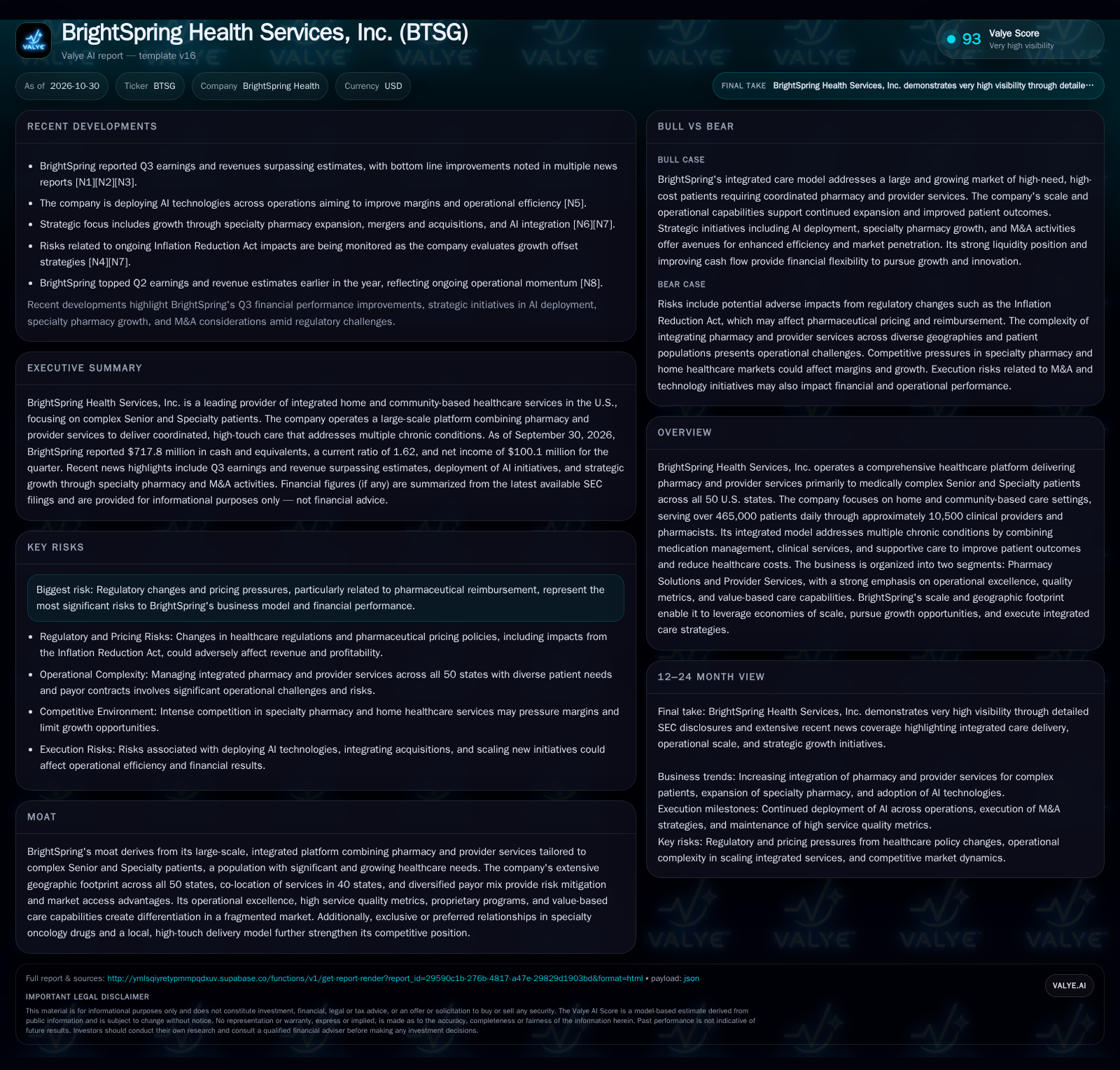
BrightSpring Health is delivering coordinated pharmacy and provider services to over 465,000 high-need patients daily, reporting margin gains and net income growth in Q3 2026. The company is deploying AI to drive operational efficiency and is targeting specialty pharmacy and M&A for expansion, while regulatory and reimbursement risks remain a central challenge. Its integrated model and large footprint offer economies of scale but require careful execution as the healthcare landscape evolves. [S1] [S2] [N1] [N2] [N3] [N5] [N6] [N7]
BrightSpring Health Services, Inc. sits at the intersection of critical healthcare trends: the shift toward home and community-based care, the growing needs of an aging and medically complex population, and the demand for integrated, value-based service delivery. The company’s Q3 2026 results show margin improvement and strong earnings, fueled by its large-scale operations and early AI adoption. However, the path forward will be shaped not only by BrightSpring’s ability to execute on specialty pharmacy and M&A ambitions, but also by its navigation of evolving regulatory and reimbursement headwinds.
Margin Improvements, AI Adoption, and Strategic Growth Efforts
BrightSpring Health reported net income of $100.1 million for Q3 2026, with basic EPS of $0.48 and revenues exceeding analyst estimates. This performance reflects both underlying operational momentum and the company’s ability to manage costs and drive margin improvement in a complex service environment. [S2] [N1] [N3]
The company is actively deploying AI technologies across operations, aiming to enhance efficiency and support margin expansion. These initiatives are complemented by a strategic push into specialty pharmacy and ongoing evaluation of M&A opportunities, using its liquidity position ($717.8 million in cash and equivalents as of 2026-09-30) as a potential lever for further growth. [S2] [N5] [N6] [N7]
Despite these positive signals, BrightSpring faces continued regulatory uncertainty, especially around pharmaceutical pricing and reimbursement driven by the Inflation Reduction Act. How the company manages these pressures will be critical for sustaining its recent performance. [N4] [N7]
Economic Impact of Scale and Integration in Home-Based Care
BrightSpring’s business model is built on integrating pharmacy services (filling over 43 million prescriptions annually from 175+ locations) with home-based provider services (delivering 21 million hours of care in 2025), targeting patients with multiple chronic conditions. This dual-segment structure allows the company to address both medication management and direct care, creating potential for higher share of patient wallet and cross-segment synergies. [S1]
Revenue generation is driven by a mix of Medicare, Medicaid, and commercial payors, with contracts covering over 4,500 customers and payors. The patient base, averaging six chronic conditions per individual, enables BrightSpring to justify higher-value, longitudinal care interventions, which are generally reimbursed at premium rates relative to episodic care.
Economically, scale offers BrightSpring leverage on procurement, technology investment, and care coordination infrastructure—critical in an industry where fixed administrative and compliance costs are high. The company’s co-location of pharmacy and provider services in 40 states further supports operational efficiency, potentially reducing patient acquisition and coordination costs.
The move to value-based care and the adoption of AI could enable further margin expansion by reducing avoidable hospitalizations, optimizing resource allocation, and supporting more precise risk stratification. However, the company’s exposure to regulated payor reimbursement means that pricing and payment policy changes can rapidly affect profitability, regardless of internal efficiency gains.
Maintaining Position Amid Healthcare Fragmentation and Regulation
BrightSpring’s competitive strength lies in its national reach, integrated care model, and the ability to serve high-need, high-cost patients at scale. The company’s platform is differentiated by its combination of pharmacy and provider services, supported by proprietary care coordination programs and strong service quality metrics (order accuracy of 99.99% and high patient satisfaction). [S1]
In the specialty pharmacy segment, BrightSpring competes with both national chains and regional providers, facing pressure from vertically integrated payors and PBMs with their own captive specialty pharmacies. In provider services, competition comes from home health, hospice, and care management firms, many of which lack the integrated pharmacy infrastructure.
The company’s local, high-touch delivery model and co-location of services in most major states offer switching frictions for institutional customers and patients, but the fragmented nature of the industry means that price competition and regulatory shifts can quickly erode local advantages.
Technology adoption, particularly in AI and care coordination, could become a new source of differentiation if BrightSpring can demonstrate measurable cost savings and outcome improvements. However, as these tools become more widely available, the competitive gap may narrow unless the company maintains a lead in integration and execution.
Potential Benefits from Integration and AI on Costs and Patient Loyalty
The most favorable scenario for BrightSpring involves successful scaling of its integrated care model—using AI to optimize clinical workflows, reduce medication errors, and proactively manage high-risk patients. If AI-enabled efficiencies translate into lower per-patient costs and the company’s value-based care programs achieve measurable reductions in hospitalizations or readmissions, payors may reward BrightSpring with expanded contracts or performance-based bonuses.
Continued expansion in specialty pharmacy, especially in high-margin therapeutic areas, could further boost revenue and profitability. If BrightSpring can leverage its scale to secure preferred access to specialty drugs and maintain high service quality, it may attract additional institutional customers resistant to switching due to the operational complexity of moving high-need patients.
M&A activity—if executed at reasonable multiples and integrated smoothly—could accelerate both geographic reach and service breadth, reinforcing network effects and amplifying operating leverage.
Evidence confirming this scenario would include sustained margin expansion, above-peer growth in specialty pharmacy revenue, and public disclosure of new or expanded value-based contracts with major payors.
Sustained Operations Amid Margin Fluctuations and Regulatory Challenges
The most plausible outcome is that BrightSpring continues to grow by leveraging its scale and integrated services, maintaining its reputation for service quality and operational excellence. AI and technology initiatives may yield incremental efficiency gains, but industry-wide adoption and regulatory complexity limit the magnitude of immediate margin expansion.
Specialty pharmacy and provider services are likely to see steady volume growth, supported by demographic tailwinds and continued demand for community-based care. However, reimbursement headwinds from the Inflation Reduction Act and ongoing price negotiation cycles could create periods of margin compression, requiring ongoing cost discipline and operational agility.
M&A may add incremental capabilities or regional scale, but integration costs and execution risks could offset some of the expected synergies.
This scenario would be confirmed by stable or slightly improving margins, periodic revenue outperformance versus peers, and ongoing—but not transformative—technology-driven operational improvements.
Profitability and Growth Threatened by Integration and Regulatory Risks
A negative scenario could unfold if pricing and reimbursement changes under the Inflation Reduction Act and related policies erode pharmacy margins faster than BrightSpring can offset through efficiency or volume growth. If value-based care contracts fail to deliver anticipated savings or if AI deployment proves more costly or less effective than projected, margin pressures could intensify.
Operational complexity—managing thousands of providers, multiple geographies, and disparate payor contracts—could lead to service quality lapses, compliance failures, or customer attrition, especially in the wake of rapid M&A or technology rollouts.
Heightened competition, particularly from vertically integrated payor-provider organizations or national pharmacy chains, could drive pricing down and make customer retention more difficult, especially if regulatory reforms encourage more open networks or lower switching costs.
This scenario would be evidenced by declining margins, loss of major contracts, negative quality or satisfaction trends, and stalled revenue growth.
Factors Influencing BrightSpring’s Progress in Integration, Margins, and Growth
Quarterly trends in gross and operating margin, particularly in the Pharmacy Solutions segment, as a leading indicator of AI and operational efficiency gains.
Disclosure of new or expanded value-based care contracts with major payors, especially those with performance-based reimbursement structures.
Growth rate in specialty pharmacy revenue and patient counts, which would confirm market share gains and successful execution in high-margin segments.
Integration costs and realized synergies from any announced M&A transactions, if disclosed, as a measure of management’s ability to execute on inorganic growth.
Updates on patient satisfaction scores and service quality metrics, especially if BrightSpring can sustain or improve its high ratings as scale increases.
Regulatory developments related to the Inflation Reduction Act or future healthcare payment reforms that could materially impact reimbursement rates.
Evidence of technology-driven cost savings or clinical outcome improvements from AI deployments, such as reduced medication errors or lower hospitalization rates.
Disclaimer: This is research-only, informational analysis and not investment advice. It may include AI-generated interpretation and general industry context. Always verify important details using primary sources.

Comments