
First Busey Corp’s Rapid Expansion Stresses Capital and Liquidity Management
A significant revenue surge driven by acquisitions and deposit growth challenges First Busey’s conservative banking approach and regulatory capital mandates.
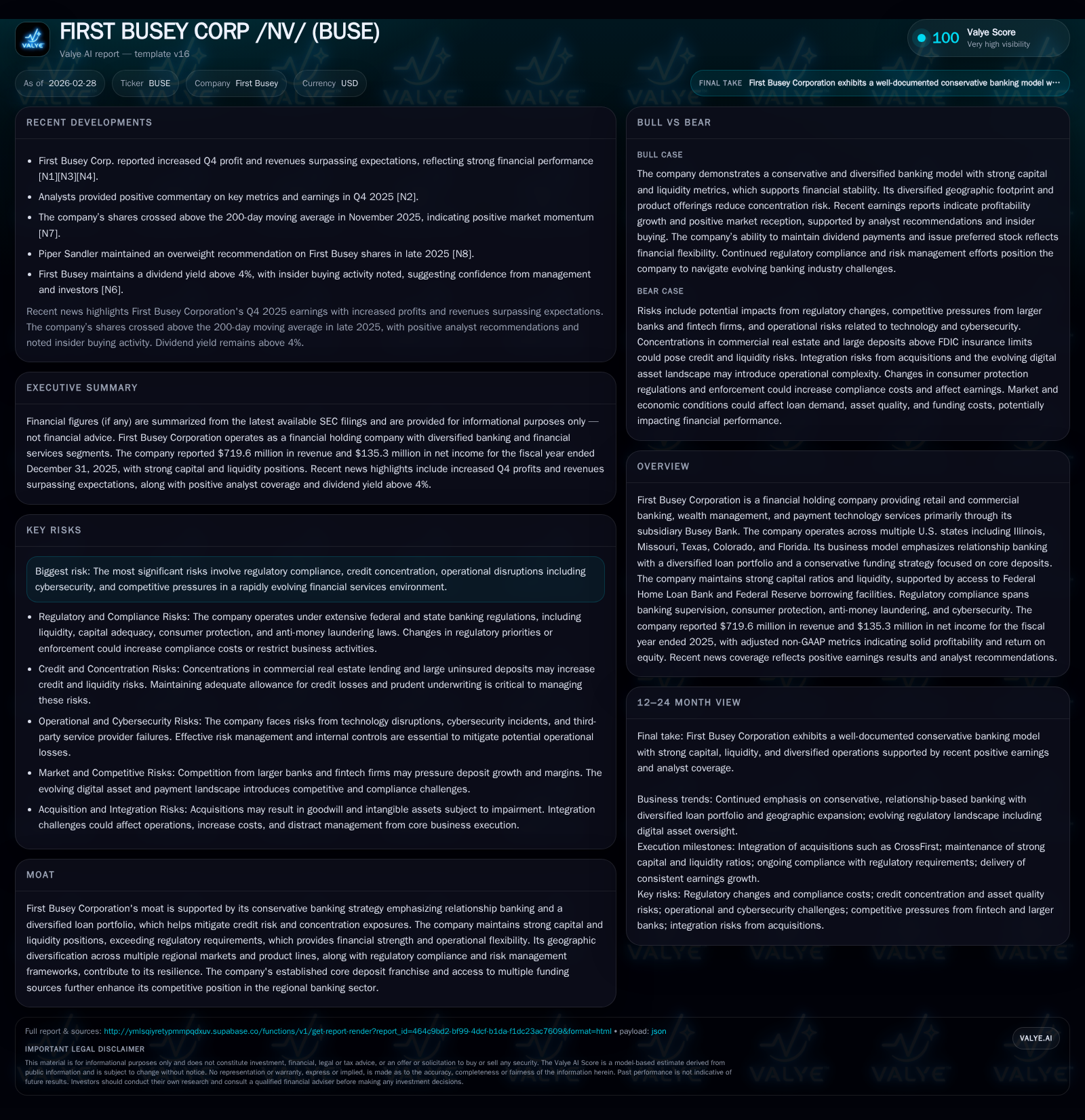
First Busey Corporation experienced robust top-line growth in 2025, with revenue jumping nearly 56% year-over-year to $719.6 million, largely fueled by the March acquisition of CrossFirst and an expanded loan portfolio. Net income increased 19%, reaching $135.3 million, reflecting solid earnings despite elevated acquisition-related expenses. The firm maintains strong liquidity supported by core deposits and access to Federal Home Loan Bank and Federal Reserve facilities but must carefully navigate capital adequacy constraints given a substantial increase in risk-weighted assets. Deployment of capital has included consistent dividends and stepped-up stock repurchases, aligning with shareholder return priorities while preserving well-capitalized status.
Historical Performance
First Busey Corporation (BUSE), a diversified financial holding company centered on Busey Bank, reflected significant growth over the recent four fiscal years through escalating revenues, earnings, and equity capitalization [F1]. The company’s revenue leapt from approximately $462 million in FY2024 to nearly $720 million in FY2025 — a striking increase of over 55%, mainly attributable to its March 2025 acquisition of CrossFirst Financial Services along with expansion into new regional markets. This contributed to broadening of both the loan portfolio and deposits.
Net income increased robustly by 19% in FY2025 to $135 million after absorbing acquisition-related costs, including the establishment of initial allowances for unfunded loan commitments ($7.2 million related to CrossFirst) [S25]. Despite these one-time expenses, profitability remained solid due to stable net interest margins underpinned by a conservative lending mix and diversified loan book.
Operating cash flow showed steady improvement, rising from $178 million in FY2024 to nearly $193 million in FY2025 — an approximate 8% gain [F1]. In contrast, capital expenditures spiked more than 200% year-over-year ($6.4 million to $19.6 million) as Busey invested in digital transformation initiatives including payment technology solutions integrated at FirsTech subsidiary, alongside gradual branch network enhancements [S12].
Historical performance (annual)
| FY | Rev ($mm) | Net ($mm) | CFO ($mm) | Capex ($mm) | Rev YoY | Net YoY |
|---|---|---|---|---|---|---|
| 2025 | 720 | 135 | 193 | 20 | +55.7% | +19.0% |
| 2024 | 462 | 114 | 178 | 6 | -7.2% | |
| 2023 | 123 | 173 | 10 | -4.5% | ||
| 2022 | 128 | 166 | 5 |
Source: SEC companyfacts cache [F1].
Capital returns and efficiency (annual)
| FY | Div ($mm) | Buybacks ($mm) | FCF ($mm) |
|---|---|---|---|
| 2025 | 91 | 70 | 173 |
| 2024 | 54 | 0 | 172 |
| 2023 | 53 | 4 | 164 |
| 2022 | 51 | 10 | 161 |
Source: SEC companyfacts cache [F1].
Note: Revenue figures for FY2022-23 not available; percentages reflect FY25 vs FY24.
Business Model and Historical Growth Drivers
First Busey operates principally through its banking subsidiary across several U.S states including Illinois, Missouri, Texas, Colorado, Florida, Kansas, Oklahoma, Arizona, Indiana, and New Mexico [S1][S12]. It emphasizes relationship-driven banking with a diversified loan portfolio that spans commercial & industrial loans (C&I), commercial real estate (CRE), retail real estate loans as well as specialty verticals such as energy lending and sponsor finance.
The bank's conservative funding strategy prioritizes core deposits — encompassing transaction accounts, savings/money market deposits, and time deposits under FDIC insurance limits — which comprised about 93.7% of total deposits at year-end 2025 [S21]. Deposit growth was remarkable in FY25 (+49%) coinciding with the CrossFirst merger that added substantial balances from Texas markets [S16][S21]. This deposit base underpins ample liquidity complemented by access to borrowing facilities through the Federal Home Loan Bank (FHLB) and Federal Reserve Bank windows providing contingencies against market stresses [S4][S8].
Underlying this expansion has been regulatory compliance focus ranging from traditional banking supervision through consumer protection statutes including CFPB oversight to risk frameworks aligned with anti-money laundering and cybersecurity mandates; all critical in maintaining operational resilience amid heightened industry scrutiny since the post-SV bank failures climate [S1][S17][S20].
Future Growth Prospects
Looking forward, First Busey's growth is poised on multiple fronts:
- Organic Expansion: Deepening existing client relationships across current geographies via cross-selling wealth management services and payment technology platforms that generate recurring fee income [S12].
- Geographic Diversification: Recent move into Texas via CrossFirst broadens regional exposure; further penetration into the West (Colorado/New Mexico/Arizona) markets offers latent volume opportunities [S16].
- Loan Portfolio Diversification: Adding specialty verticals such as energy lending addresses sector-specific financing needs; life equity loans tap into emerging home equity conversion product dynamics.
- Strategic Acquisitions: The successful integration of CrossFirst indicates capacity for bolt-on acquisitions with scale benefits; however incremental moves must be balanced against integration risks noted by management [S20].
- Technological Innovation: Investment via FirsTech subsidiary aims at payment technology modernization addressing fintech competition pressures impacting transaction fee income streams.
Constraints include maintaining regulatory capital buffers amid rapid asset growth while navigating intense competition from large banks and fintech disruptors vying for deposit market share [S20][S13]. Evolving CRA rules pose compliance uncertainties especially with state-level overlays such as Illinois’ newer requirements affecting expansion plans [S1]. Cybersecurity threats demand continuous investments in safeguards possibly heightening operational costs [S1].
Milestones and Forecast Considerations
While explicit guidance is absent from filings or news releases up through February 2026 [N1][N3], several indicators can be monitored:
- Quarterly earnings updates reflecting loan yield trends amidst interest rate cycles.
- Deposit growth sustainability post-CrossFirst acquisition.
- Development in noninterest income especially wealth management fees and payment technology revenues.
- Regulatory developments around CRA frameworks potentially impacting expansion approvals.
- Capital ratio trends particularly common equity tier-1 adequacy given sizable asset gains [S19].
Analysts should watch for management commentary on synergy realization timelines from acquisitions and any changes to share repurchase authorization or dividend policies following results announcements.
Capital Allocation & Returns
Management’s deployment of capital reflects a balanced shareholder return approach coupled with prudence amid rapid asset scale-up:
- Dividends: Cash dividends paid grew from $54 million in FY24 to about $90.9 million in FY25 representing a roughly two-thirds increase aligned with higher net income distribution ability under Illinois law constraints requiring dividends out of net profits [F1][S23].
- Stock Repurchases: Activity escalated notably during Q4 2025 with approximately 1.25 million shares repurchased costing roughly $31-$35 per share during last quarter months; full-year buybacks totaled about $69.9 million versus no repurchases in prior year [F1][S11]. This enhances EPS potential while managing outstanding share count.
- Capital Ratios: As of December 31, 2025 common equity tier-1 capital ratio was approximately 12.43% for First Busey holding company and nearly 14% for Busey Bank — well above minimum regulatory thresholds signaling financial strength amidst loan portfolio expansion exceeding +75% YoY [S19][F1]. Maintaining these buffers remains critical given Basel III-inspired supervisory expectations even if not all testing currently mandated on smaller banks.
- Liquidity & Borrowings: Holdings of liquid assets remained elevated (~$655 million average liquid assets representing ~3.7% of total assets), supplemented by borrowing capacity totaling nearly $3.9 billion especially via FHLB advances ($1.78 billion available) and Federal Reserve window ($1.58 billion available), ensuring operational flexibility [S8][S9].
Risks & Sector Context
Key risks facing First Busey stem from external regulatory shifts—especially evolving CRA rules affecting community development activities—and internal execution risks tied to merger integration costs that could dilute near-term earnings or strain systems controls [S17][S20]. Cybersecurity remains an ever-present threat demanding ongoing vigilance across technology platforms servicing tens of thousands of clients [S1]. Market trends within regional banking show intensifying competition from fintech platforms offering alternative deposit products eroding traditional funding bases; First Busey's emphasis on relationship banking aims at countering commoditization risks but necessitates continued innovation investment.
In this mature sector typified by low single-digit ROE averages nationally (~5–7%), First Busey's calculated risk posture—balancing core deposit gathering against selective credit underwriting—facilitates resilience but requires careful capital-labor allocation prudence going forward.
Summary
First Busey Corporation demonstrated marked expansion throughout FY2025 catalyzed by acquisition-fueled revenue acceleration and geographic market entry diversification. Profitability held firm despite elevated provisions tied to new loan commitments; robust deposit inflows underpin ample liquidity supported by federal credit lines ensuring funding flexibility amid ongoing sector complexity.
Management’s approach balances cautious underwriting philosophy with opportunistic scaling via bolt-on acquisitions while reinvesting proceeds consistently into dividends plus targeted buybacks supporting shareholder returns without compromising regulatory capitalization buffers essential under Basel III regimes.
Stakeholders should closely monitor quarterly performance metrics relative to asset quality trends alongside evolving regulation landscape—particularly CRA developments—as well as competitive dynamics dislodging retail deposit norms challenging legacy banking franchises across regional footprints.
This analysis is based exclusively on publicly available information from SEC filings dated through February 28, 2026 ([F1], [S#]) and contemporaneous news reports ([N#]). It does not provide any investment recommendations or price targets but serves solely as a detailed review for institutional-quality fundamental understanding of First Busey Corporation's recent performance profile, strategic context, capital adequacy status, risk exposures, and business outlook within the regional banking industry framework.
Disclaimer: This is research-only, informational analysis and not investment advice. It may include AI-generated interpretation and general industry context. Always verify important details using primary sources.

Comments