
CBIZ’s Performance Leap Amid Integration Challenges and Capital Allocation Priorities
CBIZ, Inc. achieved exceptional operating income growth in 2025 fueled by acquisitions while navigating integration costs and elevated leverage.
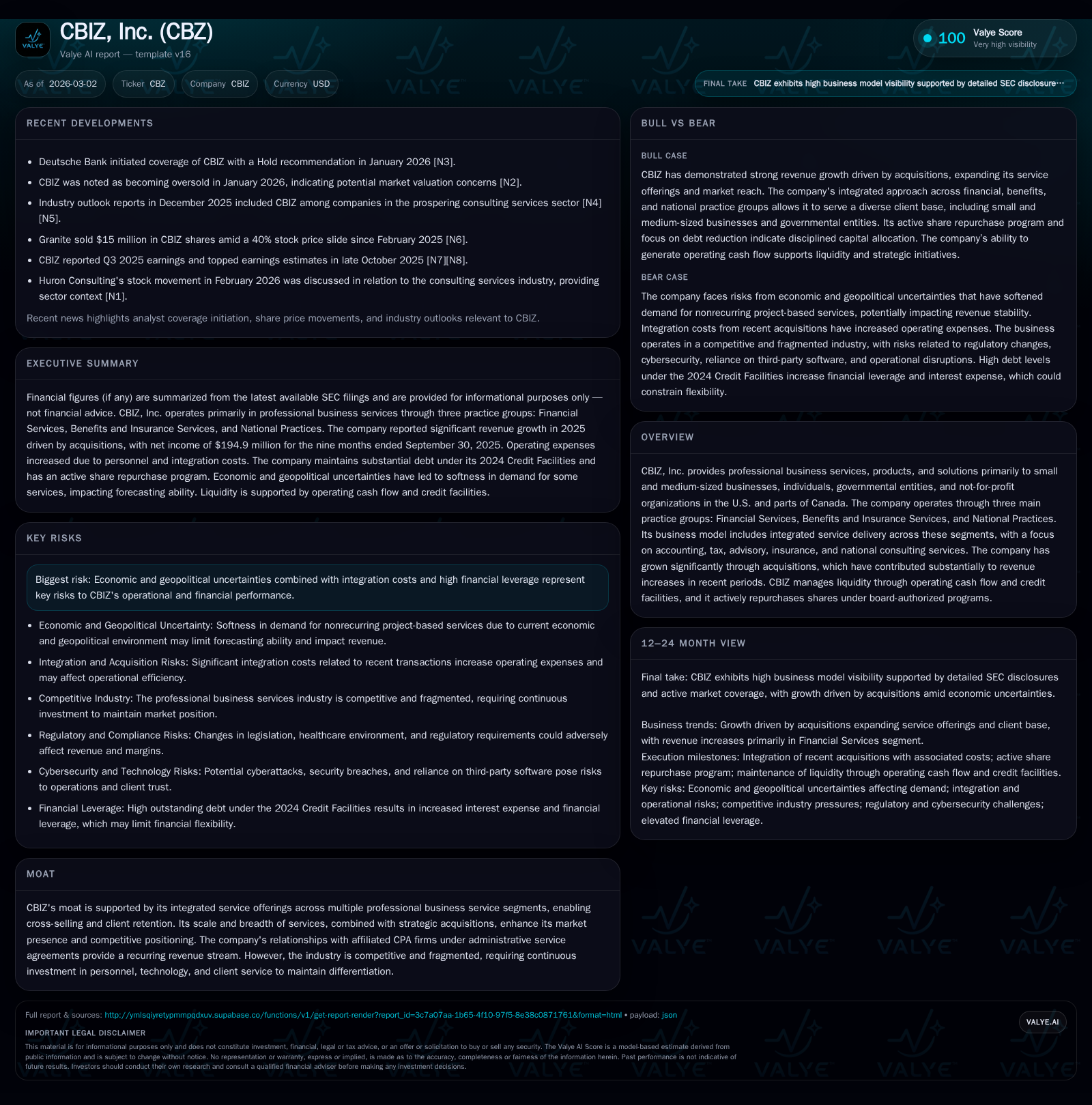
CBIZ, Inc. demonstrated notable revenue and operating income expansion in 2025, primarily driven by an aggressive acquisition strategy that contributed over 60% of incremental revenue year-to-date. Despite the top-line momentum, the company faces headwinds from integration expenses, economic uncertainty impacting demand for nonrecurring services, and substantial leverage under its 2024 Credit Facilities. CBIZ is balancing these risks with disciplined capital allocation, including sizable share repurchases and a focus on debt reduction to preserve strategic flexibility. Its integrated service model across Financial Services, Benefits & Insurance Services, and National Practices supports a competitive moat but also requires continued investment in personnel and technology to sustain growth and margin expansion.
Transformation Through Acquisitions: Historical Revenue and Profit Growth
CBIZ’s financial trajectory through recent years culminated in a remarkable leap during fiscal year 2025. Revenue expanded at a modest rate of approximately 2% year-over-year to $2.34 billion; however, the company recorded an exceptional operating income gain of over 217%, reaching $234 million—more than tripling its prior year figure of roughly $73.7 million [F1]. This nonlinear increase was predominantly driven by acquisitions completed before or during early phases of 2025 which significantly expanded the firm’s scale and scope.
The outsized jump in profitability illustrates how strategic M&A can amplify operating leverage when well-integrated. Nonetheless, the notable growth margin differential relative to revenue signals operational complexities highlighted in subsequent sections.
Historical performance (annual)
| FY | Net ($mm) | CFO ($mm) | OpInc ($mm) | Capex ($mm) | Net YoY |
|---|---|---|---|---|---|
| 2025 | 115 | 192 | 234 | 17 | +181.3% |
| 2024 | 41 | 124 | 74 | 13 | -66.1% |
| 2023 | 121 | 154 | 165 | 23 | +14.8% |
| 2022 | 105 | 126 | 168 | 9 |
Source: SEC companyfacts cache [F1].
Capital returns and efficiency (annual)
| FY | Buybacks ($mm) | FCF ($mm) | ROE% |
|---|---|---|---|
| 2025 | 160 | 176 | 6.6 |
| 2024 | 0 | 111 | 2.3 |
| 2023 | 65 | 130 | 15.3 |
| 2022 | 123 | 117 | 14.8 |
Source: SEC companyfacts cache [F1].
Table presents explicit annual data with calculated YoY percent changes highlighting inflection in fiscal year 2025 owing to acquisition-related impacts.
Revenue Composition and Practice Group Contributions Post-Acquisition
CBIZ operates through three primary integrated practice groups: Financial Services; Benefits and Insurance Services; and National Practices. These segments deliver complementary solutions such as accounting, tax advisory, insurance brokering, and specialized consulting across diverse small- and medium-sized business clients [S2].
For the nine months ended September 30, 2025, approximately $835 million (61.7%) of incremental revenue over the prior period stemmed from newly acquired businesses net of divestitures [S2], underscoring M&A as the fundamental driver of topline growth during this period. The integrated service delivery model affords substantial cross-selling opportunities across practice groups—an essential component underpinning sustained client retention and scaling.
The Financial Services group has been particularly instrumental given its dominant share (~79%-84%) of total revenues in recent quarters [S20][S27], benefiting both from organic client billings and acquired platform expansions. Benefits & Insurance Services showed steady contributions with smaller absolute but consistent increases.
The National Practices group faced slight contraction attributable partly to divested units such as CBIZ KA Consulting Services but remains anchored by a large cost-plus government contract extended through at least December 2028 [S16][S22]. Overall, service diversification across these units helps mitigate exposure to cyclical pressures inherent in specific segments.
Integration Costs, Economic Uncertainties, and Operational Headwinds
Despite substantial revenue gains from acquisitions, CBIZ confronted elevated integration costs reflecting consolidation efforts post-Transaction alongside increased facility-related expenses, higher personnel costs—including incentive compensation—and boosted technology investments [S24][S25].
Operating expenses excluding deferred compensation rose sharply by over $200 million for the quarter ended June 30, contributing to a relatively flat operating margin ratio despite absolute profit improvement [S21]. Nonrecurring integration charges were also material though tapering from prior periods.
Externally driven risks compound operational complexity: CBIZ management specifically cites softness in nonrecurring project-based services amid prevailing economic uncertainty exacerbated by geopolitical developments [S13][S23]. This softening constrains visibility into demand trends—particularly affecting consulting engagements outside core recurring offerings.
These dynamics reflect broader sector challenges where professional service providers face volatile project pipelines coupled with pressure to continually invest in talent acquisition/retention plus technology enhancements to preserve differentiation within fragmented markets.
Outlook on Organic Growth and Future Expansion Opportunities
While official guidance is absent, company disclosures suggest a cautious tone regarding organic demand outlook given current market softness—especially within discretionary project services—which could temper near-term growth prospects outside acquisition-driven expansion [N2][S2].
Nonetheless, CBIZ’s strategic emphasis on maximizing operational synergies among its integrated platforms positions it favorably for selective organic penetration amidst evolving client needs. Focused investments aimed at increasing wallet share per client via cross-practice selling remain central.
Moreover, although no acquisitions were completed during the first nine months of fiscal year 2025—a pause compared with active prior periods—the balance sheet and credit facilities maintain flexibility for high-return deals when conditions improve [S5][N2].
Capital Structure, Debt Burden, and Liquidity Management
As of September 30, 2025, CBIZ carried approximately $1.59 billion outstanding under its revolving credit facilities initiated in conjunction with its transformative transaction activities during early-to-mid-2024 [S4][S7][F1]. The weighted average interest rate on this debt increased noticeably to roughly 6.64%-6.67%, reflecting rising benchmark rates over historical levels around mid-5% [S6][S7].
Key credit covenants governing total leverage ratio and minimum interest coverage remained comfortably met as reported at mid-year and quarter-end filings impacting liquidity headroom positively [S4][S14]. Available borrowing capacity was reported near $316-$370 million after drawn amounts—providing capital agility for operational needs or future strategic acquisitions.
Operationally generated cash flows remain critical given seasonal working capital demands inherent to the financial services industry cycles as well as ongoing contingent payments related to past acquisitions [S9][S11]. Maintaining prudent leverage metrics will be essential amid rising interest expense burdens noted within quarterly profit results.
Share Repurchases and Capital Allocation Philosophy
The Board expressly reaffirmed commitment toward shareholder value via an ongoing share repurchase program authorized annually since inception more than two decades ago [S12]. In FY2025 alone, CBIZ executed approximately $160 million worth of buybacks following a zero-buyback policy stance throughout FY2024 reflecting both improved free cash generation and renewed confidence post-integration phase [F1][S20].
Share repurchases occurred primarily under a Right of First Refusal (ROFR) Agreement targeting former partners tied into acquisition consideration shares—executed alongside open market purchases to manage tax withholding settlements associated with stock awards issuance [S19].
No dividends were declared or indicated during this period emphasizing reinvestment priorities focused on debt reduction for enhanced financial flexibility aligned with strategic acquisition readiness rather than immediate yield distributions.
Operating Cash Flow Trends and Investment in Operational Capacity
Cash flow performance corroborates earnings improvements; operating cash flow jumped roughly +56% compared with prior fiscal year reaching about $192 million bolstered by higher net income partially offsetting working capital deployment during seasonal peaks typical for accounting/tax practices [F1][S18].
Simultaneously, capital expenditures increased by over +31% year-over-year signaling heightened investment in infrastructure—likely IT systems upgrades plus office space enhancements needed to support enlarged employee base post-M&A campaigns [F1][S16]. This level of capex reflects conscious efforts toward sustaining operating leverage amid expanding scale rather than discretionary spending spikes.
The interplay between cash flow growth and capex outlay suggests balanced management aimed at reinforcing long-term capacity aligned with strategic ambitions without aggressive free cash flow contraction.
Key Milestones to Track in CBIZ’s Strategic Execution
Absent explicit forward guidance specifics beyond qualitative commentary, investors should monitor key factors including:
- Progress on reducing overall debt balances against credit facility limits while maintaining covenant compliance — pivotal for future acquisition power allocation [N2][S3]
- Successful integration milestone completions ensuring full synergistic benefit capture from prior acquisitions limiting erosion from transaction-related expenses or execution risks [N2]
- Share count evolution owing to continuation or acceleration of repurchase programs under ROFR Agreements with accompanying impact on per-share profitability metrics [S12]
- Responses to external macroeconomic factors affecting demand elasticity especially around nonrecurring project-based offerings across segments that may pressure near-term organic growth potential[S13]
- Enhancements or shifts within their integrated service delivery models promoting value-added cross-practice selling considerations adding stickiness versus competitors amidst a fragmented industry backdrop
These milestones collectively will influence how sustainably CBIZ can capitalize on its recent transformational scale-up while managing capital structure risks effectively.
This analysis utilizes publicly filed SEC datasets spanning annual and quarterly periods through early March 2026 combined with relevant corporate disclosures outlined herein. It does not contain investment advice or price forecasts but aims solely at providing detailed operational-financial insights within current contextual constraints.
Disclaimer: This is research-only, informational analysis and not investment advice. It may include AI-generated interpretation and general industry context. Always verify important details using primary sources.

Comments