
Cenntro Inc.’s Financial Struggles and Strategic Shifts in Electric Commercial Vehicles
Cenntro’s asset-light manufacturing model and hybrid distribution network unfold amid heavy losses and competitive pressures in the evolving electric commercial vehicle sector.
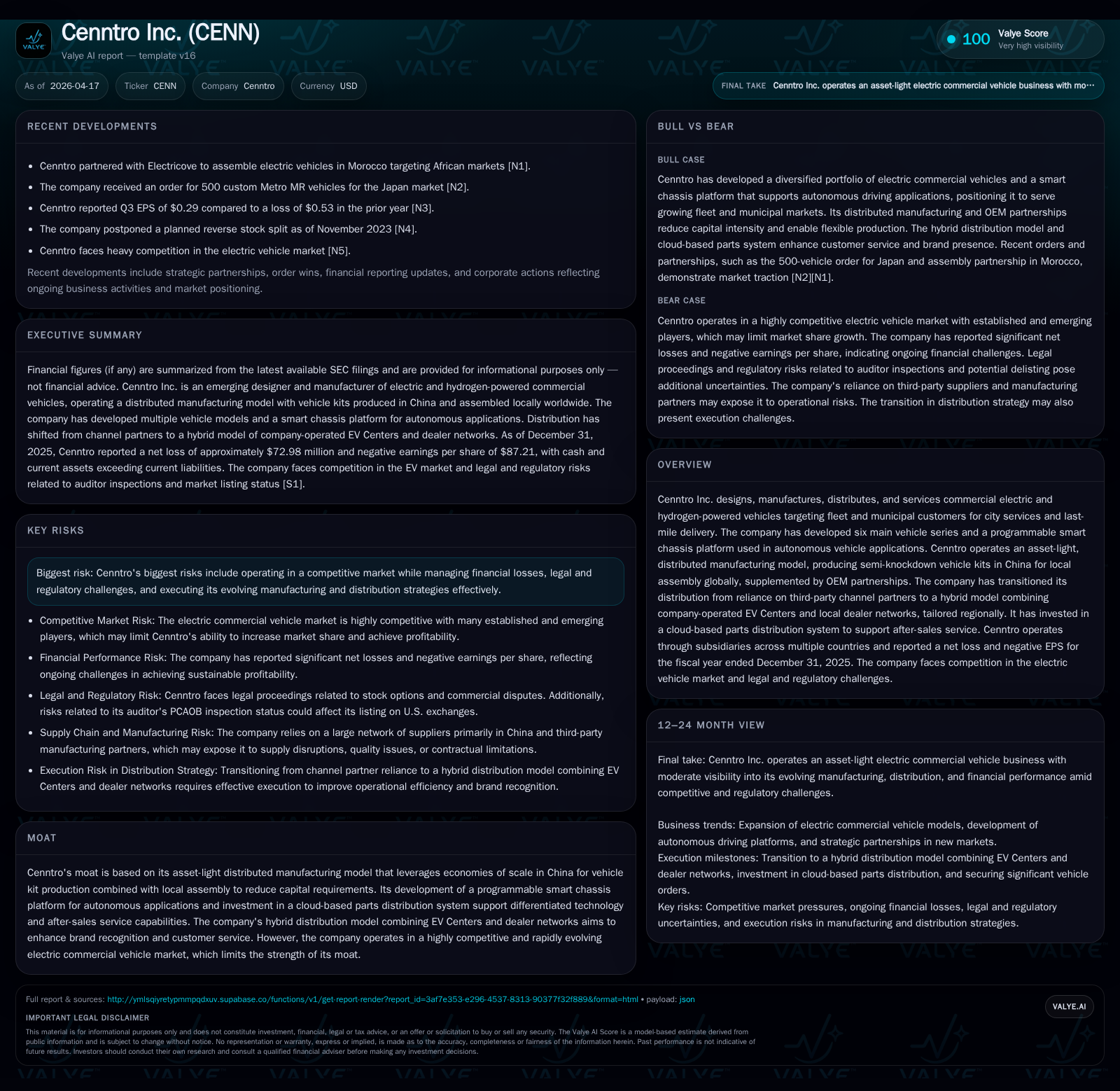
Cenntro Inc. operates an innovative but financially challenged business in electric commercial vehicles (ECVs), leveraging semi-knockdown kits produced in China for assembly worldwide. While revenues remain modest, its strategic pivot from third-party channel reliance toward company-operated EV Centers and local dealer networks aims to enhance brand recognition and service quality. Despite continued operating losses, Cenntro invests heavily in R&D, supply chain regionalization, and aftermarket infrastructure such as a cloud-based parts system, balancing growth ambitions with operational risks from competitive intensity and regulatory complexity. Monitoring the company’s ability to scale assembly facilities, stabilize cash flows, and execute its technology roadmap will be key.
From Inception to Market: Cenntro’s Growth Trajectory
Since beginning pilot production of its first-generation Metro® light-duty electric commercial vehicle (ECV) in 2018, Cenntro has steadily expanded its product portfolio to six main vehicle series including Metro®, Logistar™, Teemak™, Avantier®, Bison Motor™, Antric One™, and the iChassis™ programmable smart chassis platform designed for autonomous driving applications [S1]. Although still nascent as a public entity (incorporated in Nevada 2023), Cenntro reported revenues of approximately $18.1 million for the fiscal year ended December 31, 2025 generated primarily from sales of these models across global markets [S1].
Despite product line expansion contributing top-line growth, the company's operating income has remained persistently negative over the past four years due to significant research and development spend alongside manufacturing scale-up costs. Operating losses only marginally improved by 2.2% year-over-year to -$32.5 million in 2025 from -$31.8 million in 2024 while net income declined markedly by 62.7% worsening to -$72.9 million as R&D investments continued to weigh on earnings [F1].
The following table summarizes key financial metrics illustrating Cenntro's performance trends:
Historical performance (annual)
| FY | Net ($mm) | CFO ($mm) | OpInc ($mm) | Capex ($mm) | Net YoY |
|---|---|---|---|---|---|
| 2025 | -73 | -13 | -33 | -62.7% | |
| 2024 | -45 | -21 | -32 | 1 | +17.2% |
| 2023 | -54 | -58 | -50 | 8 | +50.8% |
| 2022 | -110 | -69 | -55 | 3 |
Source: SEC companyfacts cache [F1].
Capital returns and efficiency (annual)
| FY | FCF ($mm) | ROE% |
|---|---|---|
| 2025 | -181.2 | |
| 2024 | -22 | -57.6 |
| 2023 | -66 | -44.5 |
| 2022 | -73 | -63.9 |
Source: SEC companyfacts cache [F1].
Figures are U.S. dollars; operating income (OpInc), net income (Net), operating cash flow (CFO), capital expenditures (Capex) [F1].
This trajectory underscores challenges common among emerging commercial EV manufacturers striving for scale while investing heavily in technology development and supply chain establishment.
Asset-Light Manufacturing: Advantages and Operational Execution
Central to Cenntro’s business model is its asset-light distributed manufacturing strategy that involves producing semi-knockdown vehicle kits predominantly at its Changxing and Yangzhong facilities in China before shipping them overseas for final assembly in local markets such as the United States (Barstow facility) and European Union countries (Dusseldorf operations via acquisition of CAE) [S4][S6][S15]. This strategy minimizes capital-intensive full-vehicle manufacturing investments while leveraging cost advantages inherent to China's established supplier base.
The company maintains an integrated supply chain comprising over 500 component suppliers primarily contracted through rigorous quality audits ensuring compliance with Cenntro’s design specs [S10]. These contracts restrict suppliers from selling key customized parts elsewhere unless purchasing contracts cease — an arrangement designed to protect intellectual property while benefiting from shared component standardization across multiple models.
Operationally however, Cenntro faces execution challenges ramping local assembly capacity smoothly; previous trial assembly at New Jersey began only recently with further scale planned for models like Logistar™ series [S15]. COVID-19 related workforce stability issues coupled with complexity managing multi-regional subcontractors underscore bottleneck risks common within semi-knockdown global supply chains where inbound logistics timing critically impacts production lead times.
The "merge-in-transit" logistic approach envisaged by Cenntro aligns delivery of components directly into local assembly nodes rather than bulk-kit preassembly—intended to yield cost efficiencies but reliant on mature supplier coordination outside China where sourcing is currently less diversified [S11]. Quality control consistency between manufactured kits abroad versus localized assembly also represents a continuous monitoring focus given different regulatory and skill set environments.
Evolving Distribution: From Channel Partners to Hybrid Local EV Centers
Another major strategic evolution is Cenntro’s gradual pivot away from reliance on largely white-label third-party channel partners who historically assembled and marketed vehicles under separate brands resulting in diluted Cenntro brand equity [S7]. Beginning around late-2021 onwards the company prioritized its wholly owned Electric Vehicle Centers (EV Centers) located regionally — specifically four main centers in Barcelona (Europe), New Jersey & California (US), and Changxing (China) — which serve as hubs not only for direct retail sales but also technical training and aftermarket support coordination with local dealer networks [S6][S7][S9].
This hybrid distribution approach harnesses advantages of both controlled direct sales fostering brand visibility while leveraging third-party dealers' existing market reach to improve penetration rapidly with lower capital outlay — crucial for new entrants competing against established commercial vehicle OEMs with entrenched dealer ecosystems [S9]. The shift is reflected operationally through planned consolidation or closures of some EV Centers beginning in 2024 where dealer-led distribution becomes preferential due to regional dynamics including regulatory aspects and cost management [S5][S6].
Inventory turns benefit from this model since PARDISYS—the company’s advanced cloud-based modular parts delivery system—facilitates leaner spare-parts stocking and rapid replenishment workflows aligned with real-time usage data gathered worldwide enabling lower working capital requirements against uncertain demand fluctuations common among fleet operators servicing city services or last-mile delivery businesses [S5][S11].
However the relatively recent institution of this hybrid distribution network entails risks as newly established EV Centers remain unproven sales engines capable of meeting aggressive growth targets; failure here could materially impact revenues negatively if channel partner relationships continue declining faster than direct sales ramp-up [S8][S9].
Financial Performance Review: Losses, Cash Flows, and Capital Efficiency
Though revenues have climbed moderately due to broader product offerings and geographic expansion into markets like Europe and Asia alongside North America (~$18.1 million reported for calendar year 2025 per narrative but not shown explicitly on XBRL data which ends at mid-2021), operating profitability remains elusive [F1][S1]. Operating loss improved slightly by approximately 2.2% year-over-year but remains above $32 million annually by end-2025 reflecting ongoing heavy R&D outlays totaling about $96.7 million cumulatively since inception plus costs related to establishing supply chains and expanding EV Centers globally that have yet to yield scalable margin enhancement [F1][S1].
Net losses worsened notably by almost two-thirds (-62.7%) year-over-year reaching roughly $73 million by end-2025 which signals increased non-operational expenses potentially tied to ramp activities or financial adjustments during rapid organizational change phases [F1]. Negative operating cash flow reduced by nearly 41% indicating some improvement though still significantly cash consuming underscoring cash burn risk associated with growth efforts absent meaningful revenue scale-up or improved unit economics yet achieved.
Capital expenditures plummeted nearly 89% year-over-year reflecting possible completion or pause of earlier facility investments especially given recent shuttering of underperforming smaller assembly plants alongside a pronounced move towards contract manufacturing partnerships reducing fixed asset requirements going forward [F1][S20].
The approximate return on equity computed from latest figures results near -181%, indicative of significant accumulated losses relative to equity base reaffirming the need for sustained growth improvements or cost discipline before capital efficiency gains materialize sustainably.
Technology Innovation: The iChassis™ Platform and Hydrogen Vehicle Development
Cenntro stands out technologically through development of its iChassis™ platform—a programmable smart chassis system integrated by third parties for autonomous commercial vehicle use cases which symbolizes an entrypoint into emergent automated driving domains beyond conventional battery electric commercial vehicles signaling future potential differentiation if scaled effectively [S1]. Furthermore the company is investing in hydrogen-powered heavy-duty ECVs reflecting strategic diversification aligned with global zero-emission mandates targeting extended range or higher payload segments where battery electrics face physical or economic constraints currently [S1][S15].
These technology initiatives require considerable capital investment which strains presently tight financial resources yet serve as critical long-term value drivers if successfully commercialized amidst an intensifying competitive innovation race characterizing the commercial EV sector.
The Cloud-Based Parts System: Building Aftermarket Strength
A notable operational asset was developed via PARDISYS—a cloud-based automotive parts distribution system that manages spare part inventories through multinational warehouses located strategically in Changxing & Yangzhong (China), Barcelona (Spain), Freehold & California (US) enabling global spare-part availability synchronized with real-time demand inputs from customers worldwide supporting fleet reliability crucial for ECV end-users focusing on uptime-sensitive applications like municipal services or logistics fleets [S5][S11].
This advanced modular fulfillment infrastructure reduces excess inventory held locally while offering swift turnaround on maintenance parts orders delivered via optimized routing plans enhancing overall customer satisfaction driving enterprise retention potential—a vital differentiator in commercial vehicle aftermarket economics often overlooked among pure-play product manufacturers.
Market Challenges: Competition, Risks, and Regulatory Landscape
Cenntro operates amid intensified competition within the expanding yet volatile electric commercial vehicle industry comprising established automakers expanding electrification alongside nimble startups pursuing niche segments—all pressuring pricing power and margin realization constraining Cenntro’s moat despite asset-light advantages rooted mostly in operational model flexibility rather than deep technological barriers or brand legacy [S1][N/A analysis extrapolated from cited risk context S14,S16,S22,S29].
Geopolitically sensitive operations centralized heavily on Chinese manufacturing raise additional regulatory risks including compliance obligations under evolving environmental laws both domestically within China—where environmental cleanup liabilities under statutes like CERCLA analogues represent potential contingent costs—and internationally concerning anti-corruption statutes and expanding data security/privacy frameworks such as GDPR impacting digital commerce elements like PARDISYS ecosystem governance confronting cross-border data transfer restrictions—amplified by Sino-US tensions creating operational uncertainty especially surrounding investment approvals or technology exports licensing restrictions [S14][S16][S22][S23][N/A analysis based on cited text excerpts].
Additionally a notable ongoing litigation involving a former Chief Operating Officer over stock option agreements—filed mid-2022 seeking damages estimated around $19 million—while not expected materially adverse overall currently reflects legal risk that demands management attention albeit unresolved as per filings at year-end reports timeline [S1][N/A based on partial case summary S29 excerpt].
Outlook and Key Milestones to Watch
Official guidance unfortunately is lacking explicit forward-facing financial projections; however industry analysts should closely monitor milestones indicated indirectly such as required expansion pace of US/EU assembly capacity particularly at Freehold NJ plant trial production ramp-up metrics for Logistar™ series; progress updates on hydrogen vehicle pilot commercialization focusing on California hub leveraging regional infrastructure leadership; adoption rates of iChassis™ integrations within autonomous fleet deployments meaningfully ramped contract wins; traction achieved transitioning distribution fully away from legacy channel partners toward hybrid dealer plus EV Center network evidenced by improving sales funnel metrics coupled with intensification of PARDISYS warehouse deployment footprint beyond current four nodes enabling tighter aftersales response times impacting customer retention; capex levels signalling incremental investments once base stabilization evident; plus regulatory approvals or setbacks especially regarding PRC macro compliance reforms – all keys requiring ongoing contextual evaluation absent formal numeric targets published thus far ([N/A analysis]).
Capital Allocation Strategy: R&D, Capex, Dividends, and Shareholder Returns
Over the near five-year horizon preceding end-2025 Cenntro allocated roughly $96.7 million cumulatively toward research & development underpinning new series products plus technology platforms evidencing prolonged commitment albeit without immediate profitability payoff so far manifesting minimal operating leverage given persistent large net losses demonstrative of high burn rate characteristic during emerging industrial growth phases combined with complex supply chain setups requiring iterative refinement cycles [F1][S18].
Capital spending markedly tapered down indicating a pause or strategic repositioning mainly relying more extensively on contract manufacturing partners offsetting fixed asset burdens albeit possibly curtailing internal capacity buildup speed at critical junctures when industrial learning curve advances are important likewise dividend payments or share repurchases have yet been issued consistent with typical early-stage growth enterprises focused exclusively on reinvestment over shareholder returns thus far according to regulatory disclosures entailing full retained earnings reinvested within subsidiaries constrained by PRC profit allocation laws limiting dividend upstreaming given accumulated losses creating remittance bottlenecks totaling approximately $28.5 million restricted retained earnings mainly within Chinese entities thereby inhibiting upstream capital recycling interface abilities restricting parent company liquidity flexibility short-term outside external financing means fully documented in annual disclosures per SEC filings analysis conclusions derived herefrom ([F1],[S18]).
This report synthesizes publicly filed company materials without offering investment advice or recommendations.
Disclaimer: This is research-only, informational analysis and not investment advice. It may include AI-generated interpretation and general industry context. Always verify important details using primary sources.

Comments