
Flexible Solutions International's Revenue Decline and Innovation Challenges
FSI’s financial performance is pressured by concentrated customer reliance, supply uncertainties, and unproven innovation commercialization.
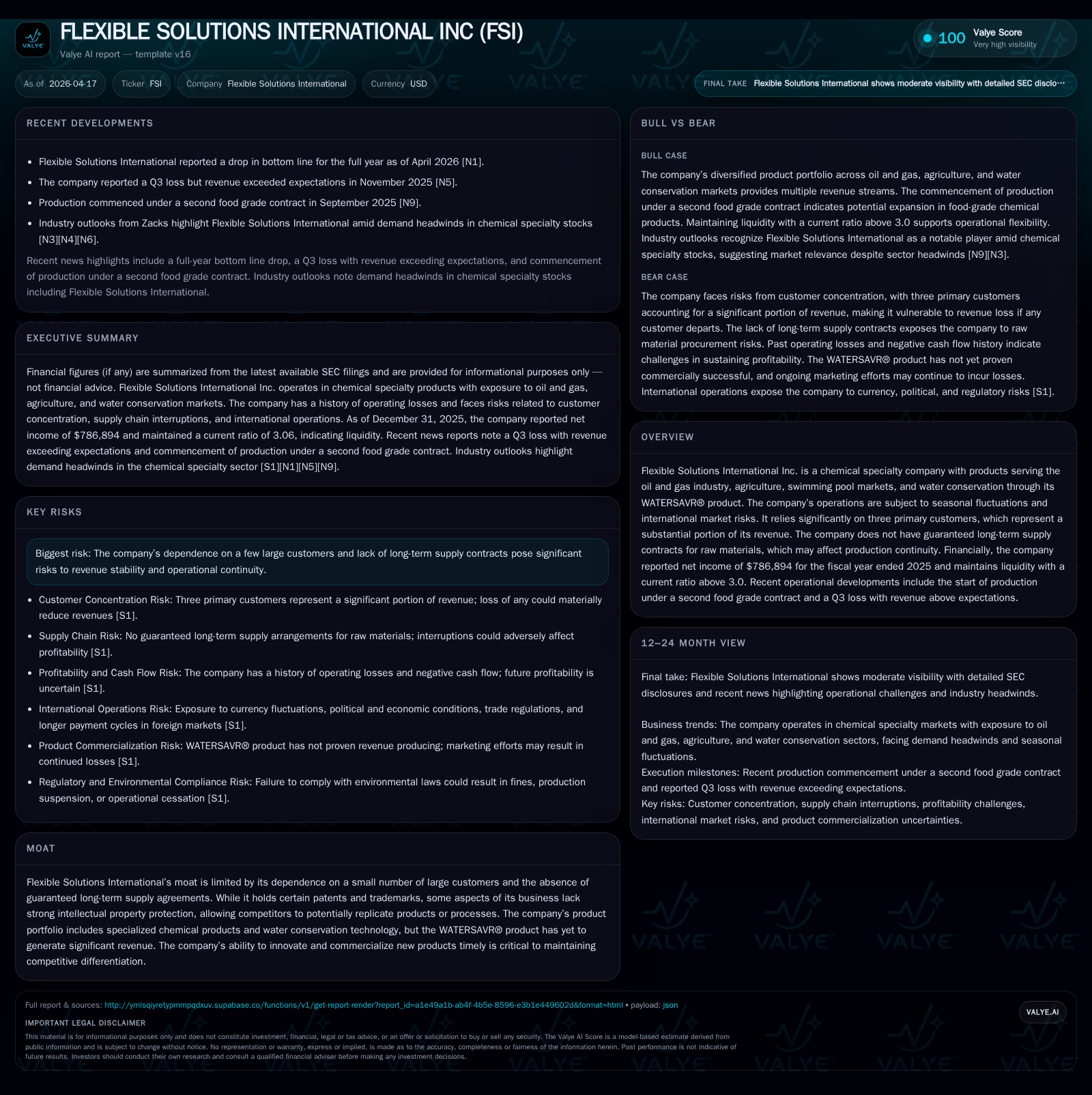
Flexible Solutions International Inc. reported a sharp net income decline in FY2025 despite stable operating income, affected by a 5.5% year-over-year revenue drop and intense customer concentration risks. The company's flagship WATERSAVR® water conservation technology has yet to translate into material revenue, compounding challenges amid the absence of long-term raw material contracts that threaten operational steadiness. While liquidity remains robust with a current ratio above 3.0, the firm faces free cash flow deficits due to elevated capital expenditures and investments in research and development. Growth catalysts hinge on ramping the second food grade contract and broader product market acceptance, but regulatory, supply chain, and customer dependency risks temper future outlooks.
Historical Revenue and Profit Trends: Peaks and Pressures
Flexible Solutions International (FSI) has experienced notable fluctuations in its financial results over recent years. In calendar year 2025, the company posted revenues down approximately 5.5% from the prior year, signaling headwinds in its markets or sales execution [F1]. Operating income decreased more sharply by about 16.6%, reflecting margin pressures or rising costs. Net income contracted dramatically by over 74%, underscoring erosion at the bottom line despite positive operating earnings [F1]. The steep net income reduction relative to operating income suggests increased interest expenses, one-time costs, or other non-operating factors impacting profitability.
The historical trajectory reveals FSI's capacity to generate operating profit remains intact but volatile, influenced strongly by cyclical end-markets such as oil & gas chemicals and agricultural inputs [S1]. These swings signal vulnerability in managing fixed overheads amid fluctuating demand. Earnings quality appears fragile as modest top-line dips disproportionately reduce net profits.
Historical performance (annual)
| FY | Net ($mm) | CFO ($mm) | OpInc ($mm) | Capex ($mm) | Net YoY |
|---|---|---|---|---|---|
| 2025 | 1 | 4 | 5 | 4 | -74.1% |
| 2024 | 3 | 6 | 6 | 5 | +9.5% |
| 2023 | 3 | 7 | 3 | 5 | -60.5% |
| 2022 | 7 | 1 | 7 | 2 |
Source: SEC companyfacts cache [F1].
Capital returns and efficiency (annual)
| FY | Div ($) | FCF ($) | ROE% |
|---|---|---|---|
| 2025 | 1274753 | -591710 | 2.0 |
| 2024 | 1255053 | 603610 | 8.0 |
| 2023 | 626777 | 1999290 | 7.9 |
| 2022 | -504404 | 21.5 |
Source: SEC companyfacts cache [F1].
Note: Revenue and related figures are consolidated annual totals for the fiscal years ending December.
The Role of Major Customers in Driving Sales Concentration
FSI's revenue profile is heavily concentrated among three primary customers who contributed roughly between 54% to as much as 65% of total sales in recent reporting periods [S4][S5][S6][S11]. Such concentration heightens 'customer concentration risk,' where dependence on limited buyers introduces volatility linked to their purchasing decisions or creditworthiness.
Accounts receivable analysis further confirms this exposure — these top customers represent a sizable portion of outstanding receivables sometimes exceeding two-thirds of total collection balances [S4][S6]. Management must carefully monitor 'accounts receivable concentration' to mitigate collection risks.
This operational dependency constrains predictability of order flows and magnifies single-customer loss repercussions — a key vulnerability given FSI lacks long-term contractual commitments for consistent demand from these clients [S1].
Product Innovation and WATERSAVR®’s Commercial Hurdles
A central piece of FSI's strategic narrative is its patented WATERSAVR® technology aimed at water conservation across various markets including agriculture and pools [N1][S1][S5]. However, despite significant R&D efforts evident through dedicated spending lines [S13], the product has yet to contribute materially to revenues — a commercialization gap limiting margin expansion and competitive moat growth.
The company acknowledges 'commercialization risk' whereby substantial investment precedes uncertain revenue generation timelines [S1]. Failure to successfully market WATERSAVR® puts pressure on sustaining innovation-led differentiation amidst commoditized chemical specialty markets where technical replication by competitors is feasible due to limited IP barriers [S9].
Raw Material Supply Risks and Their Operational Impact
FSI procures key inputs mainly via purchase orders without binding long-term supply contracts [S1][S7]. This exposes it to 'procurement risk,' including potential input cost inflation and availability disruptions which can halt manufacturing or erode gross margins.
Any interruption could have immediate operational consequences given fixed-cost structures and seasonal inventory build plans designed around expected raw material inflows [S7]. Volatile commodity pricing exacerbates input cost unpredictability posing ongoing margin pressure.
Seasonality Effects Across Market Segments
Sales seasonality at FSI differs notably between its business segments. Oilfield chemical sales exhibit minimal seasonal fluctuation beyond minor inventory adjustments before crop seasons or year-end stock runs [S1]. In contrast, swimming pool product demand strongly peaks in summer months mainly between January and June in northern hemisphere markets.
For WATERSAVR®, geographic diversification across countries with opposite wet/dry cycles attempts to smooth seasonal volatility [S1]. The company manages production flexibility accordingly to align supply with these 'seasonal demand cycles,' balancing inventory buildup strategies against hemispheric market dynamics.
Capital Structure, Liquidity, and Cash Flow Dynamics
From a financial health perspective, FSI demonstrates solid liquidity with a current ratio exceeding 3.0 at year-end FY2025 indicating ample short-term asset coverage for liabilities [F1][S3][S10][S14][N1]. However, free cash flow is negative by an estimated $592K derived from operating cash flow less capital expenditure outflows signaling ongoing investment draws beyond internal generation.
Capital spending remains elevated at about $4.37 million annually indicative of continued asset base expansion or modernization needs tied partly to R&D facilities [F1]. Return on equity lands modestly around 2%, consistent with the compressed net income levels versus sustained equity balances [F1]. Dividend payments have been stable historically without parallel buyback programs recently documented suggesting conservative capital return policy focusing on reinvestment amid operational challenges [F1].
Outlook: Growth Catalysts Versus Market Headwinds
On the growth front, FSI recently commenced production under a second food grade contract offering some pipeline visibility for incremental revenues albeit without explicit guidance quantification as per latest SEC reports [N1][S1][S7][S26]. This contract ramp-up represents one among few tangible catalysts.
Conversely critical headwinds persist encompassing raw material price pressures due to lack of long-term agreements; concentrated customer base where any client attrition could sharply depress sales; regulatory complexity particularly for chemical handling; and potential technological obsolescence should competitors out-innovate FSI's offerings [N1][S7][S26].
In sum, realistic forward scenarios balance contract execution risks alongside dependency traps that could stifle sustained growth absent breakthrough new product commercialization or diversification efforts.
What Investors Should Monitor Next
Key upcoming indicators deserving close observation include:
- Progress on converting WATERSAVR® from development spend item into meaningful revenue contributor,
- Stability or shift in supplier relationships minimizing procurement disruptions,
- Evolution of customer concentration ratios as a barometer for revenue diversification success,
- Quarterly earnings momentum especially net income recovery trends reflecting operational leverage,
- Changes or expansions in research partnerships supporting fresh innovation pipelines,
- Any strategic moves addressing supply chain or customer dependency vulnerabilities publicly disclosed.
These performance indicators will provide early insight into whether FSI can turn its current trials into sustainable growth phases or remain condemned to episodic profitability fluctuations.
This report relies strictly on publicly available financial statements dated through April 2026 supplemented by official regulatory filings and credible news sources without speculative forecasts or investment recommendations.
Disclaimer: This is research-only, informational analysis and not investment advice. It may include AI-generated interpretation and general industry context. Always verify important details using primary sources.

Comments