
CERo Therapeutics’ Next-Gen T-Cell Immunotherapy Faces Financial and Operational Challenges
CERo advances its innovative CER-T cell platform and clinical pipeline while confronting significant financial constraints that raise concerns about operational continuity.
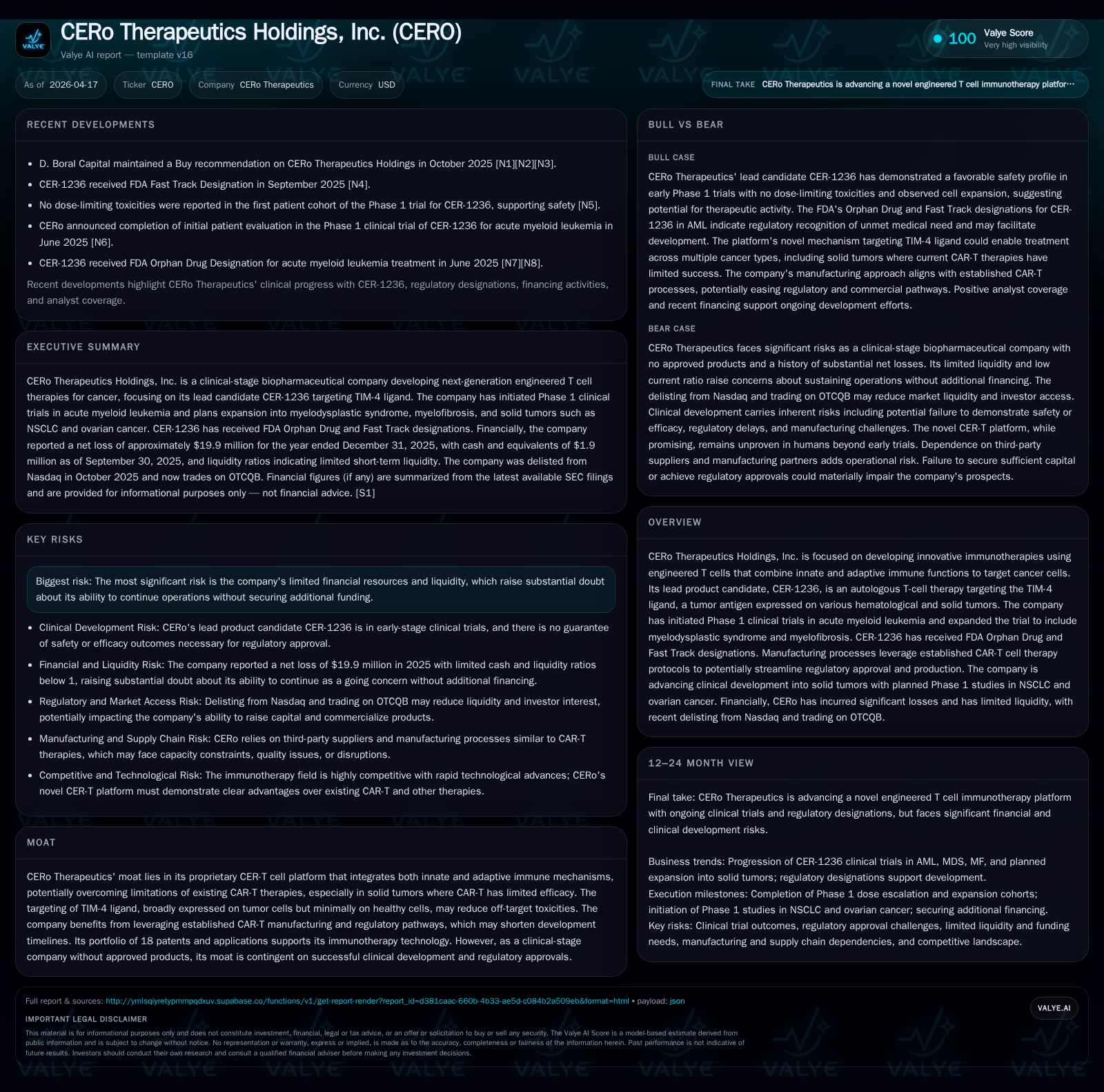
CERo Therapeutics is developing a novel Chimeric Engulfment Receptor T-cell immunotherapy targeting hematologic and solid tumors, with its lead candidate CER-1236 progressing through Phase 1 trials. Despite regulatory designations and clinical milestones, the company faces escalating operating losses and limited liquidity, with cash reserves raising going-concern doubts. Investors should monitor clinical data outcomes and CERo’s ability to secure additional financing to sustain development and commercialization efforts.
From Inception to Clinical Stage: CERo’s Development Path
CERo Therapeutics Holdings, Inc., founded in 2016 and publicly reporting since early 2024, focuses on advancing its proprietary CER-T cell immunotherapy candidate CER-1236. This autologous T-cell therapy targets the TIM-4 ligand antigen expressed on hematologic malignancies such as acute myeloid leukemia (AML), myelodysplastic syndrome (MDS), myelofibrosis, as well as solid tumors including non-small cell lung cancer (NSCLC) and ovarian cancer [S1]. The company’s growth reflects its shift from discovery into clinical development with increasing R&D expenses driving expanding net losses.
Financial data indicates this trend clearly: operating income declined from a loss of approximately $2.9 million in FY2023 to around -$15.3 million in FY2024. Net losses deepened from about -$2.5 million in FY2023 to nearly -$7.7 million in FY2024, reaching approximately -$19.9 million in FY2025—an increase of roughly -157.6% year-over-year—reflecting intensified clinical activities including trial initiations and manufacturing investments [F1]. Operating cash flow deficits widened substantially to about -$16.1 million in FY2025 compared to smaller outflows in prior years.
Historical performance (annual)
| FY | Net ($mm) | CFO ($mm) | OpInc ($mm) | Net YoY |
|---|---|---|---|---|
| 2025 | -20 | -16 | -157.6% | |
| 2024 | -8 | -15 | -204.9% | |
| 2023 | -3 | -2 | -3 | -279.8% |
| 2022 | -1 | -1 |
Source: SEC companyfacts cache [F1].
Capital returns and efficiency (annual)
| FY | Buybacks ($mm) | ROE% |
|---|---|---|
| 2025 | 365.7 | |
| 2024 | 408.1 | |
| 2023 | 33 | 17.9 |
| 2022 | 139 | 6.2 |
Source: SEC companyfacts cache [F1].
Cash & equivalents as of Q3 September 2025 [F1].
The increasing losses mainly arise from investment into pivotal Phase 1 trials initiated in May 2025 evaluating CER-1236's safety and efficacy across several hematological malignancies alongside expanding manufacturing capabilities utilizing established CAR-T production processes [S1]. As expected for a clinical-stage biotech focused on autologous cell therapy requiring complex manufacturing infrastructure and regulatory compliance, CERo’s intensified spending underscores the operational leverage typical at this stage.
Proprietary CER-T Cell Platform: An Innovative Immunotherapy Approach
CERo's proprietary Chimeric Engulfment Receptor T (CER-T) cell platform engineers autologous T cells integrating both innate phagocytic pathways and adaptive cytotoxic immunity. Unlike traditional CAR-T therapies primarily targeting B-cell malignancies via CD19 antigens with limited efficacy against solid tumors due to tumor microenvironment challenges or antigen variability, CER-T cells bind the TIM-4 ligand on tumor surfaces to trigger engulfment receptor signaling pathways [S1].
This dual mechanism aims for broader antitumor activity addressing refractory hematologic cancers such as AML as well as solid tumors like NSCLC and ovarian cancer—a difficult-to-target area for cell therapies. The restricted expression of TIM-4 ligand on healthy tissues may reduce off-target toxicities compared to existing CAR-T treatments. Manufacturing involves autologous T-cell collection followed by genetic modification through experienced CDMOs familiar with CAR-T processes supporting scalable production under Good Manufacturing Practices (cGMP).
Overall, CERo designs these CER-T cells to combine cytotoxic killing with macrophage-like phagocytosis for enhanced tumor clearance—a novel approach seeking to overcome challenges limiting current cell therapies beyond B-cell cancers.
Clinical Progress and Regulatory Status
Clinical advancement includes two FDA Investigational New Drug (IND) clearances after resolving initial concerns regarding nonclinical toxicity: one cleared November 14, 2024 covering AML indications including relapsed/refractory AML plus TP53 mutated MDS/AML populations; another IND accepted March 27, 2025 for NSCLC plus ovarian cancer solid tumors enabling planned Phase 1 initiation early 2026 [S1].
The ongoing open-label Phase 1/1b multi-center dose-escalation trial focuses on primary endpoints such as adverse events (AEs), serious AEs (SAEs), dose-limiting toxicities (DLTs), response rates including complete response (CR), composite CRs, and measurable residual disease evaluation—standard measures assessing safety and preliminary efficacy critical for subsequent trial phases.
Four patients have been treated under dose escalation cohorts demonstrating an acceptable safety profile allowing dose increases; notably one patient received two doses spaced by 48 hours indicating protocol optimization under close DLT monitoring [S1]. The fifth patient was dosed in March 2026 showing continued enrollment progress.
FDA granted Orphan Drug designation along with Fast Track status for CER-1236 supporting expedited development incentives given the rare disease focus such as AML.
Financial Overview: Escalating Losses Amid Liquidity Constraints
CERo’s financials highlight urgent sustainability challenges common among pioneering cell therapy developers but heightened here by sharply increasing expenditures alongside limited liquidity buffers.
As of December 31, 2025 net losses totaled approximately $19.9 million reflecting operational costs including trial expenses plus manufacturing infrastructure buildout essential for personalized product batches under strict compliance standards [F1][S18]. Operating cash flow deficits exceeded $16 million annually underscoring heavy spending outpacing inflows given absence of commercial products.
Cash & equivalents declined to about $1.9 million by Q3 ‘25 with current assets near $2.7 million versus $9.1 million liabilities producing a critically low current ratio around 0.3 indicating severe liquidity risk [F1][S18]. Such ratios typically signal imminent funding needs or drastic operational downsizing unless new capital is secured promptly.
Accumulated deficit surpassed $90 million eroding shareholders’ equity further into negative territory (~-$5.4 million at FY-end ‘25), reflecting cumulative losses diluting net asset values amid ongoing R&D intensity [F1][S18]. Auditors expressed substantial doubt regarding going concern status within one year absent additional financing support [S18][S26].
Capital Allocation Trends: Share Repurchases Amid Negative Equity
Despite mounting losses CERo executed share repurchases totaling roughly $33 million in FY2023 following a larger $139 million buyback campaign during FY2022—a notably aggressive capital return approach given shrinking equity (-$14 million negative at end ’23) possibly reflecting opportunistic secondary market activity or management confidence signals but raising questions on capital efficiency amid liquidity constraints [F1].
No dividends have been paid consistent with early-phase biotech norms prioritizing capital toward development over shareholder returns [F1]. Given deepening negative equity combined with increasing R&D spend without revenue prospects at this stage further equity dilution through financings appears likely absent transformative licensing or partnerships.
This allocation pattern highlights tension between advancing clinical programs versus maintaining financial runway amid scarce capital—a common tradeoff faced by emerging immuno-oncology ventures.
Risks Ahead: Financing Needs and Regulatory Complexities
Key risks include securing necessary funding given current cash scarcity which could force program curtailments or cessation if unmet [S18][S19]. Regulatory challenges encompass compliance not only with FDA mandates—including cGMP/cGTP for cell therapy manufacturing—but also extensive healthcare laws addressing fraud/kickbacks (Anti-Kickback Statute), false claims regulations affecting claims submissions and commercial conduct plus evolving global privacy rules like GDPR impacting clinical data handling internationally [S16][S21][S27].
Environmental health & safety regulations impose costly controls for hazardous biological materials intrinsic to gene-modified cellular product manufacturing exposing operations to compliance liabilities or interruptions upon lapses [S6][S7][S20]. Intellectual property risks persist due to competitive patent landscapes requiring robust patent defense strategies alongside licensing safeguards against infringement disputes potentially delaying commercialization [S11][S24].
Market access uncertainties post-approval include pricing and reimbursement pressures amid healthcare cost containment policies domestically and abroad which could affect product adoption despite successful clinical outcomes [S22][S28].
Outlook: Monitoring Clinical Data and Capital Strategy
CERo stands at a pivotal point balancing promising scientific innovation against acute financial pressures evidenced by highly compressed liquidity metrics casting doubt on short-term viability without new funding or partnerships [S18][F1]. Key upcoming milestones include expanded Phase 1 data assessing safety signals alongside preliminary efficacy endpoints across hematologic and solid tumor indications throughout 2026 potentially validating proof-of-concept.
Investors should closely monitor corporate financing developments given tight cash runway—with ~$1.9 million reported as of September ’25 likely insufficient beyond months—and any strategic moves toward partnerships sharing development costs or accelerating commercialization prospects.
Regulatory compliance progress remains critical encompassing trial quality controls plus managing complex healthcare law burdens inherent in biologics commercialization pathways.
In summary, while CERo presents unique technological promise leveraging innate-adaptive immune fusion against challenging cancer indications its path is materially constrained by capital scarcity typical of early-stage biopharma ventures still distant from revenue inflection points.
Disclaimer: This analysis is based solely on information available from SEC filings up through April 17th, 2026 ([F1],[S#]) without speculative assumptions or unpublished data.
Disclaimer: This is research-only, informational analysis and not investment advice. It may include AI-generated interpretation and general industry context. Always verify important details using primary sources.

Comments