
Sotherly Hotels LP's Post-Merger Shift and Mid-Atlantic-South Growth Focus Challenge Financial Returns
Recent structural changes and geographic concentration define Sotherly Hotels’ operational and financial landscape.
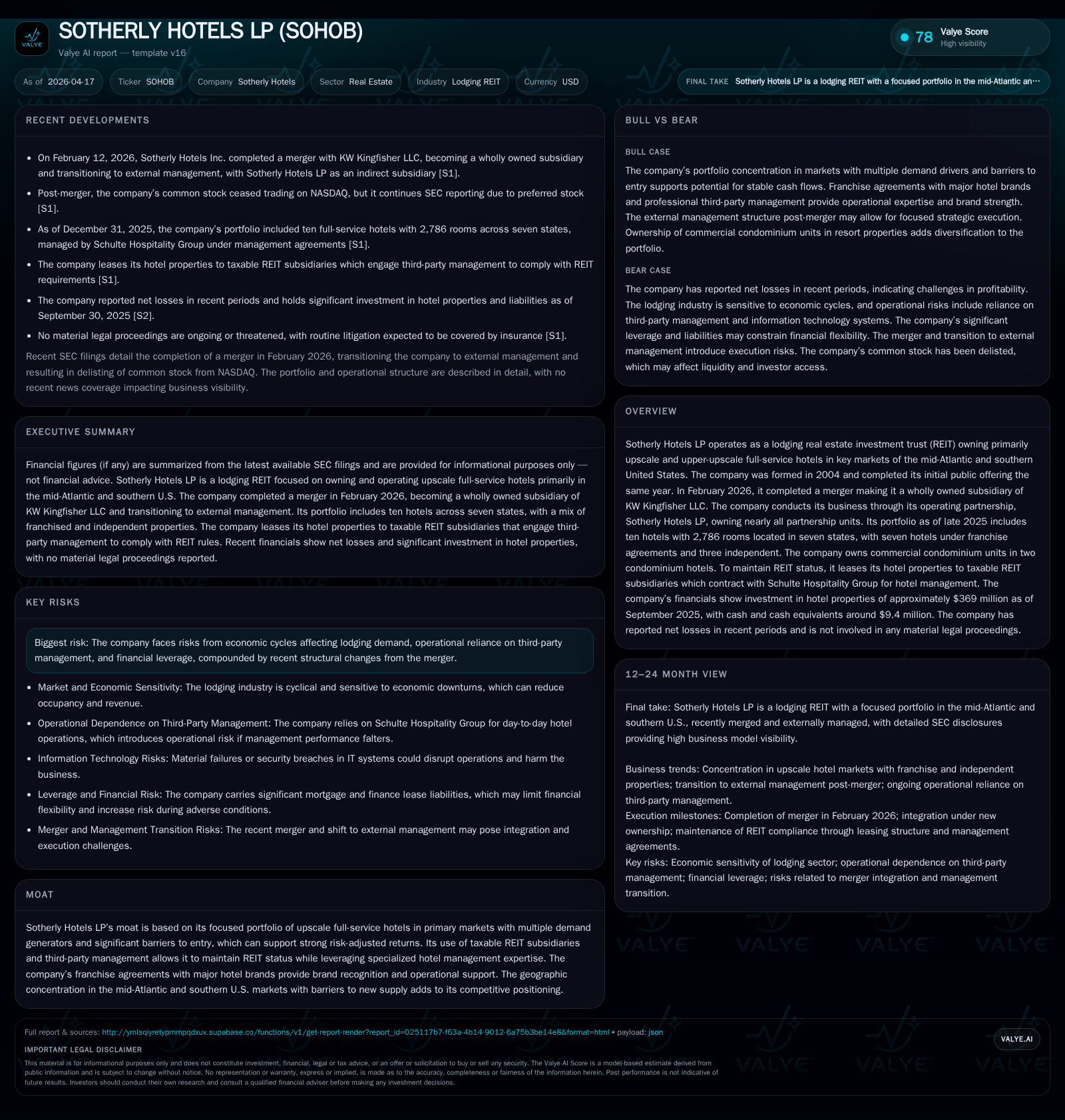
Sotherly Hotels LP, a REIT specializing in upscale full-service hotels in the mid-Atlantic and southern U.S., completed a merger in early 2026 that made it a wholly owned subsidiary of KW Kingfisher LLC. Its portfolio of ten hotels across seven states emphasizes franchised brand affiliation combined with independent properties. Historical financial data from 2014 shows revenue just under $30 million with operating and net losses indicating profitability challenges. Post-merger, the company’s growth outlook depends on market recovery and operational efficiency under third-party management, while financial leverage and economic cycles present ongoing risks. Capital allocation shifted markedly with the merger consideration paid out in cash to common shareholders, ending public trading.
Company Overview and History
Sotherly Hotels LP is a lodging real estate investment trust (REIT) specializing in upscale to upper-upscale full-service hotels primarily located in key metropolitan areas across the mid-Atlantic and southern United States. Founded in 2004, the company focused on owning properties in markets with diverse demand drivers and high barriers to new supply [S1].
As of late 2025, Sotherly’s portfolio comprised ten hotels totaling 2,786 rooms across seven states. Seven properties operate under franchise agreements providing brand recognition and operational support; three are managed independently. The REIT also owns commercial condominium units within two condominium hotel properties [S1].
Its structure involves leasing hotel assets to taxable REIT subsidiaries that engage Schulte Hospitality Group for hotel management services—balancing REIT tax requirements with specialized third-party expertise [S1].
Merger Transaction as a Strategic Inflection Point
In February 2026, Sotherly completed a merger with KW Kingfisher LLC. Under the terms, each outstanding common share was converted into cash consideration of $2.25 per share without interest. Following the merger closing, Sotherly became a wholly owned subsidiary of KW Kingfisher LLC and its common stock ceased trading on Nasdaq [S1], [S3]. Preferred stockholders were offered rights subject to conversion provisions defined in their charters.
This transaction represents a fundamental shift in ownership structure—from publicly held equity to concentrated private control—affecting strategic flexibility and capital access going forward.
Historical Financial Performance
Available audited annual data from fiscal year ending December 31, 2014 shows revenue near $29.8 million alongside operating loss of approximately $616 thousand and net loss close to $585 thousand [F1]. This corresponds to an approximate negative return on equity of -2.5% for that period [F1].
Historical performance (annual)
| FY |
|---|
| 2014 |
Source: SEC companyfacts cache [F1].
More recent quarterly filings prior to the merger indicate ongoing net losses impacting retained earnings through 2025 but do not provide comparable annual figures for trend analysis [S2], [S18].
Growth Prospects
Under new ownership,
- Geographic Focus: Continued emphasis on mid-Atlantic and southern U.S. markets characterized by strong tourism corridors supporting occupancy stability.
- Brand Affiliation: Franchise agreements offer marketing scale benefits relative to independent competitors.
- Operational Management: Contracted third-party management via Schulte Hospitality Group may enable operational efficiencies or margin improvements.
Growth potential hinges on sustained lodging demand recovery amid economic cycles but faces risks from regional concentration and competitive pressures including alternative accommodation options.
Financial Structure and Capital Allocation
As of late 2025 before merger completion:
- Mortgage loans totaled approximately $320 million alongside finance lease liabilities over $24 million [S6]. This leverage exposes the company to interest rate variability and refinancing risk.
- Dividend distributions were limited due to recurring net losses; following the merger announcement shareholders received cash consideration instead of dividends [S16], [S17], [S18].
- Public capital market access ended post-merger; capital allocation focus likely shifts toward balance sheet management under private ownership.
Risk Considerations
Key risks for Sotherly include macroeconomic factors influencing travel demand such as recessions or geopolitical events impacting tourism flow [S10]. Additional considerations involve:
- Dependence on third-party hotel managers impacting operational consistency;
- Integration risks following ownership change;
- Exposure to interest rate fluctuations given significant debt levels;
- Potential vulnerabilities in IT infrastructure critical for operations [S1].
No material legal proceedings are currently pending or threatened against the company providing some risk clarity [S10].
What To Watch Next (Analysis)
Post-merger evaluation will require attention to:
- KW Kingfisher’s strategic plans regarding asset disposition or hospitality investments;
- Operating metrics from franchised hotels signaling recovery or softness relative to regional benchmarks;
- Debt maturity profiles and refinancing activities impacting leverage;
- Management contract renewals potentially affecting cost structures.
Given lodging sector cyclicality coupled with recent ownership changes, monitoring both macro hospitality trends and firm-specific execution will be crucial.
This report synthesizes publicly filed SEC documents and historical financial data without offering investment advice. Readers should consider this analysis informational regarding Sotherly Hotels LP's operational context through April 2026 post-merger conditions.
Disclaimer: This is research-only, informational analysis and not investment advice. It may include AI-generated interpretation and general industry context. Always verify important details using primary sources.

Comments