
Tencent Music Entertainment Group’s Resurgence: Revenue Growth and Strategic Acquisitions Shape 2026 Outlook
Tencent Music’s recent earnings recovery and strategic content platform expansions signal a cautiously optimistic trajectory amid regulatory complexities.
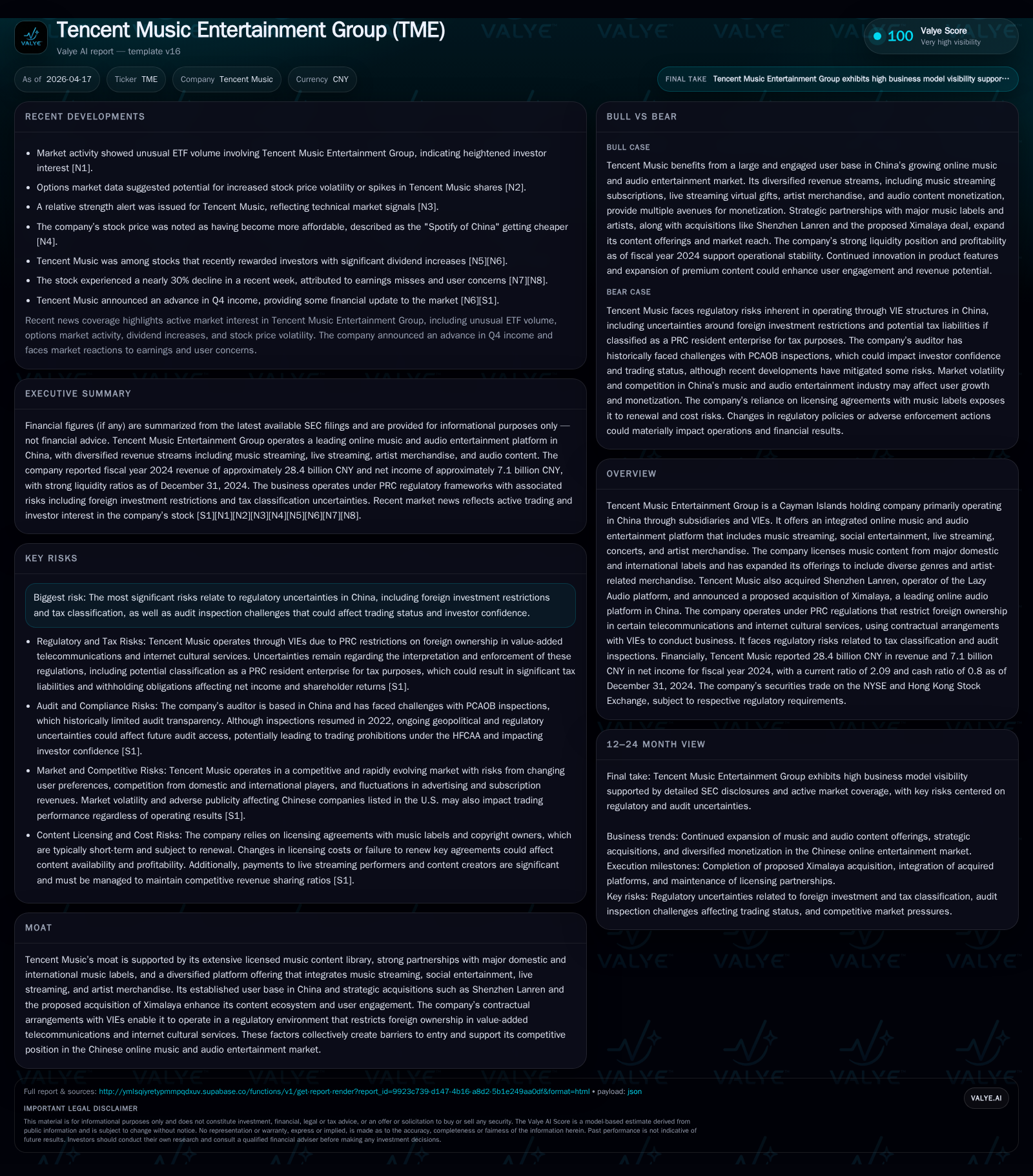
Tencent Music Entertainment Group (TME) demonstrated modest revenue growth of 2.3% in FY2024 with a notably stronger net income increase of 36.2%, reflecting operational efficiencies and monetization shifts. Strategic acquisitions including Shenzhen Lanren and the pending Ximalaya deal are expanding its digital audio ecosystem beyond music streaming into long-form audio and social entertainment, reinforcing user engagement and competitive position in China’s regulated environment. The company faces ongoing regulatory risks, particularly around licensing, foreign investment limits, and tax classification, which remain critical variables. Capital allocation has favored growing dividends alongside a solid liquidity position, with a current ROE near 10%. Market sentiment shows divergence between cautious investor reaction to an earnings miss and optimistic options market signals, with key upcoming earnings milestones to watch.
A Financial Overview: From YoY Revenue Fluctuations to Profit Acceleration
Tencent Music Entertainment's financial performance for FY2024 revealed slow but steady top-line growth paired with a significant improvement in net profitability. Revenues increased by approximately 2.3% year-over-year, from RMB 27.75 billion in FY2023 to RMB 28.40 billion in FY2024, signaling resilience amidst macroeconomic pressures and sector competition [F1]. More notably, net income surged by over one-third (+36.2%), rising from RMB 5.22 billion to RMB 7.11 billion within the same period.
This disparity between revenue and profit growth hints at improved operational efficiency or a favorable shift in monetization mix—likely reflecting Tencent Music’s increasing emphasis on high-margin subscription revenue streams alongside its social entertainment platforms such as live streaming and virtual gifting. The company's approximate return on equity (ROE) stood at a healthy 10.2%, supporting disciplined capital stewardship within an industry marked by heavy content licensing costs and user acquisition spend.
Historical performance (annual)
| FY | Rev ($bn) | Net ($bn) | Rev YoY | Net YoY |
|---|---|---|---|---|
| 2024 | 28.4 | 7.1 | +2.3% | +36.2% |
| 2023 | 27.8 | 5.2 | -2.1% | +36.0% |
| 2022 | 28.3 | 3.8 | -9.3% | +19.4% |
| 2021 | 31.2 | 3.2 |
Source: SEC companyfacts cache [F1].
Capital returns and efficiency (annual)
| FY | Div ($mm) | ROE% |
|---|---|---|
| 2024 | 1508 | 10.2 |
| 2023 | 9.1 | |
| 2022 | 0 | 7.8 |
| 2021 | 6.3 |
Source: SEC companyfacts cache [F1].
Financials exclude non-core line items; dividend history reflects new policy adoption post-2023.
Content Strategy and Ecosystem Expansion: The Impact of Key Acquisitions
Tencent Music’s moat is increasingly anchored in its fortified content library and diversified audio ecosystem reinforced by strategic acquisitions extending beyond traditional music streaming.
The acquisition of Shenzhen Lanren—the operator of the Lazy Audio platform—in early 2021 added robust audiobook, podcasting, Chinese comedy, and radio content capabilities to its portfolio [S11], [S24]. This move enriched Tencent Music’s user engagement through varied monetization channels including pay-per-title, subscriptions, and advertisement-supported formats.
Furthermore, the proposed acquisition of Ximalaya announced in mid-2025 represents a transformative expansion into one of China's most prominent online audio platforms [S24]. The transaction involves up to US$1.26 billion in cash plus equity issuance totaling more than five percent of Tencent Music’s shares pre-closing.
These deals signal Tencent Music’s pivot towards becoming a full-spectrum digital audio entertainment provider integrating music streaming with social entertainment features like live concerts, artist merchandise sales, interactive community content, and long-form audio offerings—a strategy consistent with emerging trends favoring multi-format engagement across interconnected platforms.
Contracts ensuring exclusivity through Variable Interest Entities (VIEs) protect these assets' strategic value within China’s regulatory framework that restricts foreign ownership in internet cultural services [S5]. The expanded ecosystems foster deeper cross-platform synergy crucial for monetizing diverse user segments.
Regulatory Environment: Licensing, Foreign Investment Limits, and Compliance Risks
Tencent Music operates within an intricate web of PRC regulations governing internet culture products—a category encompassing online music streaming and associated entertainment services.
Commercial internet cultural activities necessitate ICO Licenses issued by relevant authorities; key subsidiaries like Guangzhou Kugou, Beijing Kuwo, Tencent Music Shenzhen, and Shenzhen Lanren hold valid licenses supporting compliant operations [S5]. Foreign-invested entities may only engage in online music services under these rules with ownership restrictions circumvented via contractual VIE arrangements.
Regulatory oversight extends into virtual currency use within the platform economy due to concerns over money laundering and gambling risks linked to virtual gifting mechanisms common in social entertainment segments [S5]. Restrictions require stringent controls over transactions involving virtual goods—limiting conversion into real-world assets or cross-user transfers.
Heightened anti-monopoly enforcement initiated since early 2023 imposes compliance demands across pricing behaviors, algorithmic transparency, data management practices, platform dominance abuse prohibitions, merger filings surpassing specific revenue thresholds (e.g., exceeding RMB12 billion globally) [S5], [S19], [S20].
Additionally, tax residency risks loom related to SAT Circular 82 interpretations concerning "de facto management" status potentially reclassifying offshore entities as PRC residents liable for enterprise income tax on global earnings—an area flagged for close monitoring given its uncertain application impact on Tencent Music's holding structure [S5].
Given these evolving frameworks alongside audit inspection risks noted in recent SEC disclosures ([S5], [N1]), regulatory compliance remains both an operational challenge and a material risk factor for investor confidence.
Balancing Growth and Constraints: User Dynamics and Market Competition
Despite robust fundamental results reported through calendar year-end 2024 ([F1]), Tencent Music has encountered headwinds reflected in stock price volatility attributed primarily to an earnings miss announced in Q4/25 impacting market sentiment ([N1], [N8]). Concerns largely centered around user engagement metrics—potentially linked to competitive pressure from other digital music/social audio providers as well as timing latency in integrating recent acquisitions cohesively.
While explicit daily active user (DAU) or monthly active user (MAU) figures were not disclosed publicly within the latest filings or news ([N1], [N8]), marketplace commentary suggests intensifying battle for user attention leveraging multi-format content strategies blending streaming with social interaction mechanics.
Tencent Music’s approach of bundling interactive live streaming elements alongside orthodox subscription models introduces positive stickiness factors but also exposes it to regulatory scrutiny over virtual gifting adequate controls ([S5]). Maintaining balanced user growth without triggering adverse regulatory action is therefore pivotal.
Sector analysts often note that sustained innovation around personalized recommendations using AI combined with exclusive content rights can help counterbalance commoditization risks prevalent in the Chinese digital audio market.
Capital Structure and Allocation: Dividend Increases and Shareholder Returns
Tencent Music’s capital allocation discipline has evolved substantially over recent years culminating in dividend initiation policies adopted as recently as May 2024 ([S17]). Dividends paid rose materially from nil in FY2022 to approximately RMB1.51 billion by FY2024 reflecting both increased profitability capacity and management commitment towards shareholder returns as documented in their annual report filing ([F1]).
While no explicit share repurchase programs were detailed within recent filings ([S17], [S22], [S24]), Tencent Music maintains a strong liquidity profile evidenced by cash & equivalents totaling RMB13.16 billion at end-2024 alongside a current ratio exceeding two times suggesting considerable financial flexibility ([F1]).
The company's equity base grew steadily through retained earnings contributing to wider capital structure bolstering solvency metrics while enabling ongoing investments in content rights acquisitions as well as strategic platform expansions ([F1], [S18]).
Overall capital stewardship appears aimed at balancing growth funding needs with gradual enhancement of direct investor returns compatible with Cayman Islands corporate law constraints governing distributions ([S17]).
Forecast Indicators: Upcoming Earnings, Market Sentiment, and What to Watch
Tencent Music is scheduled to release its first quarter financial results for fiscal year 2026 on May 12 per company SEC disclosures ([S2]). This event represents a critical juncture against a backdrop of mixed market signals: while share prices have suffered post-Q4 earnings misses ([N1]), options market activity indicates rising implied volatility hinting at expectations for potential corrective moves or surprise catalysts ([N3]).
Unusual trading volumes flagged in ETFs holding Tencent Music shares also reflect speculative positioning or institutional rebalancing ([N2]). Technical analysis pointers such as relative strength alerts suggest some underlying resilience despite short-term headwinds ([N4]).
Absent explicit company guidance beyond routine SEC filing schedules ([S2]), investors should closely monitor updates on:
- User engagement metrics including DAU/MAU trends if disclosed,
- Integration progress on acquisitions like Ximalaya,
- Regulatory clarification progress especially relating to ICO licensing renewals or tax residency status,
- Monetization shifts balancing subscription versus social/live stream revenues,
- Commentary on capital deployment intentions including any share buybacks or special dividends schemes.
These factors collectively will shape sentiment trajectories influencing near-term valuation dynamics.
Conclusion: Assessing Risk-Reward in China’s Leading Online Music Platform
Tencent Music Entertainment Group stands at an inflection point characterized by renewed profit growth driven largely through operational efficiencies coupled with ambitious ecosystem expansions anchored by high-profile acquisitions targeting broadening the Chinese digital audio experience well beyond traditional music streaming.
This repositioning reinforces enterprise moat attributes centered on exclusive licensed content access secured via VIE structures amid an intricate regulatory landscape laden with foreign investment limitations and evolving compliance guardrails including ICO licensing regimes.[S5]
Returns metrics such as improving ROE (~10%) alongside growing dividend payouts signal maturing capital allocation frameworks complemented by ample liquidity buffers provide reassurance regarding financial stability.[F1], [S17]
However, significant regulatory uncertainties persist especially regarding anti-monopoly enforcement intensity, taxation classification risks under SAT Circular 82 interpretations,[S5] coupled with episodic investor reactions reflecting sensitivity around user engagement metrics underscoring need for careful ongoing monitoring.[N1]
For stakeholders requiring nuanced perspectives respecting China-specific legal frameworks governing intellectual property rights administration,[S23] complex foreign exchange controls affecting cross-border financing,[S4],[S6] Tencent Music symbolizes both an established leader grappling simultaneously with growth aspirations constrained by external structural factors intrinsic to operating at scale within one of the globe’s most proscriptive technology ecosystems. disclaimer: This report is for informational purposes only; it does not constitute investment advice or recommendations.
Disclaimer: This is research-only, informational analysis and not investment advice. It may include AI-generated interpretation and general industry context. Always verify important details using primary sources.

Comments