
Meiwu Technology’s Shift to Functional Skincare Undermines Profitability Despite Liquidity Strength
Transition from SMS services to functional skincare drove revenue growth but imposed margin pressure and operational challenges in 2025.
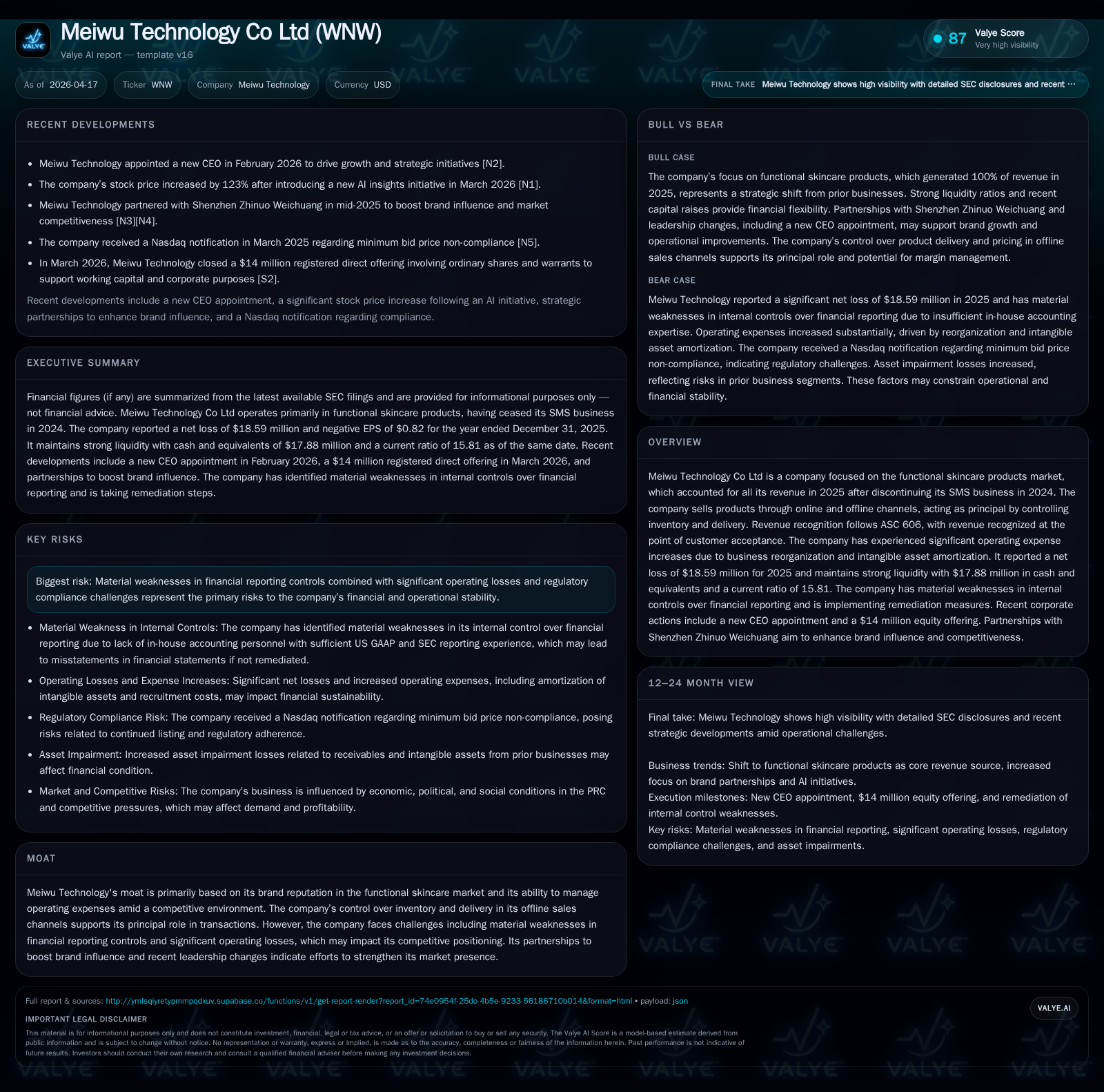
Meiwu Technology Co Ltd restructured its business in 2024–2025, exiting its SMS segment to focus solely on the functional skincare products market. This pivot led to a sharp increase in revenues—up over 4,300% year-over-year—but margins remain thin at 10.1%. Operating expenses surged primarily due to business reorganization and intangible asset amortization, resulting in a net loss of $18.6 million in 2025 despite robust operating cash flow and strong liquidity. Material weaknesses in internal controls pose risks to financial reporting fidelity, while recent leadership changes and a $14 million equity raise underscore efforts to stabilize operations and support growth.
Company Overview and Strategic Transition
Meiwu Technology Co Ltd has undergone a fundamental transformation over the last two years. Historically involved heavily in the SMS business, which accounted for 77.1% of revenues in 2023, the company discontinued this segment entirely by the end of 2024 [S1][S13]. Since then, Meiwu's operational focus has concentrated exclusively on functional skincare products—a market that generated all revenue reported for the full year of 2025 [S1]. This strategic shift aligns with broader corporate objectives to develop a sustainable brand presence within the personal care industry while leveraging offline and online channels where Meiwu exercises control over inventory management and delivery logistics.
Historical Financial Performance
The transition precipitated dramatic revenue growth: net revenues jumped from roughly $158K in 2024 to over $7 million in 2025—a staggering increase exceeding 4,300% year-over-year [S14][F1]. The revival reflects both scaling of new product offerings and wider distribution reach.
Despite this top-line acceleration, profitability metrics deteriorated markedly. Operating income swung from a loss of approximately $2 million in 2024 to a deeper deficit close to $8.8 million in fiscal 2025 [F1]. Net income followed suit, posting an $18.6 million loss compared with a positive net income of about $5.1 million the prior year—a reversal owed largely to intensifying operating expenses and non-cash asset impairments [F1][S21].
Historical performance (annual)
| FY | Net ($mm) | CFO ($mm) | OpInc ($mm) | Capex ($) | Net YoY |
|---|---|---|---|---|---|
| 2025 | -19 | 9 | -9 | 5539 | -463.5% |
| 2024 | 5 | -14 | -2 | 5539 | +131.8% |
| 2023 | -16 | -7 | -2 | 5539 | -45.1% |
| 2022 | -11 | -6 | -4 | 25916 |
Source: SEC companyfacts cache [F1].
Capital returns and efficiency (annual)
| FY | FCF ($mm) | ROE% |
|---|---|---|
| 2025 | 9 | -37.6 |
| 2024 | -14 | 8.6 |
| 2023 | -7 | -170.7 |
| 2022 | -6 | -54.8 |
Source: SEC companyfacts cache [F1].
Note: Revenue for prior years excludes full discontinuation effects; exact figures vary by segment [F1].
Breakdown of Revenue and Margin Dynamics
Gross margin contracted as Meiwu aggressively scaled functional skincare sales at lower price points intended to penetrate market share [S4][S16]. The overall gross margin decreased sharply to around 10.1% from approximately 42% the prior year when lower-volume legacy product lines commanded better margins [S14]. Functional skincare products alone generated a gross margin near 8%, considerably lower than training services or legacy food products before their discontinuation [S4][S9].
Selling and marketing expenses expanded substantially to about $3 million—over thirty times the prior year—to build brand awareness and distribution channels [S21]. General & administrative costs also rose significantly to roughly $3.8 million; these included amortization charges from intangible assets acquired amid heavy capital expenditures focused on R&D investments within skincare formulations [S21][S5]. Research and development spending surged above $2.6 million from negligible earlier levels reflecting vigorous product innovation efforts [S21].
Asset impairments related mainly to residual Code Beating receivables and intangible write-downs further deepened losses [S21]. Despite these setbacks, other income increased primarily due to reduced interest expenses on convertible notes [S21].
Cash Flow & Capital Structure
Operating cash flow turned strongly positive at approximately $9 million for FY25 after multiple years of outflows—indicating effective working capital management despite net losses [F1][S7]. Capital expenditures remained minimal relative to prior peaks caused by large intangible purchases earlier with only nominal property equipment spend recorded [F1][S12].
Liquidity remains robust with nearly $17.9 million held as cash & equivalents at year-end FY25 alongside minimal current liabilities yielding an exceptional current ratio above fifteen—signifying strong short-term solvency buffers [F1][S7].
Equity financing resumed with a sizable transaction closing March 18th, 2026; Meiwu raised gross proceeds around $14 million via registered direct offering issuing approximately seven million ordinary shares plus warrants exercisable at $2 each over one year—with zero-price exercise provisions potentially amplifying dilution depending on share price movements [N1][S2][S3]. This capital raise aims both to strengthen balance sheet resilience and provide operational runway amid repositioning.
Operational Risks & Governance Challenges
Material weaknesses persist within Meiwu’s internal controls over financial reporting—acknowledged by management—and remediation efforts are ongoing as disclosed in regulatory filings [S1][S15]. Such deficiencies present risks relating to accuracy of future financial disclosures which investors should consider alongside ongoing turnaround initiatives.
Moreover, the strategic pivot away from former core SMS services introduces execution risk as Meiwu confronts competition within China’s crowded functional skincare sector where brand reputation and cost efficiencies are critical for survival. The company’s control over inventory and direct delivery logistics underpins principal accounting treatment under ASC606 but requires rapid scaling of consumer trust.
Future Outlook & Milestones To Monitor
Explicit management guidance beyond early-2026 filings is not detailed; however stakeholders should monitor:
- Gross margin improvement as pricing power develops;
- Progress remediating internal control weaknesses affecting reporting reliability;
- Effectiveness of marketing investments converting into sustained customer expansion;
- Cash burn trends relative to equity infusion pacing;
- Product pipeline developments signaling innovation-driven competitive advantage;
- Regulatory developments impacting new product approvals or labeling standards.
Recent leadership changes signal management focus on addressing these strategic imperatives.
Capital Allocation Considerations
Return on equity stands negative at approximately -37.6%, reflecting deep net losses relative to equity base despite improved cash generation fundamentals [F1]. No dividends or share repurchases have been declared or indicated given cash preservation priorities during turnaround phase.
Meiwu’s capital allocation strategy prioritizes reinvestment through R&D alongside bolstering operational capacity financed by equity issuance—focusing on growth recovery rather than shareholder returns near term.
Disclaimer: This report is prepared solely for informational purposes without any recommendation regarding investment decisions or valuation judgments concerning Meiwu Technology Co Ltd or its securities.
Disclaimer: This is research-only, informational analysis and not investment advice. It may include AI-generated interpretation and general industry context. Always verify important details using primary sources.

Comments