
AUTOLIV INC Sustains Growth While Managing Supply Chain and Geopolitical Pressures
Autoliv reported steady sales growth driven by Asia, innovation in motorcycle safety, and disciplined capital management despite tariff and supply volatility.
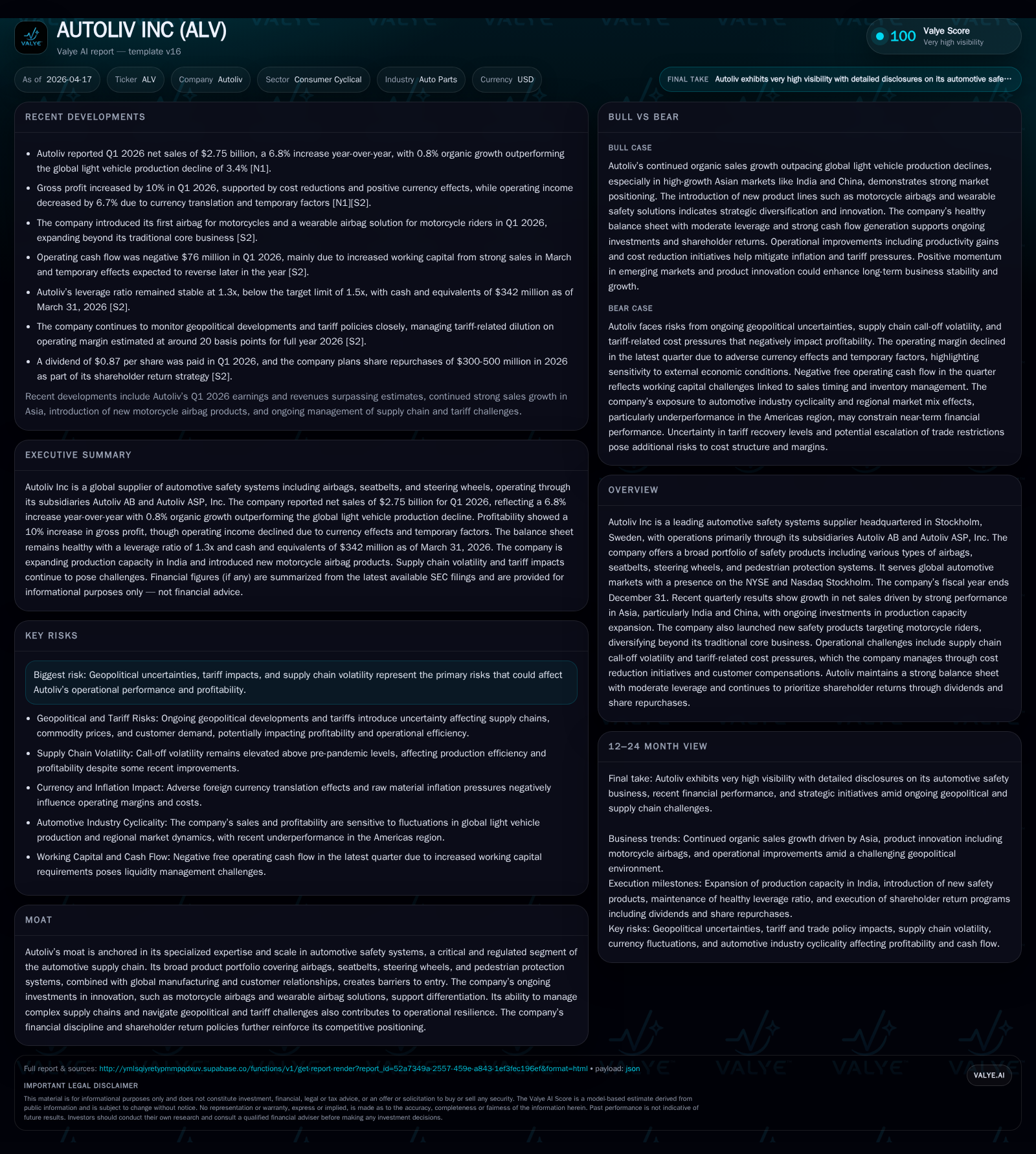
Autoliv Inc continues to leverage its leadership in automotive safety systems with a 4.1% net sales increase in 2025, primarily fueled by growth in Asian markets such as India and China. The company’s broad product portfolio and strategic investments in emerging segments like motorcycle airbags underpin future growth prospects. Operational headwinds from supply chain call-off volatility and tariff-related costs persist but are partially offset by customer compensation and productivity measures. Autoliv maintains a healthy balance sheet with strong operating cash flow generation, disciplined capital allocation including dividends and planned share repurchases, supporting consistent shareholder returns. Watch for evolving geopolitical risks and trade policies as key uncertainties shaping outlook.
Company Overview
Autoliv Inc is a global leader in automotive safety systems headquartered in Stockholm, Sweden. It designs, manufactures, and supplies primarily passive safety products such as airbags, seatbelts, steering wheels, inflators, and pedestrian protection solutions to automotive OEMs worldwide. The firm operates through its principal subsidiaries Autoliv AB and Autoliv ASP, Inc., with an extensive manufacturing footprint comprising 62 facilities across 23 countries [S1]. Its business is structured into one reportable segment focused on passive safety components.
Historical Performance
In the fiscal year ended December 31, 2025, Autoliv achieved consolidated net sales of $10.8 billion, a 4.1% increase over $10.4 billion in 2024 [F1]. This growth outpaced the global light vehicle production (LVP) increase of about 3.9%, indicating market share gains and expanded safety content per vehicle. The company's operating income improved by 11%, reaching $1.09 billion from $979 million the prior year [F1]. Correspondingly, net income attributable to controlling interests advanced 14% to $735 million [F1]. Earnings per diluted share grew 19% to $9.55 [F1].
Profitability gains were supported by operational efficiencies including a stabilized "call-off" system—order schedules from customers—which reduced production inefficiencies despite still elevated volatility relative to pre-pandemic norms [S1][S5]. Cost inflation was moderated but labor expenses remained elevated; raw material impacts were limited overall [S1]. Customer compensations mitigated over 80% of tariff-related cost increases since early 2025 although this still diluted operating margin roughly by 20 basis points on net [S1][S5].
Operating cash flow for FY2025 rose by approximately 9% to $1.16 billion [F1], reflecting solid core business cash generation even amid working capital fluctuations. Capital expenditures declined nearly 24% year-over-year to $441 million as footprint optimization projects slowed [F1]. Free operating cash flow thus remained robust at around $716 million (operating cash flow minus capex) [F1]. Equity increased to about $2.57 billion from $2.28 billion prior year benefiting from retained earnings and currency effects [F1].
Historical performance (annual)
| FY | Net ($mm) | CFO ($mm) | OpInc ($mm) | Capex ($mm) | Net YoY |
|---|---|---|---|---|---|
| 2025 | 735 | 1157 | 1088 | 441 | +13.8% |
| 2024 | 646 | 1059 | 979 | 579 | +32.4% |
| 2023 | 488 | 982 | 690 | 573 | +15.4% |
| 2022 | 423 | 713 | 659 | 585 |
Source: SEC companyfacts cache [F1].
Capital returns and efficiency (annual)
| FY | Div ($mm) | FCF ($mm) | ROE% |
|---|---|---|---|
| 2025 | 238 | 716 | 28.6 |
| 2024 | 219 | 480 | 28.4 |
| 2023 | 225 | 409 | 19.1 |
| 2022 | 224 | 128 | 16.2 |
Source: SEC companyfacts cache [F1].
Note: Revenue YoY for FY2024 presented as decline reflects a challenging year versus pandemic rebound nuances.
Growth Drivers & Future Prospects
The primary driver of Autoliv's sales remains light vehicle production volumes coupled with increasing safety content per vehicle — especially mandated or prioritized upgrades globally due to regulatory emphasis on occupant protection [S1][N1]. The company reported organic sales growth outpacing LVP notably in Asia where rising middle-class markets elevate demand for advanced safety features.
India's market witnessed a remarkable +38% organic sales increase in Q1 2026 as vehicles embrace higher safety standards alongside robust LVP growth [S2][S25]. China also showed strong outperformance relative to local LVP (+40 percentage points), underpinned by growing engagement with domestic OEMs and expanded product penetration including airbags targeted at emerging mobility segments [S2][S25]. This regional strength is expected to continue driving top-line expansion where Autoliv is investing significantly in inflator capacity expansions to meet future demand.
Innovative product launches broaden offerings beyond traditional car/passenger vehicle airbags into motorcycles — introducing both airbag units and wearable airbag systems for riders — which signals strategic diversification addressing growing two-wheeler safety needs globally [N1][S25]. Moreover, the Mobility Safety Solutions unit develops niche technologies such as battery cut-off switches pertinent for electric commercial vehicles aligning with longer-term electrification trends.
However, these opportunities co-exist with risks stemming from geopolitical tensions influencing tariffs, escalating labor costs particularly interfering in Europe/Americas operations, and residual supply chain call-off variability which imposes operational friction and margin pressure [S10][N11][N14]. Ongoing inflationary pressures may curb margin improvements even as Autoliv pursues cost reductions and strives for tariff pass-through arrangements with customers.
Latest Quarterly Developments & Outlook
Q1 2026 financials revealed continued sales strength with total revenue of approximately $2.75 billion representing a +6.8% increase over the previous year period, though organic sales growth was milder at +0.8%, supported primarily by Asia’s vigorous performance [S2][S25]. Profit margins experienced some compression due mainly to higher tariff-related costs (net negative ~40bps impact including dilution), increased R&D spending on new product innovation (+26% R,D&E portion relative to sales), elevated SG&A expenses driven by wage inflation plus non-recurring items [S6][S13][S21]. Adjusted operating margin held at a respectable ~8.9%, modestly lower than prior year quarter’s peak of ~9.9% due partly to these temporary offsets [S18].
Operationally, call-off volatility has improved compared to late-2025 levels but remains above historical pre-pandemic stability benchmarks posing ongoing efficiency challenges warranting cautious management attention going forward [S5][S17]. The company reaffirmed full-year guidance targeting flat organic sales versus prior year and an improved adjusted operating margin range around 10.5%-11%, predicated on assumptions of roughly -1% LVP change globally absent considerable tariff disruptions or volatility escalations [S23][N3].
Working capital absorption spiked due chiefly to strong March sales timing effects pushing receivables higher alongside payables normalization reducing liquidity markers resulting in negative operating cash flow of approximately $(76) million for Q1 versus positive generation previously despite healthy profitability trends; free operating cash flow similarly weakened into negative territory briefly before expected reversion later within the year [S20][S24][N3].
Capital Structure & Returns
Autoliv maintains a balanced financial profile evidenced by net debt around $1.77 billion at March end versus trailing EBITDA yielding a leverage ratio stable at approximately 1.3x—comfortably within the company's self-imposed maximum target of 1.5x ensuring room for strategic maneuvering amidst uncertainties [S4][S9][F1]. Cash balances stand near $342 million providing liquidity cushion against external shocks.
Dividend payments totaled approximately $238 million in FY2025 maintaining consistency with previous years’ distributions while reflecting steady operational cash flows underpinning shareholder returns integrity [F1][S16]. The company plans share repurchases between $300 million and $500 million during calendar year 2026 thereby reinforcing capital return commitment alongside funding innovation investments [N3][S16].
Return metrics remain attractive with approximate annualized return on equity calculated near 28%, derived from net income relative to average equity base totaling roughly $2.57 billion as of end-2025; return on capital employed similarly remains robust near low double-digit territory indicating effective utilization of invested capital across global operations despite headwinds [F1][S21].
Competitive Strengths & Moat
Autoliv's moat is principally anchored in its deep technological expertise intersecting stringent regulatory landscapes mandating occupant safety compliance globally across passenger cars, motorcycles, and commercial vehicles which requires specialized knowledge difficult for new entrants to replicate efficiently . Its comprehensive product portfolio coupled with scale advantages enables it to offer integrated passive safety modules meeting varied OEM specifications worldwide.
The company's innovation trajectory expanding into motorcycle airbag systems aligns strategically with growing micromobility trends especially pertinent across Asia where two-wheelers represent a dominant transport mode requiring enhanced rider protection solutions not conventionally offered by mainstream automotive suppliers [N1]. Established customer relationships with major OEMs help buffer pricing pressures while enabling collaboration on next generation safety standards.
Robust manufacturing network diversified geographically mitigates localized disruption risks albeit not immune altogether as evidenced during recent geopolitical strain episodes stressing the importance of agile supply chain management—a strength Autoliv leverages consistently alongside cost containment initiatives targeting wage inflation impacts particularly across Europe and Americas regions [S10][S17].
Risks & Challenges
Principal risk factors encompass geopolitical uncertainty manifesting in escalating or evolving tariffs affecting procurement costs unpredictably even if compensated partly through pricing strategies—the risk that recovery levels fluctuate causing margin squeeze remains significant [S10][S5][N11]. Supply chain restriction persistence or worsening could exacerbate call-off volatility impairing factory utilization rates reducing operational profitability incrementally.
Labor cost inflation sustained pressure particularly within mature markets could erode gain margins should productivity improvements lag or be insufficiently captured contractually with clients.[S10] Moreover technological shifts favoring active safety features or alternative materials might demand continued heavier R&D expenditures influencing near-term earnings sustainability if uptake delays occur beyond current projections.
Legal proceedings typical within automotive supply industry potentially expose Autoliv to contingent liabilities though none appear material currently that significantly threaten financial position based on disclosures available .
What To Watch Next (Analysis)
- Monitoring developments around global light vehicle production forecasts amid macroeconomic headwinds will clarify revenue trajectory given industry cyclicality linkage.
- Evaluating progress on managing tariff exposures—including ability to secure customer compensations—and evolving trade policies remains critical amid shifting US-China relations or other geopolitical hotspots.
- Tracking innovation pipeline outcomes particularly adoption rates of motorcycle airbags/wearables contributing incremental revenues evidences successful diversification efforts beyond traditional passenger vehicle segments.
- Operating efficiency gains related to stabilizing call-offs can enhance margins while mitigating supply chain-induced variability; watch quarterly working capital trends as leading indicators.
- Capital allocation execution including pace of share buybacks versus dividend consistency indicates financial discipline sustaining shareholder value creation under varying market environments.
Conclusion
Autoliv Inc maintains a resilient operational platform marked by steady revenue growth outpacing global LVP expansion primarily via Asia-led demand gains plus differentiated product development broadening addressable markets within mobility safety domains beyond core automotive passive systems. While margin headwinds persist from inflationary pressures and geopolitical tariff complexities the company successfully offsets these through customer pricing strategies, cost control programs, and productivity enhancements sustaining profitable outcomes. Liquidity metrics remain solid supporting ongoing investment activities alongside meaningful shareholder returns via dividends and buybacks reflecting prudent capital stewardship aligned with long-term value generation goals. Continued vigilance over external risk factors paired with innovation momentum will shape Autoliv’s adaptability navigating shifting automotive ecosystems toward enhanced occupant & rider protection paradigms worldwide.
This analysis reflects information available as of April 17, 2026 based on SEC filings (Form 10-K annual report for FY2025; Form 10-Q quarterly report Q1/26) and verified news sources referenced herein without providing investment advice.
Disclaimer: This is research-only, informational analysis and not investment advice. It may include AI-generated interpretation and general industry context. Always verify important details using primary sources.

Comments