
Selectis Health’s Shift to Owner-Operator Model Challenges Profitability Amid Liquidity Pressures
Selectis Health, Inc. has transitioned its business model from leasing to direct healthcare operations, driving growth but also intensifying operational and financial stress.
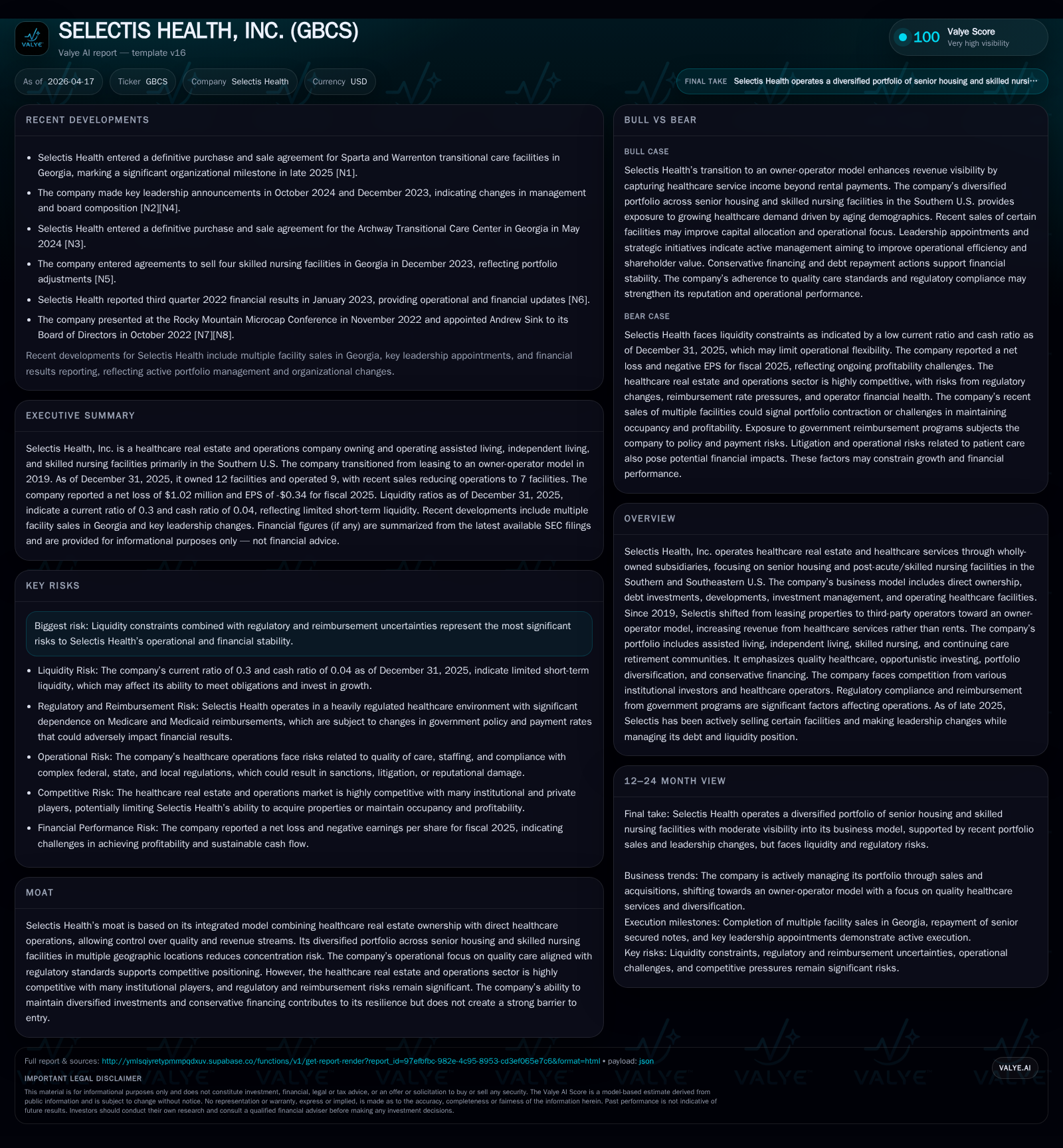
Selectis Health, Inc. evolved from a leasing-focused healthcare real estate investment trust to an integrated owner-operator of senior housing and skilled nursing facilities starting in 2019. This transition expanded healthcare services revenue but coincided with persistent operating losses and liquidity constraints through 2025. Although operating cash flows improved significantly last year, the company carries substantial current liabilities far exceeding current assets, underscoring ongoing financial strain. Regulatory risks, competition, and reimbursement uncertainties continue to press on profit margins and growth potential.
Company Overview and Business Model Shift
Selectis Health, Inc., originally Global Healthcare REIT until its rebranding in September 2021, owns and operates a portfolio of healthcare real estate properties focused primarily on senior housing (assisted living, independent living) and post-acute skilled nursing facilities across the Southern and Southeastern United States [S1]. Historically dependent on triple-net leases with third-party operators, the company made a strategic pivot commencing in 2019 toward an owner-operator model aimed at capturing more revenue directly from healthcare services rather than rental income [S1]. This integrated approach—combining real estate ownership with direct healthcare operations—allows for enhanced quality control over care delivery and broader revenue streams, forming the company's moat alongside portfolio diversification and conservative financing practices.
Historical Performance: Growth Drivers and Performance Trends
Revenue development since the pivot reflects modest top-line growth paired with persistent profitability challenges. The company reported revenues around $3.62 million for fiscal year (FY) 2018 [F1], demonstrating a low base consistent with its prior leasing model approach. Unfortunately, more recent revenue figures are not detailed explicitly; however, operational income trends illustrate mounting pressures as the company transitioned full force into the owner-operator segment.
Operating losses escalated sharply in FY2023 to approximately -$8.96 million before narrowing substantially to -$2.73 million in FY2024 and further improving to -$1.56 million by FY2025 [F1]. Net losses followed a similar trajectory: shrinking from -$3.97 million in FY2023 to -$2.42 million in FY2024, then down to -$1.02 million for FY2025 [F1]. The contraction of losses indicates progress towards operational stabilization despite ongoing financial strain.
From an operational cash flow perspective, Selectis made remarkable strides during these losses—shifting from negative CFO of nearly -$1.82 million in FY2024 to positive CFO of about $1.88 million in FY2025 [F1]. Capital expenditures increased significantly in FY2025 ($443k) compared to prior years ($36k-$30k), signaling investments likely aimed at facility upgrades aligned with the owner-operator strategy [F1]. The resultant free cash flow roughly approximates $1.44 million for FY2025 (CFO minus capex), an encouraging sign for liquidity improvement.
Historical performance (annual)
| FY | Net ($mm) | CFO ($) | OpInc ($mm) | Capex ($) | Net YoY |
|---|---|---|---|---|---|
| 2025 | -1 | 1882030 | -2 | 443611 | +58.1% |
| 2024 | -2 | -1824437 | -3 | 36063 | +39.0% |
| 2023 | -4 | 536666 | -9 | 29805 | -65.7% |
| 2022 | -2 | -305148 | 0 | 222361 |
Source: SEC companyfacts cache [F1].
Capital returns and efficiency (annual)
| FY | FCF ($) | ROE% |
|---|---|---|
| 2025 | 1438419 | 16.4 |
| 2024 | -1860500 | 44.8 |
| 2023 | 506861 | |
| 2022 | -527509 |
Source: SEC companyfacts cache [F1].
Reported values are USD; Revenue data limited beyond FY2018 [F1].
Liquidity Position and Capital Structure
Despite operational improvements, the company's balance sheet signals significant liquidity pressure at year-end FY2025: current liabilities totaled approximately $25.27 million against current assets of only about $7.58 million—a current ratio near 0.3—indicating short-term liabilities substantially exceed available liquid assets [F1]. Cash and equivalents stood at roughly $1.01 million.
Historically reliant on debt financing including senior secured promissory notes issued since 2018 bearing annual interest rates rising as high as 13%, Selectis renegotiated terms repeatedly through December 31, 2025 [S4][S5]. Following amendments extending maturity dates contingent upon securing qualifying transactions or proceeds enabling full repayment, the company settled all notes by January 2026 [S4][S5][S25]. This debt repayment marks a key milestone amidst cautious financial restructuring but underscores past dependence on costly borrowings.
The company also maintains two commercial lines of credit secured with Southern Bank totaling $750,000 each; one line matured December 14, 2026 with an interest rate near 7.75% as of end-December 2025 but carried an outstanding balance of about $0.33 million providing partial liquidity headroom [S5].
Equity remains negative at approximately -$6.21 million at FY2025 close reflecting accumulated losses and balance sheet challenges [F1]. Dividend payments were last recorded several years ago (in the mid-2010s), with no recent distributions or share buybacks noted since fiscal year 2021 [F1][S21].
Industry Context: Risks and Competitive Environment
Selectis operates within the tightly regulated U.S. healthcare real estate market intersecting senior housing and post-acute/skilled nursing care sectors subject to pronounced regulatory scrutiny by CMS, state agencies, and federal enforcement bodies including DOJ oversight on billing practices [S10][S11][S13]. The company's tenant operators face regulatory compliance mandates spanning numerous federal statutes encompassing fraud prevention (False Claims Act), privacy protections (HIPAA/HITECH), anti-kickback statutes, physician referral restrictions (Stark Law), quality standards monitoring via CMS Five Star ratings, certification requirements under state Certificate of Need laws, ADA compliance obligations, and environmental regulations affecting property management [S10–S16].
These extensive regulations entail risks such as sanctions resulting from identified deficiencies or billing irregularities which may materially impact operators’ financial health—and consequently Selectis’ revenues derived either as rents or operational earnings under the owner-operator model [S10][S11][S27]. Staffing shortages exacerbated by pandemic aftermath remain acute hazards affecting service delivery quality while increasing labor expenses under tighter health protocols [S8][S18]. Tenant/operator bankruptcies pose additional risks given lease terminations or insolvency proceedings potentially limiting rent collections or forcing property repossession under adverse conditions [S1][S17][S27].
Competitive pressures stem from a broad spectrum of real estate investment trusts (REITs), private equity firms with larger capital bases willing to pay premium prices for strategic facilities, regional developers specialized in medical office/life sciences properties that can capitalize on tailored developments/redevelopments initiatives, as well as experienced healthcare operators managing large networks fostering scale-based efficiencies particularly in value-based reimbursement environments evolving rapidly post-pandemic [S9][S22].
Future Growth Prospects
The core growth levers for Selectis entail achieving higher occupancy levels across owned facilities while optimizing revenue per resident through enhanced service offerings including ancillary care support aligned with increasingly stringent regulatory quality metrics aimed at CMS value-based purchasing programs [N1][S7][S23]. The shift towards direct operations may enable margin improvements if controlled effectively although it raises exposure to operational cost volatility linked to labor markets post-COVID-19.
Opportunistic development or redevelopment projects may further expand capacity contingent upon pre-leasing success typically required per internal investment thresholds—Selectis targets properties with minimum pre-leased positions or clear market-driven justifications before undertakings presumably reducing speculative risk while supporting incremental growth avenues [N1][S6][S23]. Geographic diversification across southern U.S markets provides some risk mitigation against localized demand downturns or adverse regulatory changes.
Key downside constraints include exposure to reimbursement cuts from Medicare/Medicaid reform efforts expected to persist nationally pressing SNFs especially; sustained labor cost inflation; potential litigation liabilities related to professional negligence claims notwithstanding comprehensive insurance coverage; constrained access to low-cost capital given historical leverage profile; plus external macroeconomic uncertainties impacting seniors’ ability to afford premium levels of care or presiding demographic shifts deviating downward regionally vs national averages [N1][S8–S15][S18–S19][F1].
Milestones & What To Watch (Analysis)
There is no explicit financial guidance provided as per recent SEC filings or news releases; however notable forthcoming milestones include:
- Monitoring quarterly occupancy trends post-implementation of enhanced clinical/service standards delivering on quality improvement promises.
- Tracking management’s ability to contain operating expenses amid labor inflation while growing ancillary revenue streams.
- Compliance audit results tied to OIG/CMS regulatory reviews impacting facility ratings critical for CMS reimbursement continuation.
- Progression on balance sheet repair efforts beyond early debt repayment including potential equity recapitalizations or asset dispositions signaling financial stability.
- Impact assessment stemming from Black Pearl’s recently launched tender offer completed March 11, 2026 which may precipitate ownership structure changes influencing strategic direction or capital access terms [N1].
Capital Allocation & Returns Profile
Return metrics such as ROE remain challenging given negative equity balances though back-of-the-envelope calculations using net income (-$1.02 million) relative to negative equity (-$6.21 million) yields a rough positive figure (16%) indicating distortions due primarily to accumulated deficits rather than genuine profitability improvements [F1]. Dividend distributions have been suspended for years reflecting focus on internal resource preservation amid protracted losses.
With improving free cash flow generation (~$1.44 million) Selectis retains some capacity internally for reinvestment but prudence dictates maintaining ample liquidity buffers given industry cyclicality and regulatory uncertainty [F1][S20–21]. Share repurchases ceased after minor activity up through fiscal year 2021 suggesting that capital returns have been deprioritized in favor of stabilizing operations.
The layered debt refinancings culminating recently allowed reduced refinancing risk but maintained elevated cost of borrowing historically constraining net margins; no public disclosures indicate plans for dividend resumption or aggressive buybacks pending fundamental turnaround clarity [S4–7][F1].
Conclusion
Selectis Health’s transformation into an entity blending real estate ownership with operator-led healthcare services reflects both strategic evolution towards integrated value capture and heightened complexity necessitating strong operational execution amidst tough regulatory headwinds and competitive dynamics typical of senior housing/post-acute sectors today.
While revenue expansion through expanded services has materialized alongside narrowing operating losses and recovering cash flows by end-FY2025, substantial liquidity constraints together with sizeable current liabilities caution regarding short-term financial vulnerabilities that will require mindful capital management moving forward.
Stakeholders should watch closely regulatory compliance developments impacting operator performance metrics alongside occupancy trajectories that fundamentally underpin liquidity outlooks—all set against a backdrop where reevaluation by new investors like Black Pearl could reshape corporate strategy imminently.
This analysis is based solely on publicly available information derived from Selectis Health’s SEC filings up through April 15, 2026 ([F1],[S#]) and relevant news ([N#]) without providing investment recommendations.
Disclaimer: This is research-only, informational analysis and not investment advice. It may include AI-generated interpretation and general industry context. Always verify important details using primary sources.

Comments