
FG Nexus Inc.’s Evolution: From Digital Assets to Affordable Housing Leadership
FG Nexus transitions its core business from digital asset holdings towards tokenization in affordable housing, signaling a strategic pivot amid operational and market challenges.
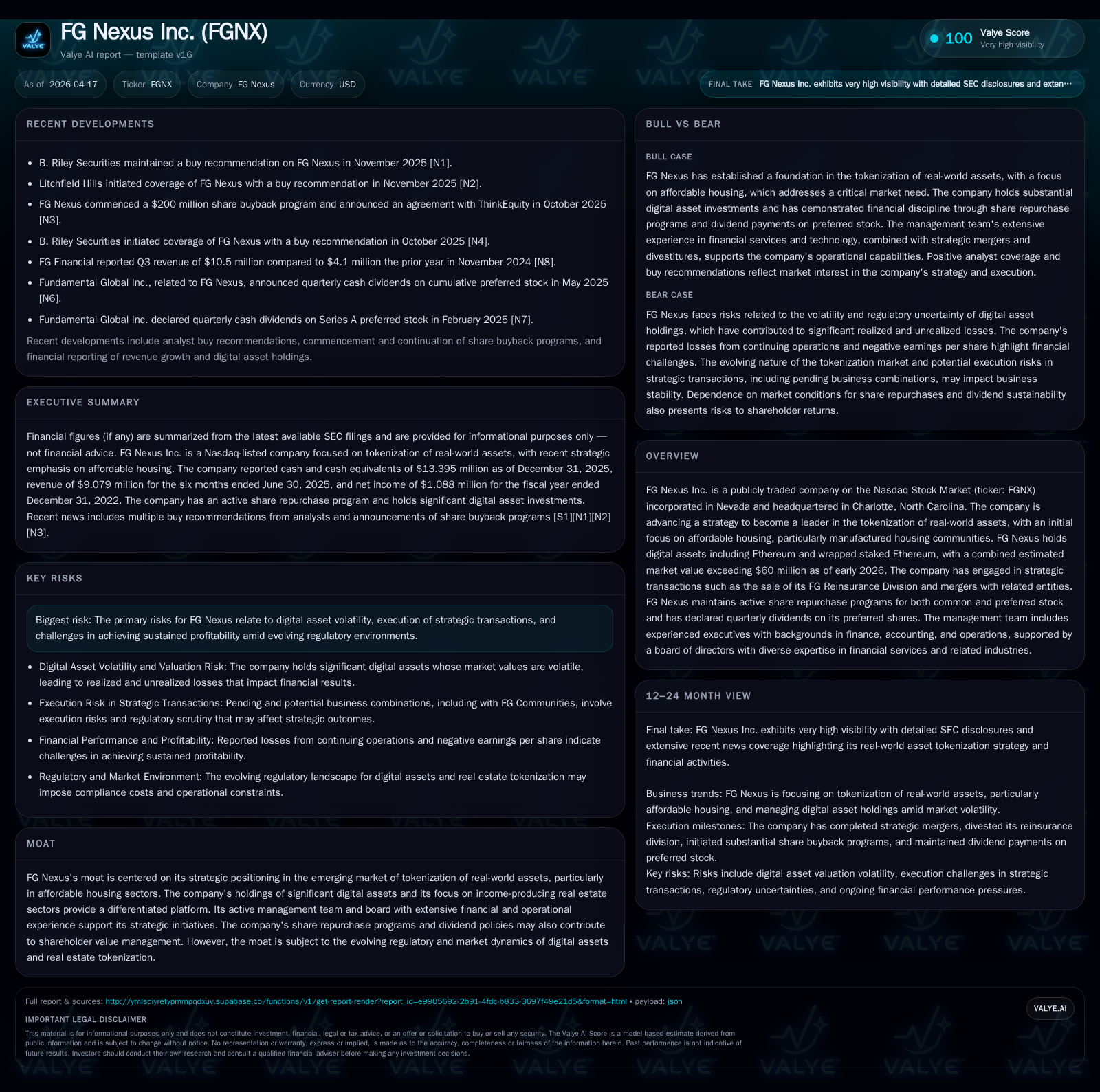
FG Nexus Inc. has experienced significant revenue growth over recent years driven by strategic transactions and asset repositioning but faces growing operating losses linked to its evolving business model. The company leverages substantial Ethereum holdings to underpin its new focus on tokenizing manufactured housing communities in the affordable housing sector. Capital allocation actions including a reverse stock split, active repurchase programs, and preferred dividends demonstrate management's efforts to optimize shareholder value while navigating liquidity and regulatory risks inherent to its hybrid blockchain-real estate approach.
Historic Revenue Surge Amid Transitional Earnings Pressures
FG Nexus Inc.’s financial trajectory over the past five years reveals an aggressive top-line expansion coupled with widening operating losses indicative of a company undergoing fundamental transformation. Revenue climbed from approximately $4.86 million in fiscal year 2021 to a peak of just over $32 million in fiscal year 2024 — marking an extraordinary compound increase of more than fivefold within three years ([F1]). This leap largely reflects strategic business combinations including divestiture of its FG Reinsurance Division and other restructurings that repositioned the firm’s asset base.
However, this rapid revenue expansion masks underlying profitability challenges. Operating income swung negative into -$24.88 million in FY2024 before further deteriorating to -$64 million in FY2025 ([F1]). The magnitude of these losses suggests heavy reinvestment costs or write-downs potentially related to the firm’s pivot away from legacy segments toward blockchain-related real estate tokenization platforms.
Operating cash flows have concurrently remained negative since at least FY2022 (with CFO at -$11.02 million), moderating somewhat to -$6.25 million in FY2025 but still constrained ([F1]). This persistent cash burn signals ongoing capital need pressures despite revenue growth.
Historical performance (annual)
| FY | CFO ($mm) | OpInc ($mm) | Capex ($) |
|---|---|---|---|
| 2025 | -6 | -64 | |
| 2024 | -5 | -25 | |
| 2023 | -4 | 81000 | |
| 2022 | -11 | 81000 |
Source: SEC companyfacts cache [F1].
Capital returns and efficiency (annual)
| FY | FCF ($mm) |
|---|---|
| 2025 | |
| 2024 | |
| 2023 | -4 |
| 2022 | -11 |
Source: SEC companyfacts cache [F1].
Note: Percent changes calculated where applicable based on available data; Capex shows minor spend consistent with asset-light strategy.
Pivoting Toward Real-World Asset Tokenization in Affordable Housing
The most consequential strategic shift at FG Nexus is its embrace of real-world asset tokenization leveraging blockchain technology, focusing initially on affordable housing sectors—specifically manufactured housing communities ([N1], [S7]). This approach seeks to combine the liquidity and transparency benefits of digital assets with durable physical real estate income streams addressing critical demand in U.S. affordable housing.
Supporting this strategy is FG Nexus's substantial digital asset portfolio that as of early 2026 includes approximately 20,638 Ethereum (ETH) tokens and nearly 7,659 wrapped staked ETH (WSTETH), collectively valued around $63 million — providing significant platform liquidity and capital backing ([S6], [S14]). This cryptocurrency base enables FG Nexus not merely to hold digital currency but also to deploy it as collateral or investment within tokenized property structures.
Furthermore, the company is actively engaged in structural corporate transactions designed to consolidate capabilities for scaling this model; discussions with FG Communities—a group specializing in manufactured home community management—could accelerate their penetration into this niche via potential business combinations overseen by independent special committees ([S7]).
Upcoming Catalysts and Board-Level Strategic Options
Among catalysts to monitor are ongoing developments concerning the proposed related party transaction with FG Communities focused on manufactured housing community acquisitions ([S7]). The transaction remains preliminary with no binding agreements yet; however, it reflects a high-priority board agenda element intended to boost operational scale within the new strategic domain.
To manage conflicts inherent in related party deals, FG Nexus plans to employ a special committee wholly composed of independent directors and retain external fairness advisors—signaling thorough governance practices ahead of any deal consummation ([S7]). Observers might track committee findings, deal negotiations progress, or alternative strategic moves emanating from board deliberations as potential value inflection points.
Capital Allocation: Reverse Stock Split, Dividends, and Repurchase Programs
FG Nexus has taken explicit steps recently to recalibrate its capital structure for enhanced valuation metrics. A notable move was the execution of a 1-for-5 reverse stock split effective February 13, 2026 that compressed outstanding common shares from around 32.8 million pre-split to roughly 6.5 million post-split shares without altering overall ownership proportions ([S4], [S5]). This maneuver aims primarily at improving per-share statistics post-expansion.
Complementing this structural adjustment are vigorous share repurchase activities supporting price stability amid operational losses:
- In fiscal 2025 alone, buyback expenditures totaled approximately $26.13 million across both common and preferred classes.
- Specifically, around 2.2 million common shares were repurchased averaging $16.04 per share; alongside nearly 220 thousand Series A Preferred shares bought at an average price near $24.88 per share through early April 2026 ([S6]).
Dividend policy remains active on preferred equity layers with quarterly payments declared at an annualized rate of roughly 8%, signaling commitment to maintaining attractive yield for preferred shareholders despite overarching operating deficits ([S20]).
Balancing Liquidity, Debt Structure, and Shareholder Returns
Liquidity analysis as of Q1/2026 indicates the firm held approximately $14 million in cash alongside digital assets with an estimated market value near $63 million — predominantly Ethereum-based tokens ([S14]). Total debt exposure remains limited at about $1.9 million with no large maturities imminent based on disclosures ([S14]).
This conservative leverage stance suggests prudent balance sheet management allowing runway for continued investment into tokenization ventures while balancing shareholder distributions through dividends and buybacks.
The net asset value approximates $11 per common share post-adjustments highlighting residual equity cushion notwithstanding near-term operating losses and unrealized portfolio value fluctuations ([S14]).
Addressing Volatility and Regulatory Risks in an Emerging Sector
Key risks lie entrenched in intrinsic cryptocurrency price volatility which materially affects valuation of the firm’s ETH holdings that underpin its liquidity pool for real-world asset token issuance ([S22], [S26]). Sharp downward swings can exacerbate mark-to-market losses creating earnings pressure unrelated directly to core operations.
Moreover, the regulatory landscape governing digital assets linked to real estate is evolving rapidly with jurisdictions varying widely on definitions and compliance paths for tokenized securities or property interests ([S22], [S26]). Navigating these shifting rules requires adaptable governance frameworks complemented by legal expertise—areas highlighted by management oversight descriptions.
The firm maintains comprehensive risk committees including audit oversight focusing on financial exposures including cybersecurity threats—critical given reliance on blockchain technologies ([S22]). Governance policies specifically prohibit hedging or derivatives trading among insiders further emphasizing risk containment discipline.
FG Nexus's moat hence partially depends on successfully managing this nexus between innovative techno-financial models and regulatory certainty while delivering tangible affordable housing solutions via manufactured home communities—a challenging but potentially lucrative niche with systemic societal benefit.
Disclaimer: This analysis synthesizes available financial data and regulatory filings up to April 17, 2026 without forward-looking statements or investment advice. Investors should conduct further due diligence considering market developments beyond the covered period.
Disclaimer: This is research-only, informational analysis and not investment advice. It may include AI-generated interpretation and general industry context. Always verify important details using primary sources.

Comments