
MiniMed Group's Launch Year Reveals Challenges and Opportunities in Diabetes Tech
MiniMed's spin-off and FDA-cleared MiniMed Flex™ launch mark a pivotal year balancing innovation with financial and operational headwinds.
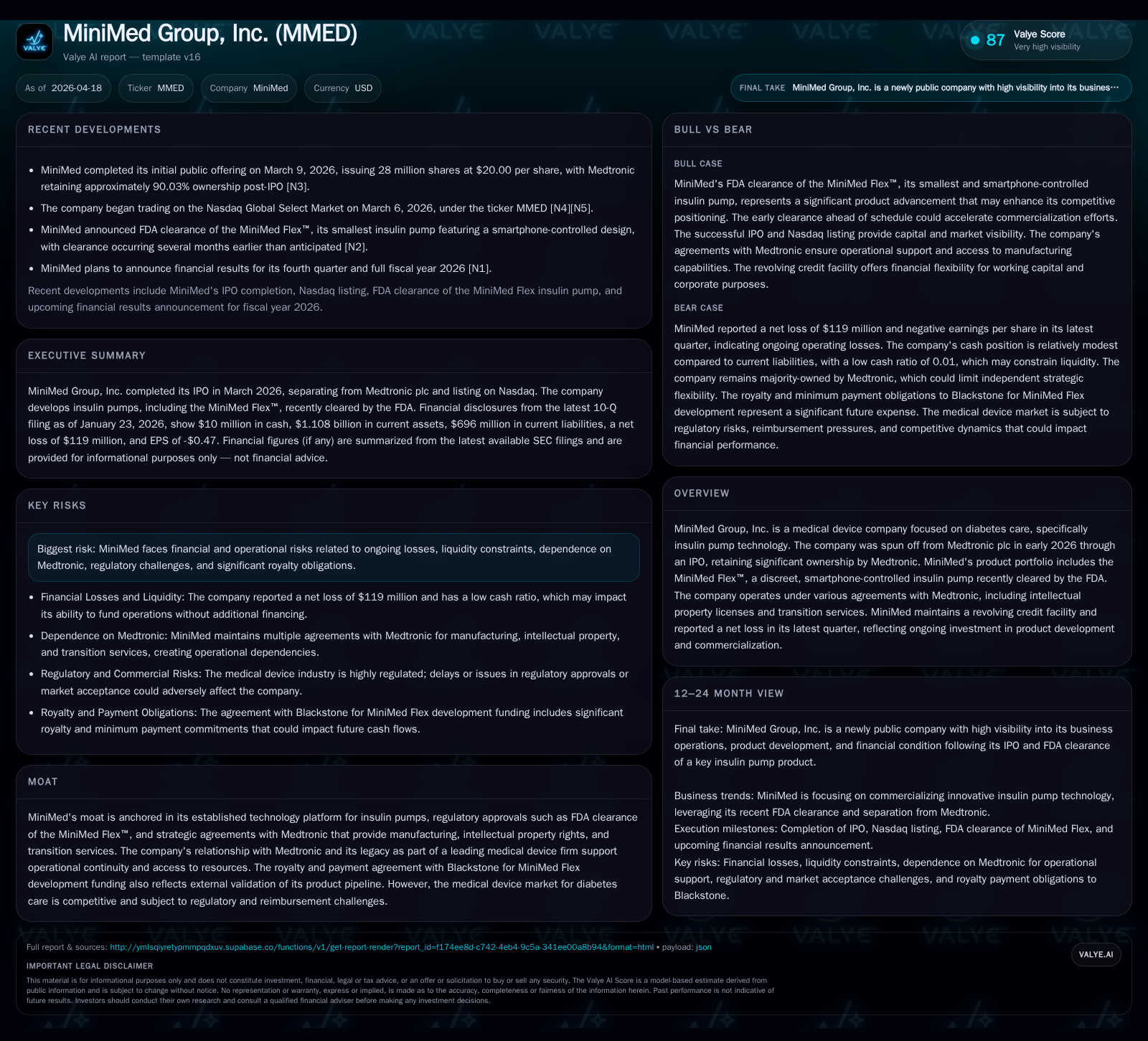
MiniMed Group, Inc. began independent operations in early 2026 following its separation from Medtronic, debuting the MiniMed Flex™, the smallest smartphone-controlled insulin pump cleared by the FDA. Despite promising product innovation, initial standalone results show a net loss and negative cash flow reflecting substantial R&D and commercialization investments. Operational continuity is supported by transitional agreements with Medtronic, while capital structure includes a $500 million revolving credit facility. Near-term focus will be on commercial execution and managing leverage amid investment-driven losses.
From Unit to Public Company: Initial Financial Snapshot
MiniMed Group, Inc. transitioned from Medtronic's Diabetes Operating Unit to an independent publicly traded company in March 2026 [N3][N4][N5]. Standalone historical financial data remain limited given the recent spin-off; however, the latest quarterly report through January 23, 2026 provides insight into its initial standalone performance [F1]. The company reported an operating loss of $100 million and a net loss of $119 million for this period. Cash and equivalents were approximately $10 million against current liabilities totaling $696 million, resulting in a current ratio of about 1.59 — indicating tight but manageable short-term liquidity.
These figures reflect the capital-intensive nature of transitioning to an independent medical device entity amid heavy R&D and commercialization costs. The absence of prior standalone annual data limits trend analysis but establishes a baseline characterized by significant losses as MiniMed builds scale separate from Medtronic.
Historical performance (annual)
| FY |
|---|
| 2026 |
Source: SEC companyfacts cache [F1].
(Note: Data represent latest quarterly period due to recent spin-off.)
MiniMed Flex™: Innovation Fuels Growth Potential
On March 18, 2026, MiniMed announced FDA clearance for the MiniMed Flex™, its smallest insulin pump featuring smartphone control capabilities [N2]. This device offers discreet management of insulin delivery via mobile integration and leverages advanced wearable biosensor technology aligned with evolving closed-loop diabetes care trends.
This early regulatory milestone accelerates commercial launch prospects in a competitive medtech segment. Funding support from Blackstone Life Sciences includes contractual obligations involving mid-to-high single-digit royalties or minimum payments aggregating $157 million within two years post-launch. This commitment will result in a one-time charge recognized in Q4 fiscal year 2026 [S19], highlighting financial considerations accompanying external development partnerships.
Operational Continuity Through Transition Agreements with Medtronic
Despite independence achieved in early 2026, MiniMed maintains substantial operational relationships with Medtronic via several agreements executed around March 1, 2026 [S5][S11]. Key arrangements include:
- Intellectual Property Cross-License Agreements ensuring mutual freedom to operate essential patent rights.
- Transition Services Agreement providing temporary service support from Medtronic post-separation.
- Transition Manufacturing and Supply Agreement enabling continued production capacity during scale-up phases.
- Registration Rights Agreement granting Medtronic certain stockholder rights following the IPO.
These contracts facilitate cost-efficient operations and mitigate disruption risks common in newly independent entities managing complex medical technology products. However, such reliance may limit cost flexibility and expose MiniMed to counterparty risks over time.
Financial Overview: Losses Amidst Capital Structure Support
The first quarter standalone results reveal significant operating losses reflecting ongoing investment in product development and market entry efforts [F1]. Net losses translate into an approximate return on equity of -3.4%, indicative of expected early-stage capital inefficiency.
Liquidity stands constrained with cash reserves at $10 million against sizeable current liabilities; however, MiniMed benefits from a $500 million senior secured revolving credit facility established concurrent with the IPO [S4][S18]. Interest rates on borrowings are tied to Term SOFR or EURIBOR plus margin in line with industry norms.
This credit line provides essential working capital flexibility but introduces leverage covenant risks requiring proactive management until positive cash flow generation is achieved.
Capital Allocation Focused on Growth Investments
Post-spin capital deployment prioritizes research and development alongside commercialization activities without declared dividends or share repurchase programs [S7–S10][S13–S17][S23–S24][S27]. Executive compensation includes equity grants aligning incentives during corporate transition phases [S8][S9][S16].
Royalty obligations tied to Blackstone funding impose material future payments that must be factored into financial planning.
Absent detailed return-on-invested-capital disclosures, the spending emphasis underscores management’s expectation that innovation-driven differentiation will eventually yield sustainable returns despite near-term earnings pressure.
Market Positioning Amid Regulatory Complexity
MiniMed operates within a fiercely competitive diabetes device market characterized by rapid technological shifts and rigorous regulatory oversight [S6][S19–S22]. Its competitive moat is grounded in legacy Medtronic IP assets coupled with strategic licenses preserving freedom-to-operate.
Market access challenges persist due to evolving payer reimbursement frameworks requiring demonstration of clinical benefit and cost-effectiveness—common hurdles across medtech diabetes players.
Ongoing regulatory vigilance remains essential to maintain FDA clearances for implantable devices like insulin pumps amidst safety scrutiny.
Outlook: Execution Milestones and Risk Factors
With limited formal guidance available [N1], key near-term indicators include sales ramp-up for MiniMed Flex™ and effective liquidity management within credit facility parameters.
Execution risk centers on supply chain resilience dependent on transition manufacturing agreements during volume expansion phases [S4]. Monitoring reductions in operating losses alongside progress toward free cash flow positivity will provide insight into scaling effectiveness.
Leverage covenant compliance under the revolving credit facility warrants close attention given modest cash balances relative to liabilities.
This analysis is based solely on publicly available SEC filings through April 2026 and Nasdaq news releases without speculative projections or investment recommendations.
Disclaimer: This is research-only, informational analysis and not investment advice. It may include AI-generated interpretation and general industry context. Always verify important details using primary sources.

Comments