
Hooker Furnishings Shifts Portfolio Focus Amid Persistent Profitability Challenges
The company divests lower-margin brands while managing supply chain pressures and working capital to bolster long-term performance.
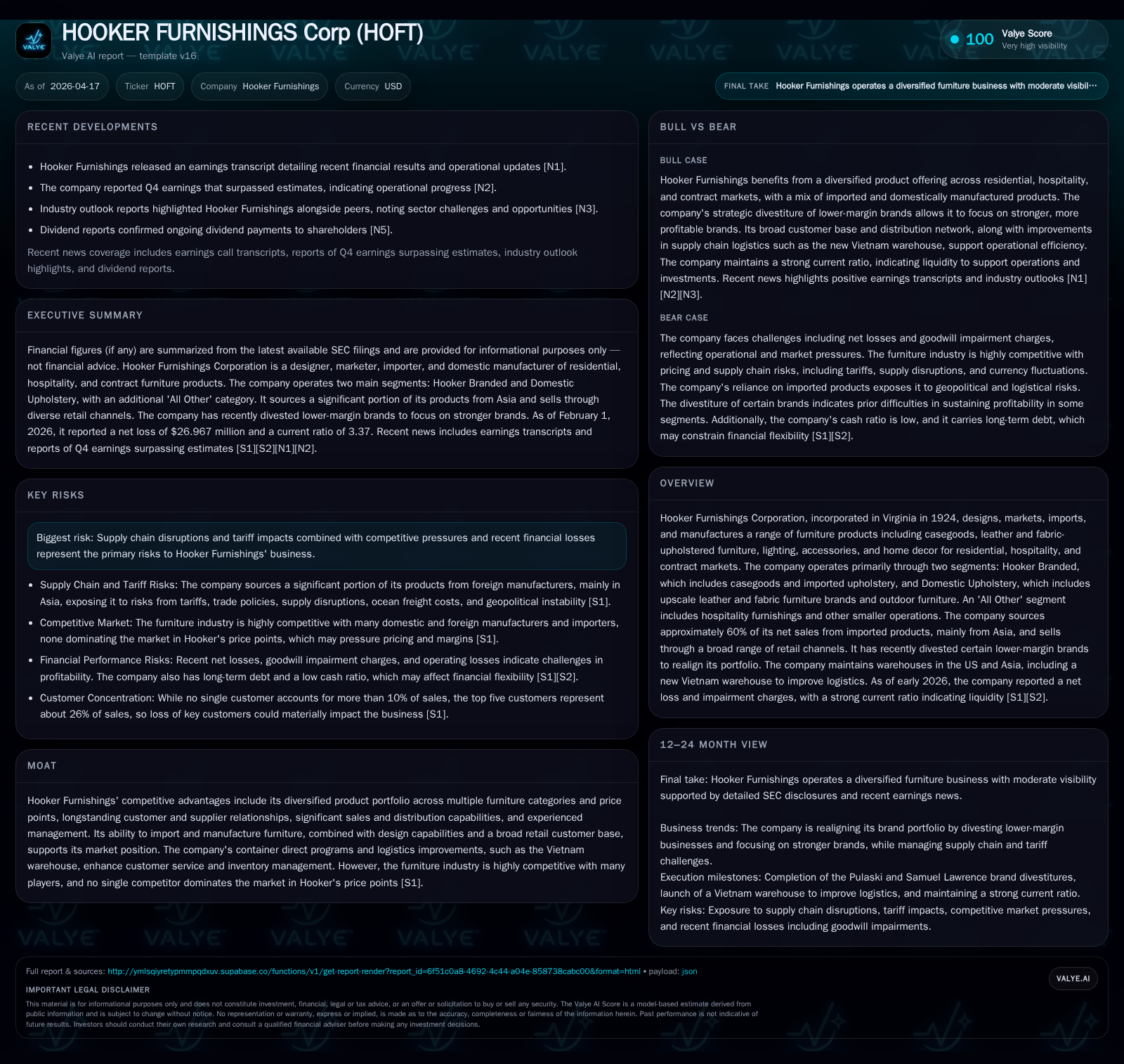
Hooker Furnishings Corporation's revenue has seen a modest decline over the past few years, reflecting macroeconomic headwinds and industry challenges. The company's strategic divestiture of the Pulaski Furniture and Samuel Lawrence Furniture brands aims to refocus on higher-margin segments. Despite robust order backlogs and supply chain improvements, persistent operating losses and negative net income highlight ongoing profitability pressures. Capital allocation remains conservative with no recent stock buybacks, while liquidity and leverage profiles suggest manageable credit conditions. Key monitoring points include margin recovery, integration of new logistics capabilities, and pricing power in a competitive furniture market.
Historical Performance
Hooker Furnishings, a century-old designer and importer of residential and contract furniture, has faced challenging industry dynamics reflected in its financial results over recent years. The company generated revenues around $218 million by fiscal year ending February 2026 [F1], showing a slight contraction relative to prior periods such as FY2011 when revenues stood near $222 million [F1]. This muted top-line trend underscores softness partly attributed to macroeconomic factors like elevated housing prices, higher mortgage rates, inflationary pressures, and tariffs that have constrained consumer discretionary spending on home furnishings [S1],[S26].
Operationally, Hooker's profitability remains under strain with operating income losses of $16.5 million recorded in FY2026 though slightly improved from the prior year's $18 million deficit [F1]. Net income followed this negative trajectory more steeply, dropping to -$27 million largely due to goodwill impairment charges linked to the company's lower-margin brand divestitures completed during the fiscal year [F1],[S1].
Cash flow from operations deteriorated significantly resulting in a negative free cash flow of approximately $26 million after accounting for capital expenditures around $3.16 million targeted towards maintaining existing assets rather than growth capex [F1],[S15],[S19]. No buybacks occurred this year as liquidity management took precedence given challenges sustaining positive earnings [F1],[S17].
Historical performance (annual)
| FY | Net ($mm) | CFO ($mm) | OpInc ($mm) | Capex ($mm) | Net YoY |
|---|---|---|---|---|---|
| 2026 | -27 | -16 | 3 | -115.6% | |
| 2025 | -13 | -23 | -18 | 3 | -226.8% |
| 2024 | 10 | 55 | 12 | 7 | +328.8% |
| 2023 | -4 | -22 | -6 | 4 |
Source: SEC companyfacts cache [F1].
Capital returns and efficiency (annual)
| FY | Buybacks ($mm) | FCF ($mm) | ROE% |
|---|---|---|---|
| 2026 | 0 | -15.9 | |
| 2025 | 0 | -26 | -6.1 |
| 2024 | 12 | 49 | 4.4 |
| 2023 | 13 | -26 | -1.8 |
Source: SEC companyfacts cache [F1].
Note: Figures nominally rounded; returns calculated where data available.
Recent Strategic Actions
In December 2025, Hooker strategically divested its Pulaski Furniture (PFC) and Samuel Lawrence Furniture (SLF) brands responsible for substantial sales declines amid adverse housing market conditions and weak margins inherent to these value-priced offerings [S1],[S26]. The sale price approximated $5.5 million cash with retention of Samuel Lawrence under its hospitality business unit transitioned into an 'All Other' segment category reflecting a portfolio realignment away from volume-driven low-margin models towards stronger brands expected to drive sustained performance [S24],[S26].
Additionally, Hooker enhanced its supply chain footprint by launching a new Vietnam warehouse facility in May 2025 intended to reduce container lead times dramatically—from about six months previously to four-to-six weeks currently—and improve inventory management along with customer service responsiveness via more flexible container customization options [S7],[S16]. This logistical upgrade mitigates some risks tied to import sourcing delays impacting roughly 60% of net sales sourced predominantly from Asian suppliers including Vietnam and China [S7],[S10].
Growth Prospects & Constraints
Growth prospects hinge largely on leveraging improved operational efficiencies gained through supply chain optimization including the Vietnam warehouse facility coupled with portfolio concentration on higher margin furniture lines within the Hooker Branded and Domestic Upholstery segments covering mid- to upper-price categories across wood casegoods, leather and fabric upholstery products [S24],[S26]. Order backlogs have shown solid increases; as of February 2026 the Hooker Branded segment reported $16.5 million backlog or pending orders equivalent to about 5.8 weeks of sales while Domestic Upholstery backlog reached over $19.5 million or roughly nine weeks of sales indicating sustained demand momentum despite broader industry headwinds [S23].
However, profitability remains challenged by tariff-related cost pressures on imported raw materials such as fabrics, steel alloys and hides utilized domestically as well as foreign currency volatility risks inherent in US Dollar-denominated sourcing contracts which limit pricing flexibility when costs rise unexpectedly beyond negotiated fixed-price periods [S9],[S16]. Competitive intensity is heightened given no single dominant competitor exists within their served price segments forcing continuous investments in design innovation and customer service infrastructure just to maintain share rather than capture outsized growth opportunities nationally or internationally where less than 1% of revenues currently derive outside North America [S4],[S24].
Financial Forecasts & Milestones to Monitor
Explicit forward guidance remains limited post-divestiture but investors should monitor several key metrics: operating margin recovery trends following year-end restructuring effects; integration benefits realization from logistics enhancements; order backlog execution rates particularly translating into revenue growth with controlled delivery costs; and ongoing tariff cost-management success including sourcing diversification efforts beyond Asia into regions like Mexico or India noted for competitively priced products without compromising quality or lead time reliability [N2],[N4],[N5],[S7],[S10].
Given recent negative free cash flow positions alongside stable though elevated leverage ratios secured by assets excluding real estate under revolving credit facilities maturing in late 2029 [S12], liquidity status also warrants attentive oversight especially relative to working capital dynamics amidst fluctuating receivables linked to retail channel variability common within furniture distribution networks.
Returns & Capital Allocation
ROE stands negative at approximately -15.9% for fiscal 2026 consistent with net loss pressures while operating cash flow volatility reflects both cyclical demand fluctuations plus exceptional goodwill impairments influencing net income measures severely this year relative to small positive gains only a few years prior [F1]. Dividend payments have continued albeit without accompanying share repurchases since FY2025 demonstrating conservative capital deployment policies focusing on preserving liquidity over shareholder distributions or stock buybacks amid ongoing restructuring costs and earnings recoveries yet to materialize robustly [F1],[S17].
Industry & Competitive Context Analysis
Hooker's market operates amid broad fragmentation featuring numerous domestic manufacturers alongside sizeable import volumes stabilized recently after tariff hikes eased somewhat post-2023 but still subject to geopolitical uncertainties affecting material input costs and freight availability intensifying overhead burdens on mid-tier producers without scale advantages enjoyed by larger furniture conglomerates or pure-play offshore manufacturers benefiting from ultra-low cost bases elsewhere globally.
Their container direct program—whereby shipments arrive directly from Asian manufacturers passing through the Vietnam warehouse—is an important component differentiating their distribution approach by cutting transit times drastically compared with typical ocean freight industry norms averaging three-to-six months plus buffering inventories. This capability not only improves customer fulfillment but reduces inventory carrying costs that otherwise weigh heavily on working capital structure within furniture retail supply chains.
Conclusion
Hooker Furnishings continues navigating persistent profitability headwinds through structural portfolio rationalization marked by exiting lower-margin brands undermined by shifting macro conditions impacting demand elasticity for value-oriented furniture lines. While enhanced supply chain logistics offer operational advantage improving delivery timelines and inventory efficiency, the company must overcome tariff-induced input price inflation amidst fierce competition without dominant market share benefits. Maintaining adequate liquidity alongside restrained capital allocation reflects prudent management's approach under current fiscal stresses although monitoring earnings turn-around milestones coupled with further cost containment initiatives will be critical indicators of sustainable turnaround prospects going forward.
This report is based solely on publicly available data as of April 17th, 2026 including company filings (10-K/10-Q/8-K), transcripts, news articles and SEC-extracted datasets cited herein — it does not offer investment opinions or recommendations.
Disclaimer: This is research-only, informational analysis and not investment advice. It may include AI-generated interpretation and general industry context. Always verify important details using primary sources.

Comments